
ALTA Certified Academic Language Therapist (CALT) Practice Exam
$69.00
- Buy to unlock unlimited access to all Quiz questions.
- After purchase you can print a PDF of the whole quiz at any point. The PDF will contain the questions and the correct answers.
About this Exam
The Academic Language Therapist Association (ALTA) Certified Academic Language Therapist (CALT) credential is a prestigious, nationally recognized certification for professionals who provide advanced, diagnostic, explicit, systematic Multisensory Structured Language Education (MSLE) to individuals with dyslexia and related learning disorders. Designed for dedicated educators, special education specialists, reading interventionists, and speech-language pathologists, this certification validates the deep understanding of language structure and the expertise required to design and implement highly individualized, evidence-based therapy plans. Earning the CALT designation signifies that you possess the rigorous training and clinical experience necessary to change the trajectory of individuals struggling to read, write, and spell, providing them with the essential linguistic tools for academic success.
Ready to test your knowledge?
Buy Now to Access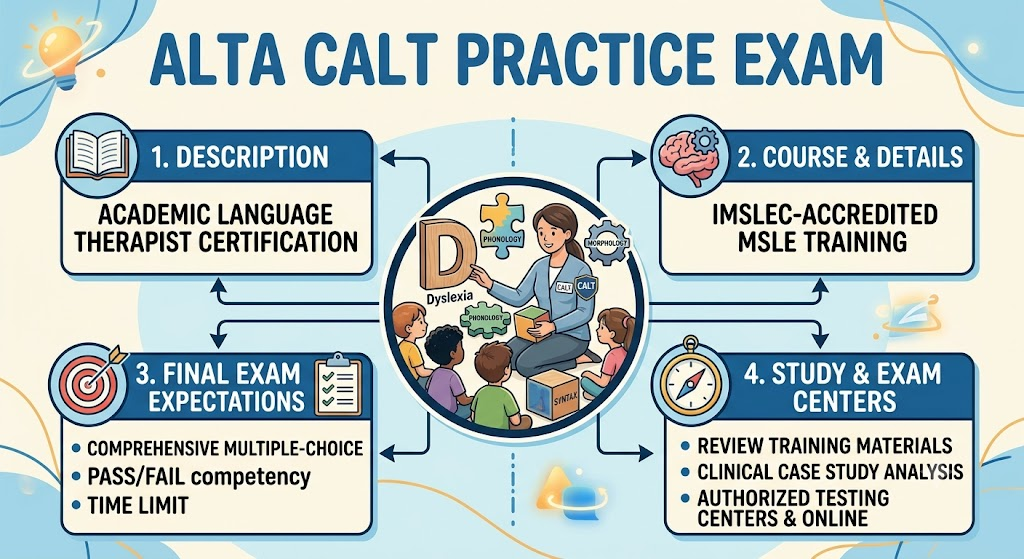
Additional Information
What the Course Entails and Exam Details
The path to becoming a CALT is demanding, requiring completion of a comprehensive, therapy-level Multisensory Structured Language Education (MSLE) course accredited by the International Multisensory Structured Language Education Council (IMSLEC) or the Academic Language Therapy Association. This extensive training, often spanning two or more years, encompasses aminimum of 200 hours of coursework and a minimum of 700 hours of a supervised clinical practicum, where you must conduct dynamic and demonstration lessons. The core topics covered during training, which the CALT exam assesses, include the science of reading, the structure of the English language (phonology, morphology, syntax, semantics, and pragmatics), principles of multisensory instruction, diagnostic teaching, and advanced knowledge of dyslexia and related learning differences. The ultimate final hurdle, the ALTA Competency Exam, is a critical comprehensive assessment designed to measure your mastery of these concepts and your readiness to practice at the therapy level. The exam is typically administered upon completion of all coursework and practicum requirements and is available to applicants who have completed a minimum of two years from the beginning of their training.
What to Expect in the Final Exam
While ALTA keeps specific exam details confidential to maintain professional integrity, the ALTA Competency Exam for CALT is a single, rigorous assessment. You should expect a format primarily composed of comprehensive multiple-choice questions that require not just recall, but the practical application of your deep understanding of language, teaching principles, and diagnostic skill. The questions will cover all major content areas of your accredited MSLE training. ALTA provides candidates with information on the minimum acceptable performance (the passing score) during the application process, but it's important to understand this is a pass/fail competency exam designed to evaluate minimum readiness, not provide a curved score. The exam has a specified time limit which is sufficient for thorough analysis of all scenarios and questions. You are expected to take the exam in one sitting.
How to Study and Exam Centers
Studying for the CALT exam is not about cramming but a culmination of your two-plus years of intensive training and clinical practice. Your absolute best resource is the documentation and materials from your accredited MSLE program, including all lecture notes, required texts, case study analyses, and lesson plans. To effectively prepare, create a structured review plan focusing on deep conceptual understanding: (1) Re-read and categorize training materials, creating an active index. (2) Revisit and summarize key language concepts (e.g., the 6 syllable types, morphology roots, and syntax rules). (3) Simulate diagnostic decisions by reviewing past client cases from your practicum and asking, "Why did this lesson work?" (4) Actively engage with your colleagues or peer group, as teaching a concept to someone else is the highest level of mastery. ALTA does not publish practice tests, but working through clinical decision-making scenarios is your best approximation. The exam is often taken online, requiring reliable, proctored conditions, but ALTA also designates specific authorized testing centers, often associated with training sites or universities, where physical administration can occur.
Job Opportunities from the Course
Earning the CALT credential opens a wide range of specialized and rewarding career paths, primarily in education, clinical settings, and private practice. This certification designates a therapist rather than a tutor, allowing for independent practice and leadership roles in addressing dyslexia. Your training prepares you for positions that prioritize evidence-based, multisensory instruction. The specific job titles include: Dyslexia Therapist, Academic Language Therapist, Special Education Specialist, Reading Specialist/Interventionist, Special Education Department Chair, Curriculum Coordinator (for reading/literacy), Private Academic Language Therapist (Self-Employed), Clinic-Based Learning Therapist, and University or Training Program Instructor (requires Master's or higher). The CALT is often a prerequisite for advanced administrative positions in special education.
Frequently Asked Questions
Reviews
5.0
Based on 0 reviews
Leave a Review
No reviews yet. Be the first to review!