
ALS Military Studies Practice Test
$69.00
- Buy to unlock unlimited access to all Quiz questions.
- After purchase you can print a PDF of the whole quiz at any point. The PDF will contain the questions and the correct answers.
About this Exam
The Airman Leadership School (ALS) is a foundational professional military education course required for all United States Air Force enlisted personnel, primarily Senior Airmen (SrA) who are transitioning into supervisory and management roles. This comprehensive study guide and practice resource is specifically designed for Airmen preparing to master the critical "Military Studies" component of the curriculum. It offers targeted preparation to help students solidify their understanding of leadership principles, the Profession of Arms, and strategic USAF concepts before taking the high-stakes final evaluation.
Ready to test your knowledge?
Buy Now to Access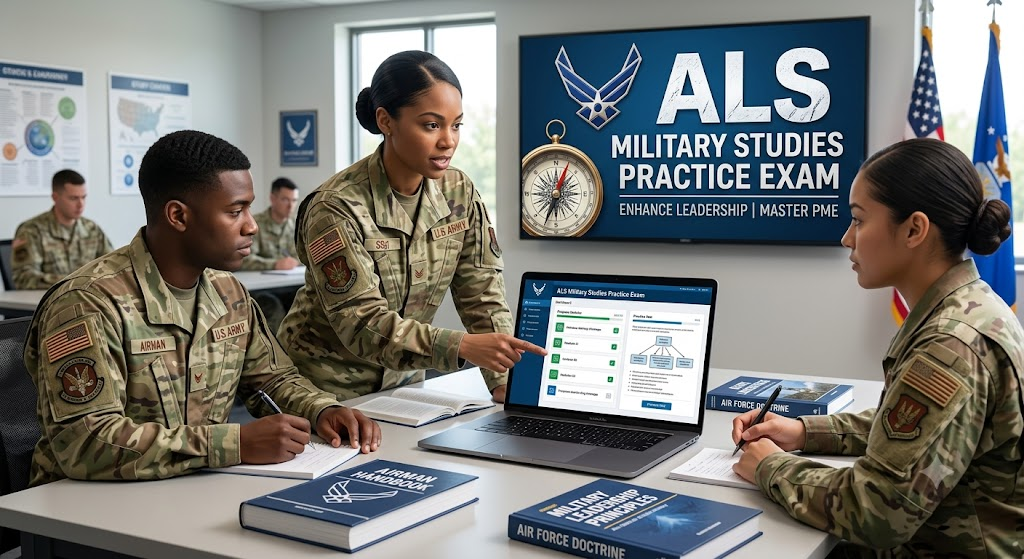
Additional Information
What the Course Entails and Exam Details
The ALS curriculum is dynamic and broad, focusing on developing the leadership capabilities and supervisory skills necessary for new NCOs. The Military Studies portion, which this practice material covers, is essential for every emerging leader. Key areas covered in the course and assessed on the exam include:
Profession of Arms: Exploration of Air Force history, heritage, core values, ethical leadership, and international relations context.
Leadership and Supervision: Study of various leadership theories, practical application of supervisory skills, counseling techniques, and interpersonal relationships.
Communication Skills: Techniques for effective written, verbal, and digital communication within the chain of command and with subordinates.
Team Building and Management: Strategies for developing cohesive teams, managing resources, and optimizing performance.
Strategic Thinking and Military Doctrine: Understanding military strategy, operational structures, joint capabilities, and the application of doctrine.
The practice test is designed to mirror these key learning objectives and knowledge areas.
What to Expect in the Final Exam
The final ALS Military Studies examination is a comprehensive evaluation that students must pass to graduate. Knowing what to expect can significantly reduce anxiety and improve performance. Key characteristics of the exam include:
Format: The test typically consists of multiple-choice questions administered in a secure, computerized environment.
Focus: It emphasizes knowledge recall, critical application of concepts to scenario-based problems, and comprehension of Air Force leadership philosophies.
Passing Score: Students must achieve a minimum percentage, often 70% or higher, to pass and meet the requirements for graduation. Specific score requirements can vary by cycle.
Time Limit: The examination is timed, requiring quick thinking and efficient question-answering skills.
Strict Proctoring: To ensure academic integrity, the test is administered under strict supervision in a designated physical testing facility.
How to Study and Exam Centers
Preparation is vital for success on the ALS exam. Effective study strategies and an understanding of the testing environment will enhance performance:
Actionable Study Strategies:
Review Course Materials: Thoroughly study your student guides, reading assignments, and lecture notes. Pay close attention to definitions, key principles, and practical examples.
Utilize Practice Tests: Engage with the ALS Military Studies Practice Exam to identify weak areas, understand question formats, and improve your test-taking speed. Focus on understanding the rationales behind correct answers.
Group Study: Collaborate with your peers to discuss complex concepts, run scenario-based drills, and test each other's knowledge.
Apply Concepts to Experience: Try to relate leadership and management theories to real-world scenarios you’ve encountered during your career or observe in your workplace.
Manage Your Time: Create a study schedule that allows for consistent review rather than last-minute cramming.
The final examination itself is not taken at general testing centers. It is typically administered on-site at the specific USAF installation where the ALS course is being conducted, usually within a secure computer testing lab dedicated to PME evaluations. Students are notified of the exact date, time, and location during the course.
Job Opportunities from the Course
Graduation from ALS is a mandatory step for USAF personnel to be promoted and take on higher levels of responsibility. While not leading directly to specific civilian job titles, it unlocks several vital military career paths and leadership roles:
Airman First Class (A1C) / Senior Airman (SrA) (Preparation for promotion)
Staff Sergeant (SSgt) (Eligibility following graduation)
Supervisor / Front-Line Manager in all Air Force career fields (e.g., Maintenance Supervisor, Medical Technician Supervisor, Security Forces Squad Leader)
Flight Chief
NCO in Charge (NCOIC) of a specific function or section
Leadership roles within the Squadron or Wing structures (e.g., First Sergeant track, various staff NCO positions)
Enhanced readiness for future advanced Professional Military Education (e.g., NCO Academy)
Frequently Asked Questions
Reviews
5.0
Based on 0 reviews
Leave a Review
No reviews yet. Be the first to review!