
Alliance Registration for Multi-Sensory Structured Language Education (MSLE) Practice Exam
$69.00
- Buy to unlock unlimited access to all Quiz questions.
- After purchase you can print a PDF of the whole quiz at any point. The PDF will contain the questions and the correct answers.
About this Exam
Embarking on a career dedicated to transforming lives through literacy is a powerful choice. The Alliance Registration for Multi-Sensory Structured Language Education (MSLE) is a vital benchmark in this field, designed for dedicated educators, therapists, tutors, and educational leaders. This professional standard validates your expertise in implementing evidence-based instruction to help students overcome reading and writing challenges, particularly those associated with dyslexia and related learning difficulties. Earning this registration is not just about a title; it is a testament to your commitment to providing effective, science-backed language education.
Ready to test your knowledge?
Buy Now to Access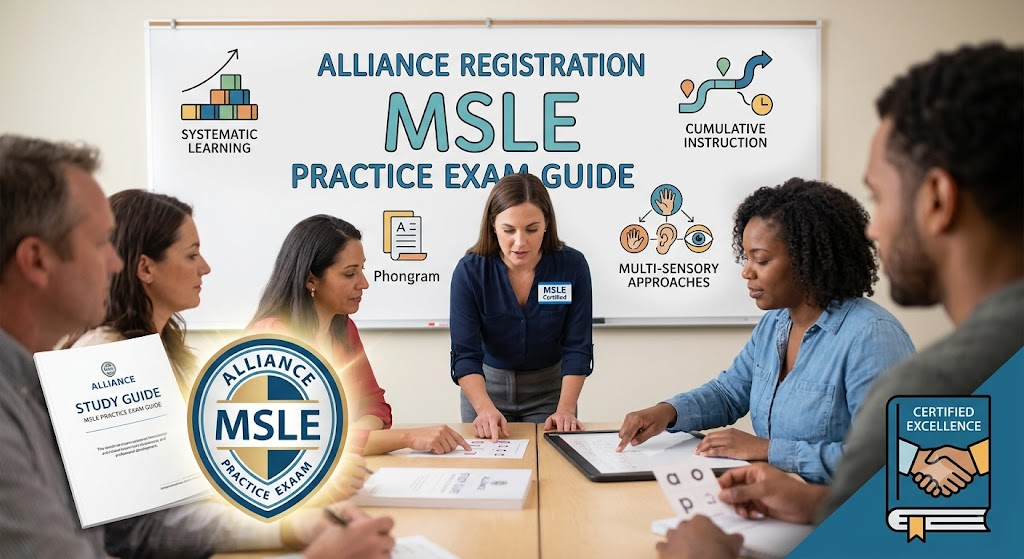
Additional Information
What the Course Entails and Exam Details
This registration exam is the culmination of rigorous, accredited training in the principles of structured literacy and Multi-Sensory Structured Language Education. The coursework that leads to this level of certification provides comprehensive instruction on the structure of the English language and how to teach it explicitly and systematically. You will master the foundational MSLE principles: that instruction must be multi-sensory (visual, auditory, kinesthetic, tactile), explicit, cumulative, and diagnostic. The content area is extensive, ensuring you have a deep understanding of:
Phonological Awareness and Phonology: Understanding and explicitly teaching the sound structure of language.
Sound-Symbol Association (Phonics): Making concrete connections between speech sounds and written symbols.
Syllable Instruction: Teaching the different types of syllables and rules for division.
Morphology: Analyzing and teaching the smallest meaningful units of language (prefixes, roots, suffixes).
Syntax and Semantics: Instructing on grammar, sentence structure, and meaning.
Diagnostic Teaching: Mastering continuous assessment and data-driven lesson planning.
Lesson Planning: Designing systematic and cumulative lessons that integrate all language components.
What to Expect in the Final Exam
The final Alliance MSLE registration exam is a comprehensive assessment designed to measure both your theoretical understanding and your practical ability to apply these methods in a teaching environment. While exact formats can vary slightly by specific level, you should be prepared for a rigorous examination. The exam frequently combines a multiple-choice section that tests your knowledge of language theory, MSLE history, and instructional principles. Crucially, the final exam typically includes practical application components, such as case-study scenarios, lesson plan analysis, or video observations of teaching. This aspect requires you to demonstrate that you can effectively plan and deliver structured, multi-sensory instruction. A typical passing score is within the 70-80% range, reflecting high standard expected. Candidates are generally allotted between two and four hours to complete the exam, which is formally proctored either at a physical site or via secure online proctoring services.
How to Study and Exam Centers
Effective preparation for this exam requires a multi-layered approach.
Master the Coursework: Begin by thoroughly reviewing all materials, notes, and manuals from your accredited MSLE training program.
Practice Active Multi-Sensory Learning: Study just as you would teach. Use kinesthetic and tactile methods, such as skywriting phonograms, using letter tiles, and physically marking words to reinforce memory.
Utilize This Practice Exam: The Alliance Registration MSLE Practice Exam is your most critical tool. Use it to gain familiarity with the type and structure of questions, refine your timing, and pinpoint areas where you need additional study.
Create Practical Scenarios: Practice creating lesson plans for a variety of hypothetical students with different learning profiles and skill gaps.
Form Study Groups: Collaborating with peers is invaluable for discussing complex cases and sharing teaching strategies.
Review Language Rules: Ensure you have instant recall of all phonogram rules, syllable patterns, and major morphological elements.
Regarding exam locations, the final registration exam is typically coordinated through the authorized, accredited organization or academic program that provided your MSLE training. They will provide information on upcoming exam dates and locations. Many organizations utilize official physical testing sites, which can include universities or dedicated educational centers. Increasingly, many levels of testing are also available through secure, recognized online proctoring services, allowing you to take the exam from a private location of your choice, provided it meets strict requirements. Always confirm registration and location details directly with your official training provider to ensure you are following the correct path for your specific Alliance registration.
Job Opportunities from the Course
A certification and registration through an Alliance-recognized program opens professional doors across the educational landscape. Here are some of the career paths that value this high standard:
Certified Academic Language Therapist (CALT)
Certified Academic Language Practitioner (CALP)
Dyslexia Specialist
Reading Specialist
Educational Therapist
Structured Literacy Teacher
Special Education Teacher (K-12)
Private Reading and Language Tutor
Educational Consultant and Curriculum Designer
Literacy Coach
Your Alliance MSLE registration will not only signify your expertise to employers and families but will also prepare you to make a profound and lasting impact on your students' academic and personal success.
Frequently Asked Questions
Reviews
5.0
Based on 0 reviews
Leave a Review
No reviews yet. Be the first to review!