
ALE Standards of Professional Practice (SPP) Annex Practice Test
$69.00
- Buy to unlock unlimited access to all Quiz questions.
- After purchase you can print a PDF of the whole quiz at any point. The PDF will contain the questions and the correct answers.
About this Exam
Embarking on the path to becoming a licensed architect requires not just design prowess, but a profound understanding of the professional responsibilities and ethical frameworks that govern the industry. The ALE Standards of Professional Practice (SPP) Annex Practice Test is an essential tool designed to help aspiring architects, architecture graduates, and interns meticulously prepare for this crucial portion of their Architecture Licensure Examination (ALE). This practice exam focuses specifically on the SPP Annex, which includes the detailed guidelines issued by the regulatory board concerning an architect's services, ethical conduct, compensation, and legal liabilities. Passing this portion of the examination is non-negotiable for anyone seeking to practice architecture legally and ethically. By utilizing this comprehensive practice test, candidates can build their confidence, identify their knowledge gaps, and ensure they are fully prepared to uphold the highest standards of the profession.
Ready to test your knowledge?
Buy Now to Access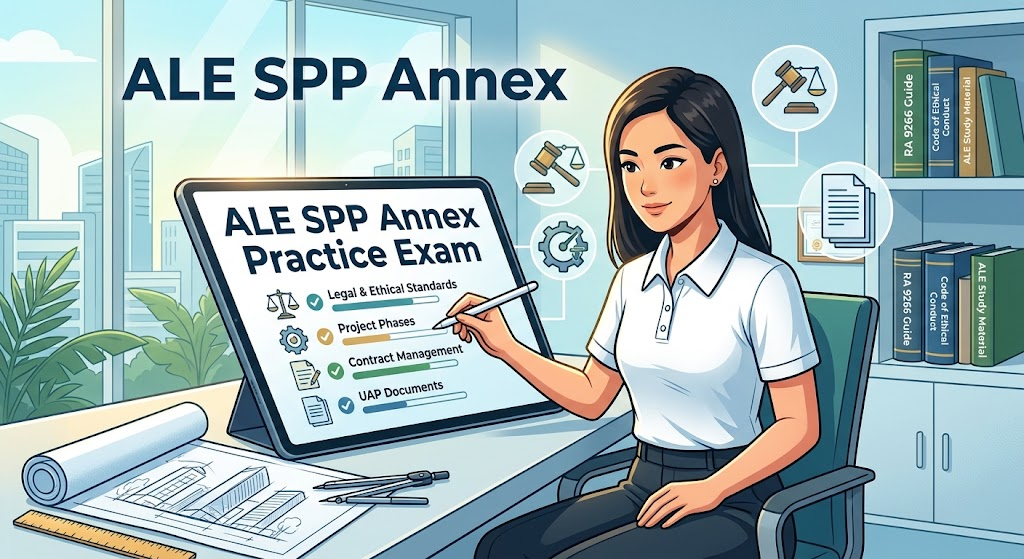
Additional Information
What the Course Entails and Exam Details
This specialized study guide focuses on the intricate details of the Standards of Professional Practice, often detailed in the "Annex" of the Architecture Licensure Examination. The core objective is to validate a candidate's readiness to operate as a reliable professional in a real-world setting.
The course covers a broad spectrum of critical topics. Candidates will be tested on the entire lifecycle of an architectural project from a professional standpoint. This includes Pre-Design Services, where architects conduct feasibility studies and spatial programming. Regular Design Services follow, focusing on the five phases: Schematic Design, Design Development, Contract Documents, Bidding or Negotiation, and Construction Phase. Beyond this, knowledge is required in Specialized Architectural Services, such as security planning or heritage conservation, and Post-Design Services related to facilities management. Other vital areas are Construction Management Services and Design-Build Services, testing your knowledge of roles and responsibilities when managing or executing construction directly.
Crucially, the exam dives deep into Architect's Compensation, ensuring you understand the multiple methods of calculation, such as percentage of construction cost, unit cost, lump sum, and time-based fees. You must also be well-versed in professional ethics, liability, and standard contract provisions to protect yourself and your clients.
What to Expect in the Final Exam
The final ALE SPP Annex exam is a rigorous, standardized test that assesses your application of professional standards, rather than simple rote memorization. It is integrated into the larger Architecture Licensure Examination and typically takes a multiple-choice format, often consisting of 100 to 150 questions.
Candidates are usually given a strict time limit, typically ranging from three to four hours for this section alone. To successfully pass this portion, you must achieve a predetermined minimum score, which is commonly set at 70% or 75%. The questions can range from straightforward definitions to complex situational scenarios where you must determine the correct professional action, the appropriate compensation structure, or the legal implications of an architect's decisions. It is designed to be challenging, requiring critical thinking and a deep understanding of standard practice documents and ethical codes.
How to Study and Exam Centers
Preparation for the ALE SPP Annex exam demands a structured and comprehensive approach. Your first step should be to acquire the official, updated Standards of Professional Practice documents. In the Philippines, for example, this means studying the UAP (United Architects of the Philippines) Documents or the equivalent circulars from the Professional Regulatory Board of Architecture (PRBOA). Read them thoroughly, multiple times.
Using this practice test as a diagnostic tool is invaluable. Take the test early to identify weak areas. Re-take it regularly to track your progress. Supplement your study by creating flashcards for key terms, fee percentages, and the specific stages of various architectural services. Form study groups to discuss complex scenarios and debate ethical dilemmas, which can deepen your understanding significantly.
Regarding exam logistics, the ALE, which includes the SPP Annex portion, is rarely taken through an online portal alone. Candidates must register through an official governmental licensing agency, such as the PRC (Professional Regulation Commission) in the Philippines, via their online portals. The physical exam itself is administered twice a year at authorized testing centers, typically in major regional hubs, city convention centers, or government-designated schools. Ensure you know the exact location of your designated testing center and fulfill all requirements, including bringing the appropriate identification and materials.
Job Opportunities from the Course
Passing the ALE and successfully navigating the SPP Annex section unlocks the final, most crucial door to your career: the title of Registered and Licensed Architect. This credential opens diverse and rewarding professional paths:
Principal Architect: Lead and manage your own architectural firm.
Project Architect: Oversee entire project life cycles within a larger company.
Architectural Consultant: Provide expert advice on specific topics like ethics, code compliance, or planning.
Construction Manager: Direct construction operations for clients, utilizing your professional practice knowledge.
Urban Planner: Work with government agencies to design sustainable communities.
Educator/Professor: Teach professional practice and ethics at universities.
Building Inspector/Reviewer: Evaluate construction plans and practices for regulatory bodies.
Frequently Asked Questions
Reviews
5.0
Based on 0 reviews
Leave a Review
No reviews yet. Be the first to review!