
Alabama Gas Practice Test
$69.00
- Buy to unlock unlimited access to all Quiz questions.
- After purchase you can print a PDF of the whole quiz at any point. The PDF will contain the questions and the correct answers.
About this Exam
The Alabama Gas Practice Test is an essential, preparatory tool for anyone seeking to pass certifications or licensure related to natural gas safety, distribution, or installation within the state of Alabama. This comprehensive practice exam is specifically designed for a wide range of professionals, including entry-level utility technicians, experienced HVAC installers looking to specialize, plumbers extending their license, and industrial safety managers focusing on natural gas infrastructure.
Developed as a rigorous simulation, this resource helps candidates build the critical knowledge and confidence needed for official state-recognized qualification. It serves as a diagnostic tool, identifying specific areas where additional study is required, ensuring that individuals are thoroughly prepared for the technical and safety demands of working in Alabama's gas sector. Successfully challenging this practice exam is a key step towards achieving professional advancement and ensuring compliance with the stringent safety standards of the industry.
Ready to test your knowledge?
Buy Now to Access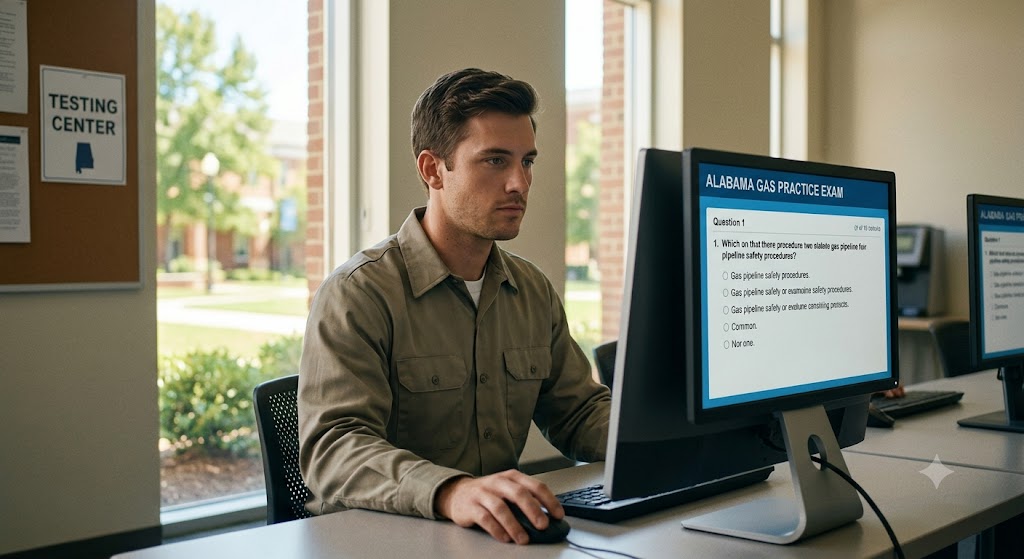
Additional Information
What the Course Entails and Exam Details
The Alabama Gas Practice Test covers a broad and detailed
spectrum of topics foundational to the natural gas industry in Alabama. It is
structured around core competency areas, ensuring a comprehensive evaluation of
knowledge that directly translates to real-world job requirements. The core
focus areas include:
State and Federal Gas Safety Regulations: In-depth
understanding of relevant Alabama state laws, codes (such as the Southern
Standard Gas Code as adopted), and US Department of Transportation (DOT)
pipeline safety regulations, particularly those from the Pipeline and Hazardous
Materials Safety Administration (PHMSA). This is a critical area for legal and
operational compliance.
Natural Gas Properties and Handling: Thorough knowledge of
the physical and chemical characteristics of natural gas, odorization, gas
properties, principles of combustion, and essential safe handling procedures,
including emergency response protocols and leak detection techniques.
System Installation and Design: Comprehensive concepts and
best practices for the design, installation, operation, and maintenance of
natural gas systems. This encompasses proper material selection (e.g., steel
pipe vs. polyethylene), fitting and joining methods, system pressure testing,
code-compliant regulator and meter installation, and required venting systems.
Customer-Side Appliances and Equipment: A primary focus on
the safe installation, connection, and troubleshooting of various end-use
natural gas appliances, including furnaces, water heaters, boilers, and
industrial equipment, ensuring proper venting and combustion air requirements
are met for each.
Operator Qualification (OQ) Knowledge: Targeted questions
align with Operator Qualification (OQ) requirements commonly utilized by
utility operators in Alabama. OQ tasks are verified knowledge and skill units
required for individuals to perform certain safety-sensitive tasks on a
pipeline facility.
Syllabus/Structure: The comprehensive nature of the practice
exam means it is effectively a full preparatory syllabus. Each set of practice
questions is categorized to mirror the logical progression found in the
official exam or the OQ tasks, covering theoretical knowledge and practical,
scenario-based applications.
What to Expect in the Final Exam
While the exact final exam details can vary depending on the
specific certification (e.g., HVAC license endorsement, utility Operator
Qualification), candidates preparing for an official natural gas qualification
in Alabama should expect a serious and technical examination. Here is what is
generally typical:
Exam Format: The primary final exam is almost always
multiple-choice and delivered in a proctored, computer-based testing (CBT)
format. Some specialized operator tasks may also include a practical skill
assessment, where candidates must demonstrate a skill in a controlled, observed
environment.
Passing Score Requirements: The industry and the state of
Alabama maintain high standards due to the critical safety aspects of natural
gas. Expect a passing score on the official knowledge exam to be demanding, typically
ranging from 70% to 80%, meaning proficiency is essential.
Time Limits: The final CBT exam will be strictly timed. The
specific duration depends on the number of questions, but candidate should be
prepared for a focused, time-controlled environment.
Specific Rules: Candidates are typically not permitted to
use outside reference materials (books, notes, phones) during the knowledge
exam. A calculated number of hours of documented experience or certified
education may be prerequisites for even scheduling the final exam. Registration
and fees are processed through official channels, whether it's the specific
utility operator or the state licensing board, and require pre-approval.
How to Study and
Exam Centers
Actionable Study Strategies and Practice Methods
To maximize your chances of success on an Alabama
Gas-related certification, a multi-faceted study approach is highly
recommended. Utilizing standard industry materials and a structured study plan
is essential.
Leverage the Alabama Gas Practice Test: Integrate the
practice exam early and often in your study process. The primary value of this
tool is its diagnostic ability. After taking a practice set, immediately
identify any and all questions missed or answered through guessing. Focus
subsequent study time on these specific knowledge gaps.
Official Resources and Materials: Obtain official study
guides or materials directly from the organizing body. If seeking a license
endorsement, this would be the Alabama Electrical, Plumbers, and Gas Fitters
Examining Board. If seeking an OQ certificate, this will come from your employer
or an accredited training provider.
Code Books are Your Bible: The southern gas code, specific
state amendments, and relevant DOT PHMSA code parts are non-negotiable study
requirements. While you cannot use them on the test, you must become intimately
familiar with their organization and key safety standards.
Instructor-Led Training or Courses: Many professional trade
schools and dedicated technical training centers in Alabama offer specific prep
courses. These provide invaluable structure, hands-on application for practical
components, and access to experienced instructors for clarification.
Group Study and Discussion: Natural gas safety is
collaborative. If possible, join or form study groups with peers preparing for
the same exam. Discussing complex scenarios and code requirements can
significantly deepen your understanding.
Where and How to Take the Exam
The official location for your final gas-related exam
depends entirely on the specific certification or qualification you are
pursuing. There is no single, centralized location.
Online Portals: Some modern OQ knowledge assessments can be
taken via approved, secure online testing portals, though these may require an
active proctor to oversee the session.
Pearson VUE or PSI Testing Centers: For state licensure
exams, candidates are often directed to schedule and take their computerized
final exam at authorized commercial testing centers like Pearson VUE or PSI,
which maintain locations in major Alabama cities such as Birmingham, Mobile,
and Montgomery.
Specific Physical Testing Centers or Authorized Schools: Large
utility operators like Alabama Power and Southern Company Gas frequently
operate their own internal, physical testing and evaluation centers
specifically for Operator Qualifications. Furthermore, certain technical trade
schools and community colleges throughout the state are officially authorized
as testing locations for specific industry credentials.
Key Takeaway: Carefully review the registration information
for your specific desired certification. That official body will provide
detailed instructions on where and how to schedule your examination.
Job Opportunities from the Course
Achieving certifications related to natural gas opens a wide
range of rewarding and critical career paths, supporting a vital aspect of
Alabama's infrastructure. While the exact position and level of responsibility
will vary based on your primary trade and experience level, holding these
recognized credentials makes you highly marketable in a dynamic field. Here is
a clear list of potential job opportunities that this pathway unlocks:
Natural Gas Technician: Responsible for the installation,
inspection, maintenance, and repair of natural gas lines, meters, regulators,
and other system components, both on the utility distribution side and
customer-side piping.
Pipefitter / Gas Fitter: Specializes in layout, assembly,
installation, and troubleshooting of piping systems, including natural gas
lines in commercial, residential, and industrial settings.
HVAC Service Technician (with Gas Endorsement): Performs the
installation, repair, and ongoing maintenance of heating, ventilation, and air
conditioning (HVAC) units that utilize natural gas, ensuring proper safe
connections and efficient operation.
Pipeline Inspector / Operator: Conducts crucial,
code-mandated safety inspections of natural gas pipelines and distribution
systems to ensure full regulatory compliance, identify potential leaks or
corrosion, and verify the overall integrity of the infrastructure.
Safety Compliance Officer: Manages the comprehensive safety
program for natural gas operations within an industrial facility or for a
utility provider, focusing on regulatory compliance, risk mitigation, and
emergency preparedness.
Distribution System Superintendent: Oversees the strategic
planning, safe operation, and crucial maintenance of the entire gas
distribution network for a municipality or private natural gas company, managing
teams of technicians and coordinators.
Industrial Maintenance Mechanic: Handles the on-site
operation, diagnostics, and repairs of large, natural-gas-fueled equipment such
as industrial boilers, turbines, and furnaces within manufacturing and power
generation plants.
By focusing on these strategies and mastering the material
through dedication and practice, candidates can confidently approach the
official Alabama Gas certification exams and embark on a fulfilling and
essential career in the natural gas industry.
Frequently Asked Questions
Reviews
5.0
Based on 0 reviews
Leave a Review
No reviews yet. Be the first to review!