
Alabama Fire College Rapid Intervention Crew Practice Exam
$69.00
- Buy to unlock unlimited access to all Quiz questions.
- After purchase you can print a PDF of the whole quiz at any point. The PDF will contain the questions and the correct answers.
About this Exam
The Alabama Fire College Rapid Intervention Crew (RIC) Member certification is an advanced, critical designation for firefighters dedicated to the highest levels of safety and rescue. It is designed for certified firefighters (Pro Board or IFSAC Fire Fighter I or Volunteer Fire Fighter) who are ready to specialize in the life-saving art of rescuing their own. This course provides the definitive foundation for rapid intervention operations, training personnel to function as a dedicated crew to rescue downed, lost, or trapped firefighters in the most hazardous immediately dangerous to life and health (IDLH) environments. This practice exam is the essential first step in ensuring your readiness for the high-pressure, skill-intensive challenges of this certification, helping you identify knowledge gaps and build the confidence to succeed
Ready to test your knowledge?
Buy Now to Access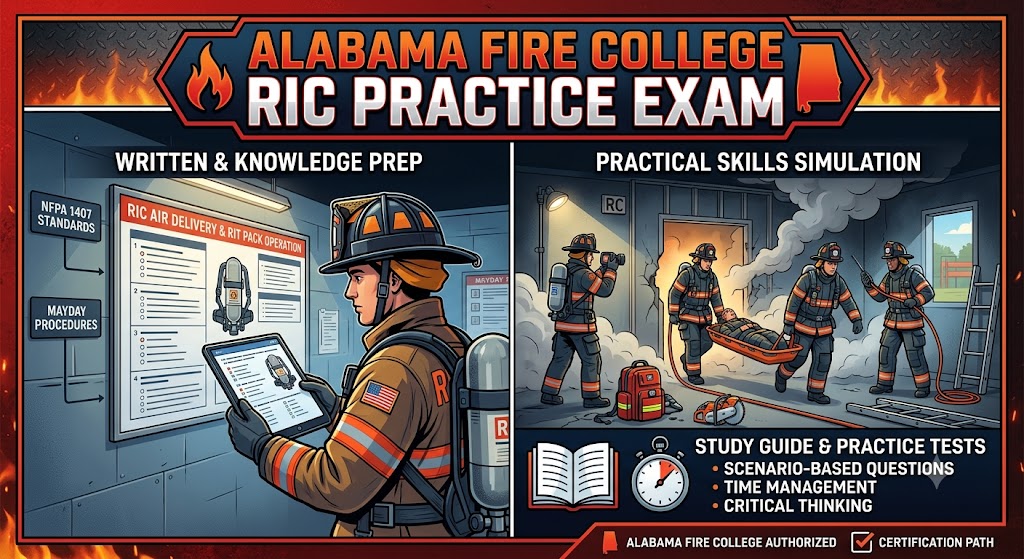
Additional Information
What the Course Entails and Exam Details
The Rapid Intervention Crew Member course is an intensive
40-hour program that demands a prerequisite of a current Certified Fire Fighter
I or Certified Volunteer Fire Fighter certification (either Pro Board or IFSAC
accredited). The curriculum is based on the NFPA 1407 Standard for Training
Fire Service Rapid Intervention Crews and covers a wide range of
specialized topics. These include understanding the 'RIC mindset,' the
historical basis and laws requiring RIC, crucial proactive tasks like RIC
size-up and 'softening the structure' by removing barriers, and the advanced
skills of firefighter search, assessment, packaging, and removal. Students will
learn horizontal drags, stair removals, window and floor removals, and how to
operate in tight, confined spaces. Emphasis is also placed on initial RIC
companies utilizing common tools to start rescue operations, particularly in
structural collapse situations, which are covered extensively, including basic
techniques on stabilizing, shoring, lifting, breaching, and removing trapped
firefighters. The practice exam, and subsequent final, will measure your
understanding of these critical concepts.
What to Expect in the Final Exam
While a 'practice exam' provides a snapshot of knowledge,
the final certification process for the Alabama Fire College RIC Member
typically consists of both a written examination and a practical skills
evaluation, both of which must be passed. The final written exam will be a
multiple-choice assessment that tests your comprehension of the NFPA 1407
standards, case studies, terminology, and procedural knowledge covered in the
40-hour course. A passing score of at least 70% is generally required.
Following successful completion of the written exam, candidates must
demonstrate proficiency in various physical, hands-on 'evolutions' or skills
evaluations. These practical tests often include scenarios like RIC size-up,
assembling a tool cache, search line deployment, oriented search, assessing a
downed firefighter, air delivery, packaging a firefighter for removal, and
specific dragging and ladder removal techniques in a simulated IDLH
environment. Strict adherence to safety protocols and time-critical performance
is essential in the practical section.
How to Study and
Exam Centers
Preparation for the Alabama Fire College RIC Practice Exam
and the final certification must be multi-faceted. First, the practice exam is
a powerful diagnostic tool; take it to identify weak points, then use your
course materials to revisit those specific areas in depth. Focus heavily on
mastering the NFPA 1407 standard itself, and create flashcards for key terms,
definitions, and procedural steps, such as the sequence for 'Mayday' management
or a structural collapse size-up. Participate in hands-on drill sessions with
your department. Utilize search lines, practice air management, and rehearse
firefighter drags and packages until they become muscle memory. For your
practical test preparation, ensure you have access to fully compliant NFPA
turn-out gear, a Self-Contained Breathing Apparatus (SCBA) with a spare bottle,
and a PASS device, as these are prerequisites for participation in the AFC
course itself.
All official certification exams are administered through
the Alabama Fire College (AFC) system. After completing the requisite 40-hour
course, candidates can schedule their certification exams. Tests are typically
proctored and may be taken at the Alabama Fire College main campus in
Tuscaloosa, Alabama, or at various authorized regional training centers
throughout the state. Some written components might be available via an online
portal to complement a physical skills assessment. Candidates must submit
proper prerequisites, such as proof of Fire Fighter I certification, to AFC
before testing. It is advisable to consult the AFC's "Certifications &
Testing" page and use their course calendar to find specific testing
locations and upcoming exam dates.
Job Opportunities
from the Course
Earning the Alabama Fire College Rapid Intervention Crew
Member certification significantly enhances a firefighter's specialized skill
set, making them an invaluable asset to their department and unlocking numerous
focused career paths. Possessing this high-level rescue qualification can lead
to opportunities including:
- Dedicated
Rapid Intervention Crew (RIC/RIT) Member
- Fire
Department Safety Officer (FDSO) / Incident Safety Officer
- Advanced
Technical Rescue Specialist (e.g., Structural Collapse, Confined Space)
- Fire
Service Instructor (specializing in Safety and Survival)
- Hazardous
Materials/WMD Incident Commander
- Urban
Search and Rescue (US&R) Task Force Member
Frequently Asked Questions
Reviews
5.0
Based on 0 reviews
Leave a Review
No reviews yet. Be the first to review!