
Alabama CNA Practice Exam
$69.00
- Buy to unlock unlimited access to all Quiz questions.
- After purchase you can print a PDF of the whole quiz at any point. The PDF will contain the questions and the correct answers.
About this Exam
The Alabama Certified Nursing Assistant (CNA) certification is an entry-level credential designed for individuals seeking to provide direct patient care under the supervision of registered nurses or licensed practical nurses. This exam is for people who have completed an Alabama Department of Public Health (ADPH) approved training program and wish to work in various healthcare settings such as long-term care facilities, hospitals, assisted living facilities, and home health agencies within the state of Alabama. The certification ensures that individuals have the fundamental knowledge and clinical skills required to safely and effectively assist residents and patients with daily activities and basic healthcare needs.
Sample Questions
Explanation:
Explanation:
Explanation:
Explanation:
Explanation:
Ready to test your knowledge?
Buy Now to Access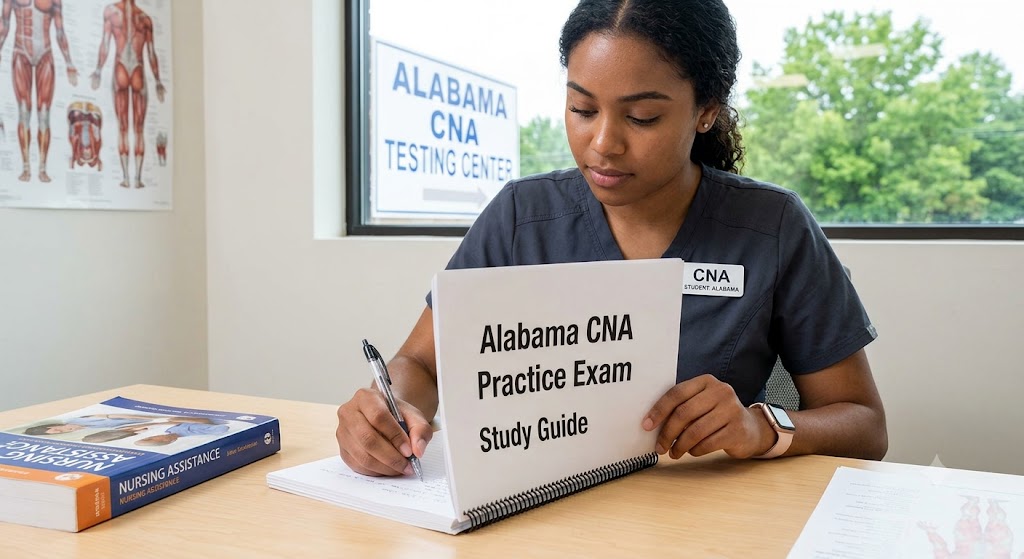
Additional Information
What the Course Entails and Exam Details
To be eligible for the Alabama CNA exam, you must first
complete a training course that meets the federal and state requirements,
usually consisting of a minimum of 75 hours, with at least 16 hours dedicated
to clinical skills training. The core curriculum covers essential nursing
assistant skills and knowledge, including:
Basic Nursing Skills (e.g., measuring vital signs, infection
control, safety procedures)
Personal Care Skills (e.g., bathing, dressing, feeding,
grooming)
Restorative Services (e.g., assistance with movement and
exercise, use of assistive devices)
Mental Health and Social Service Needs of residents
Residents' Rights and promoting independence
Communication and Interpersonal Skills
Understanding your Role as a Certified Nursing Assistant
What to Expect in the Final Exam
The actual Alabama CNA exam, which is administered by
Prometric, consists of two distinct components that must both be passed to
receive certification: a written examination and a clinical skills evaluation.
Written Examination:
The written part is a multiple-choice test. It usually
consists of about 60 questions, covering a range of topics found in the CNA
curriculum. You are typically given a time limit of 90 minutes to two hours to
complete this section. The exam focuses on knowledge application in scenarios a
CNA would encounter.
Clinical Skills Evaluation:
The practical skills portion is a hands-on test in a
clinical setting, often a simulation lab at the testing center. You will be
asked to perform a set of randomly selected skills, which can include tasks
like handwashing, measuring and recording vital signs, transferring a patient,
providing catheter care, and making an occupied bed. An evaluator will observe
your performance. To pass, you must demonstrate proficiency in the specific
skills, adhering to safety protocols and respecting patient dignity. Passing
scores are set by Prometric and are required for both sections to be listed on
the Alabama Nurse Aide Registry.
How to Study and
Exam Centers
Preparing effectively for the CNA exam requires a
combination of theory review and practical skills practice.
Actionable Study Strategies:
Review Your Course Materials: Thoroughly go over your
textbook, class notes, and all handouts from your approved CNA training
program. Pay special attention to safety guidelines, measurement procedures,
and the steps for each clinical skill.
Use the Official Prometric Candidate Handbook:
Download the specific candidate handbook for Alabama from the Prometric
website. This is an essential resource that details the exam content, format, and
has a complete list of all the clinical skills you might be tested on,
including the critical steps you must not miss.
Take Practice Exams: Dedicate time to taking
multiple-choice practice tests for the written portion. This will help you
identify weak areas and get accustomed to the types of questions and the time
constraints.
Practice Clinical Skills repeatedly: Find a partner
(a friend, family member, or classmate) to role-play scenarios for the clinical
skills portion. Practice the steps sequentially for every skill, from
handwashing to recording measurements, until they become second nature. Pay
attention to communication and respecting the 'resident.'
Exam Centers:
The Alabama CNA exam is a proctored, in-person examination.
It is administered by Prometric at authorized testing locations throughout the
state. Candidates typically register for the exam through Prometric once their
training provider has verified completion of the program. Testing centers are
often located at community colleges, technical schools, or other facilities
that have approved lab setups for the clinical skills evaluation. There is no
option to take the full exam online.
Job Opportunities from the Course
Becoming a Certified Nursing Assistant in Alabama opens
doors to various rewarding career paths. With your CNA certification, you will
be eligible for job titles such as:
Certified Nursing Assistant (CNA) in nursing homes and
skilled nursing facilities.
Patient Care Technician (PCT) or Nurse Aide in hospitals and
medical centers.
Home Health Aide (HHA) with home care agencies.
Resident Assistant in assisted living facilities and
retirement communities.
Hospice Aide, providing compassionate care to end-of-life
patients.
Geriatric Nursing Assistant, specializing in elder care.
Additionally, CNA certification often serves as a
foundational step for those looking to advance their healthcare careers by
pursuing further education to become a Licensed Practical Nurse (LPN) or
Registered Nurse (RN).
If you need any adjustments to the structure, tone, or
details, please let me know. Good luck to all the students preparing for this
essential step in their healthcare journey!
Frequently Asked Questions
Reviews
5.0
Based on 0 reviews
Leave a Review
No reviews yet. Be the first to review!