
AIRS Accreditation Practice Exam
$69.00
- Buy to unlock unlimited access to all Quiz questions.
- After purchase you can print a PDF of the whole quiz at any point. The PDF will contain the questions and the correct answers.
About this Exam
The AIRS Accreditation, now administered by Inform USA, is the premier national standard for organizations providing information and referral services. It serves as a seal of quality, verifying that an I&R program operates with a high level of professionalism and efficiency.
The AIRS Accreditation Practice Exam is designed to mirror the knowledge and problem-solving skills required for both organizational success and individual certification. It is an invaluable resource for program managers, resource specialists, and any staff member involved in the delivery of human services. By successfully completing this practice exam, individuals and teams can gain the confidence needed to pursue formal accreditation or certification, demonstrating their mastery of the core concepts in connecting people with the resources they need.
Ready to test your knowledge?
Buy Now to Access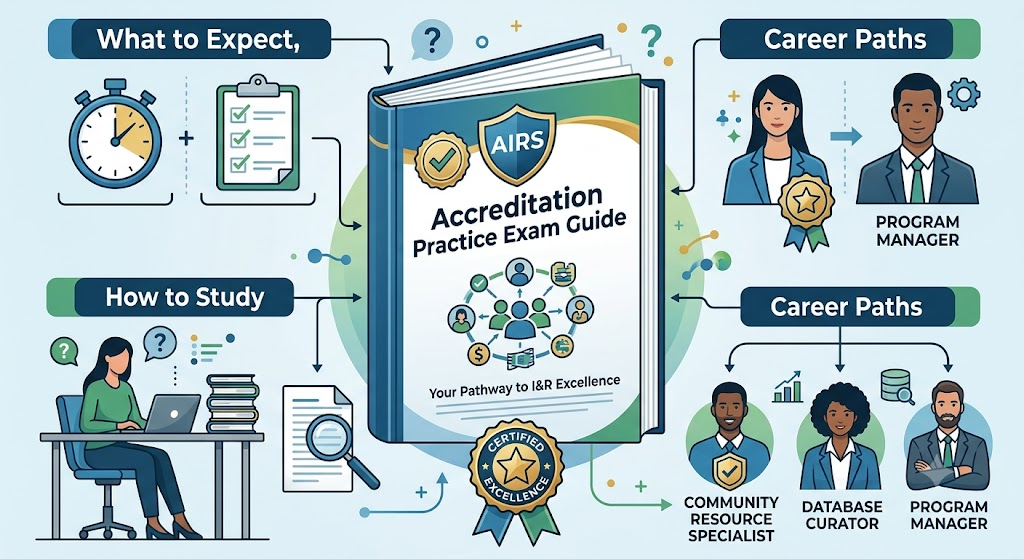
Additional Information
What the Course Entails and Exam Details
This practice exam covers the essential competencies and ethical principles fundamental to the AIRS Standards for Information and Referral Services.
The core syllabus and topics you should expect to see covered include:
Understanding I&R: The role of information and referral in the broader health and human services network.
The I&R Process: Detailed understanding of the steps: Assessment, Information, Referral, and Follow-up.
AIRS Standards: Deep knowledge of the multi-part standards that govern a high-quality I&R service, including governance, data accuracy, community involvement, and service delivery.
Taxonomy and Data Management: Mastering the structured classification systems and best practices for creating and maintaining an accurate community resource database.
Inclusion/Exclusion Policy: Developing and applying criteria for which organizations and services are included or excluded from the resource database.
Quality Assurance and Evaluation: Methods for monitoring service quality and measuring outcomes.
Ethics and Confidentiality: Navigating the complex ethical considerations in client interaction and data protection.
Disaster preparedness and recovery in I&R: How to effectively continue I&R services during and after a disaster.
What to Expect in the Final Exam
While a "practice" exam is a study tool, it is designed to prepare you for a formal assessment that is both rigorous and reflective of real-world scenarios.
The final comprehensive exam is typically:
Format: Digital, consisting of approximately 100 to 120 multiple-choice questions, many of which are situational, requiring the application of knowledge to specific, practical I&R scenarios.
Passing Score: Often requires a minimum of 70% to 80% to demonstrate proficiency.
Time Limits: Candidates are generally given two to three hours to complete the entire exam.
Rules: The exam is closed-book, and candidates must complete it independently. For digital versions, a remote proctoring service may be utilized.
How to Study and Exam Centers
Effective preparation is key to success on the AIRS Accreditation Practice Exam and subsequent formal testing. Here are actionable strategies:
Study Strategies:
Master the Standards: The most critical resource is the complete and current version of the "AIRS Standards for Information and Referral Services." You must understand not only what the standards are but why they are in place and how they are applied.
Use the Practice Exam as a Diagnostic: Take the AIRS Accreditation Practice Exam multiple times. Analyze not just your correct answers, but also your incorrect ones. This is the best way to pinpoint your weak areas.
Utilize Inform USA Training: Participate in official training sessions and webinars offered by Inform USA. These are specifically designed to align with the current standards and certification requirements.
Create and Study Flashcards: Make flashcards for key terms, taxonomy structures, data management rules, and I&R ethical scenarios.
Practice with Case Studies: Seek out or create I&R case studies. Discussing how you would handle complex scenarios using the AIRS Standards with your colleagues is an exceptional form of preparation.
Exam Centers and Access:
The AIRS Accreditation Practice Exam is typically accessed online through a dedicated learner portal hosted by Inform USA or its authorized training partners. This allows for flexible access from any location with a secure internet connection.
For formal individual certification exams, while the practice exam is digital, the formal test might be taken:
Online via Remote Proctor: This is the most common method, allowing for a secure, proctored environment from your home or office.
At an Authorized I&R Agency: Some accredited agencies may be authorized to host physical in-person testing.
Specific Online Portals: Access is typically controlled through an individual’s unique login on the Inform USA certification website.
Job Opportunities from the Course
A strong performance on the AIRS Accreditation Practice Exam demonstrates a significant level of proficiency that is highly valued in the non-profit, government, and healthcare sectors.
This knowledge and subsequent formal certification open specific job opportunities and career paths, including:
Community Resource Specialist (CRS): This is the core role for directly interacting with clients to assess needs and provide tailored referrals.
Community Resource Specialist - Database Curator: Specializes in the management, taxonomy application, and quality of the resource database.
I&R Program Manager/Supervisor: Oversees the daily operations, training, and quality assurance of an entire I&R department.
I&R Quality Assurance Coordinator: Dedicated to monitoring and improving the quality and consistency of service delivery and database integrity.
I&R Trainer and Educator: Focuses on onboarding and continuing the professional development of I&R staff.
Client Services Manager (in human services): Managing client-facing services in a broader organization, benefiting from I&R process knowledge.
Non-Profit Program Coordinator: Overseeing programs that rely heavily on accurate resource connection for their success.
Frequently Asked Questions
Reviews
5.0
Based on 0 reviews
Leave a Review
No reviews yet. Be the first to review!