
Airplane Flying Handbook Practice Test
$69.00
- Buy to unlock unlimited access to all Quiz questions.
- After purchase you can print a PDF of the whole quiz at any point. The PDF will contain the questions and the correct answers.
About this Exam
The "Airplane Flying Handbook Practice Test" is a critical self-assessment tool designed for aspiring pilots who are preparing for their formal FAA knowledge exams, specifically the Private Pilot Knowledge Test (PAR). It is based on the Federal Aviation Administration's definitive guide, the Airplane Flying Handbook (FAA-H-8083-3C). This handbook is the foundational textbook for all students learning to fly, introducing the basic skills, knowledge, and safety principles required to pilot airplanes. A practice test allows students to gauge their understanding of these essential concepts, simulate the pressure of a timed exam, and identify specific areas that require further study before attempting the actual certification test. It is primarily designed for student pilots but is also an invaluable resource for rated pilots seeking to improve their proficiency or prepare for additional certificates and ratings.
Ready to test your knowledge?
Buy Now to Access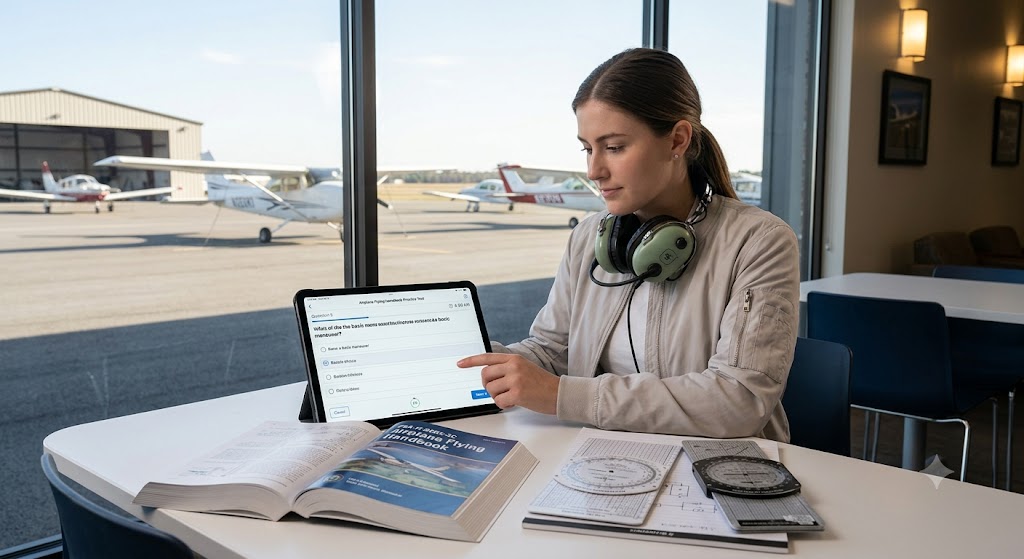
Additional Information
What the Course
Entails and Exam Details
The knowledge base covered by this practice test mirrors the
key content areas of the Airplane Flying Handbook. The core goal is to
validate that an applicant possesses the aeronautical knowledge required by
Federal Aviation Regulations (14 CFR Part 61) to safely act as pilot in
command. The following topics are typical focus areas:
- Introduction
to Flight Training: The roles of the FAA, instructors, and examiners;
Airman Certification Standards (ACS); and collision avoidance.
- Ground
Operations: Visual preflight assessment of the aircraft, risk
management, and resource management.
- Basic
Flight Maneuvers: The four fundamentals of flight—straight-and-level,
turns, climbs, and descents.
- Slow
Flight, Stalls, and Spins: The critical aerodynamic knowledge required
for maintaining control at low speeds and recovery techniques.
- Takeoffs
and Departure Climbs: Procedures for normal and crosswind takeoffs,
and short-field and soft-field operations.
- Ground
Reference Maneuvers: Techniques to adjust the aircraft's path based on
visual ground references, including rectangular courses and s-turns.
- Airport
Traffic Patterns: The standard procedures for arriving at and
departing from controlled and uncontrolled airports.
- Approaches
and Landings: Detailed instructions for normal, crosswind,
short-field, soft-field, and go-around procedures.
- Emergency
Procedures: Managing system and equipment malfunctions, including
partial and complete power failure.
What to Expect in
the Final Exam
While the Airplane Flying Handbook itself does not
have a single "final exam," the formal test you are preparing
for—typically the FAA Private Pilot Knowledge Test—has specific parameters. It
is a computerized, multiple-choice exam taken at an official testing center.
Here are the key details for the Private Pilot knowledge test:
- Number
of Questions: 60 scored multiple-choice questions.
- Time
Limit: 120 minutes (2 hours).
- Passing
Score: 70% minimum score is required to pass.
- Authorized
Aids: Applicants are permitted to use specific test aids, including
navigation plotters, electronic or manual flight computers (e6B), and
simple calculators. All test aids must be free of unauthorized notes.
- Result
Validity: A successful test result is valid for 24 calendar months.
How to Study and
Exam Centers
Effective preparation for the FAA knowledge test involves a
multi-faceted approach. Success requires more than just memorization; it
demands a deep, practical understanding of flight principles. Consider these
actionable study strategies:
- Master
the Core Text: Your primary resource should be the actual Airplane
Flying Handbook (FAA-H-8083-3C). You must read and understand each
chapter, not just study summary guides. It is available for free from the
FAA website.
- Take
Multiple Timed Practice Exams: Utilize high-quality practice tests
from reputable aviation training providers. Do not just look at questions;
simulate the real exam experience by setting a timer and taking
60-question blocks in one sitting to build stamina.
- Analyze
Practice Test Results: For every practice question missed, read the
detailed explanation and refer back to the corresponding section of the Airplane
Flying Handbook to understand why the correct answer is correct
and why the distractors are incorrect.
- Utilize
the Process of Elimination: During the exam, a key test-taking
strategy is to systematically eliminate answers that are clearly wrong.
Often, even a partial understanding of a topic can help you identify the
sole remaining correct option.
- Exam
Centers: The actual FAA Knowledge Test is administered by computer at
designated PSI Testing Centers. You can register and schedule your
exam online through the PSI portal. You will need to bring a current,
valid photo ID and, for a first attempt, a written endorsement from an
authorized ground or flight instructor.
Job Opportunities
from the Course
A strong knowledge of the Airplane Flying Handbook is
the prerequisite for obtaining the Private Pilot Certificate, which is the
foundational license that all subsequent career paths in aviation are built
upon. By mastering this material and obtaining your commercial licenses, you
can unlock a wide array of professional opportunities. Here are some key career
paths available to licensed pilots:
- Commercial
Airline Pilot (Regional/Major): Transporting passengers on scheduled
routes, with paths starting at regional carriers and leading to major
international airlines.
- Flight
Instructor (CFI): Teaching the next generation of student pilots,
which is also a primary method for accumulating necessary flight
experience.
- Cargo
and Freight Pilot: Operating complex aircraft to transport goods and
packages, including overnight and long-haul operations for companies like
FedEx or UPS.
- Corporate
and Business Aviation Pilot: Flying high-end jets for specific
corporations or individuals.
- Agricultural
Pilot (Crop Duster): Utilizing aircraft for aerial application of seed
or chemicals.
- Charter
or Air Taxi Pilot: Operating private flights for clients to specific,
on-demand destinations.
- Government
Service Pilot: Flying for various federal agencies, such as the FAA,
DEA, FBI, or Customs and Border Protection.
- Air
Ambulance and Medical Pilot: Conducting critical transport of patients
or organs in emergency situations.
- Law
Enforcement Pilot: Performing aerial surveillance and support for
local, state, or federal law enforcement.
- Military
Pilot: A challenging and rewarding path serving as a pilot within the
armed forces.
The foundation you build with the Airplane Flying
Handbook is the first step toward any of these exciting careers. Good luck
with your studies and your practice exams!
Frequently Asked Questions
Reviews
5.0
Based on 0 reviews
Leave a Review
No reviews yet. Be the first to review!