
Airline Transport Pilot Written Knowledge Practice Test
$69.00
- Buy to unlock unlimited access to all Quiz questions.
- After purchase you can print a PDF of the whole quiz at any point. The PDF will contain the questions and the correct answers.
About this Exam
The Airline Transport Pilot (ATP) Multi-Engine Written Knowledge Test (often abbreviated as the ATM) is the final and most advanced theoretical knowledge exam required by the FAA for pilots seeking the ultimate pilot certificate. This certification is mandatory for any pilot looking to act as an captain (Pilot in Command) or first officer in multi-engine aircraft operated by scheduled air carriers, cargo operators, and charter companies. It is designed for seasoned commercial pilots who have met the minimum flight hour requirements, including substantial cross-country, instrument, and night flying experience, and are prepared to prove their theoretical expertise in all facets of airline-level aviation operations.
Ready to test your knowledge?
Buy Now to Access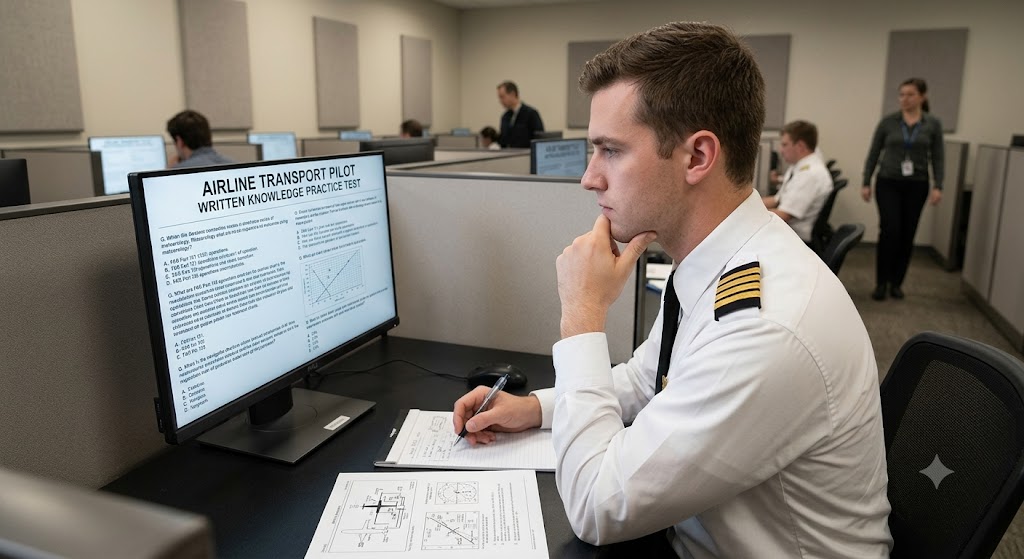
Additional Information
What the Course Entails and Exam Details
This examination is not about basic airmanship but rather
the complex rules, regulations, systems, and operating principles required for
multi-pilot, large-scale air carrier operations. While technically a single-day
exam, preparation for the ATP written often involves a combination of rigorous
self-study and sometimes specialized ground school courses, especially those
focusing on the required ATP Certification Training Program (ATP CTP). The ATP
CTP is a prerequisite course that pilots must complete before they can even
register for the multi-engine ATP knowledge test. This foundational course
focuses on advanced aerodynamics, automation, adverse weather, and air carrier
operations.
The actual written exam focuses on a broad range of
operational and technical domains:
- Regulations
(FAR Parts 121 and 135): In-depth knowledge of rules governing
scheduled carriers and on-demand operations.
- Aviation
Weather: Advanced meteorology, identifying complex weather systems,
and decoding specific aviation forecasts and reports.
- Weight
and Balance: Comprehensive calculations for large multi-engine and
turbojet aircraft, including center of gravity shifts.
- Aircraft
Performance: Understanding charts for takeoff, climb, cruise, landing,
and single-engine operations.
- Aerodynamics:
Advanced principles of flight, including high-altitude aerodynamics,
swept-wing characteristics, and stall/upset recovery.
- Navigation:
Advanced flight planning, fuel management, high-altitude jet routes, and
required navigation performance (RNP).
- Air
Traffic Control (ATC): Specific communication and procedural protocols
relevant to air carriers.
What to Expect in the Final Exam
The Airline Transport Pilot Multi-Engine Knowledge Test is a
high-level exam administered via computer. While specific question counts and
time limits can adjust slightly, candidates generally face a long-duration exam
with a large number of questions.
- Format:
The test consists of approximately 125 to 135 multi-engine,
airline-focused multiple-choice questions. These questions often involve
complex scenarios, referencing large figures, charts, and diagrams
provided electronically or in a separate supplement book.
- Time
Limit: Candidates typically receive a generous time allocation, often
4 to 5 hours. Despite the length, the exam is challenging, and careful
time management is essential.
- Passing
Score: The FAA standardized passing score is 70% or higher.
- Specific
Rules: The exam must be proctored at an authorized testing center. You
must bring valid, current identification. The use of certain FAA-approved
electronic flight computers and calculators is permitted, but all
materials must be strictly scrutinized by testing staff. Cell phones,
recording devices, and unauthorized study materials are strictly
prohibited. The ATP Certification Training Program (ATP CTP) completion
certificate is a required document to register for the test.
How to Study and Exam Centers
Effective preparation for the ATP written is critical. Many
pilots find this to be the most demanding written exam of their careers. A
combination of structured resources is highly recommended:
- Structured
Practice Exams: Utilizing dedicated test preparation software or
online portals from reputable vendors (like Gleim, ASA, or Sheppard Air)
is vital. These tools provide expansive question banks that mirror actual
test questions and categories. Consistent, timed practice sessions are
essential for building speed and accuracy.
- Comprehensive
Study Guides: Specialized ATP study manuals provide detailed
explanations of all core topics. They break down regulatory parts (like
121 operations) into digestible sections.
- FAA
Documents: Don’t ignore official sources. Study relevant Federal
Aviation Regulations, the Aeronautical Information Manual (AIM), and FAA
Advisory Circulars.
- Ground
School Support: While the ATP CTP focuses heavily on high-altitude
operations and aerodynamics, some pilots benefit from dedicated ground
school instruction (online or in-person) specifically for the ATP
knowledge categories.
Testing Centers:
The ATP knowledge test must be taken at an authorized
computer testing center. FAA-authorized testing vendors manage these facilities
nationwide. These typically include commercial testing centers (like those
operated by PSI) and approved flight training institutions. Registration is
usually done online or over the phone through the vendor’s centralized booking
system after you have confirmed your eligibility.
Job Opportunities
from the Course
Earning the ATP Multi-Engine Certificate (unlocked by
passing this written test and the subsequent practical exam) is the
prerequisite for all airline-level pilot positions and many high-level
corporate flying jobs. It significantly increases your marketability in the
aviation industry.
- Airline
First Officer (Regional Airlines)
- Airline
First Officer (Major/Legacy Airlines)
- Airline
Captain (Regional/Major Airlines, after meeting experience requirements)
- Cargo
Pilot (Scheduled and On-Demand Operations)
- Corporate
Jet Captain or First Officer
- Charter
Pilot (Multi-Engine/Turbojet Operations)
- High-Altitude/Complex
Aircraft Pilot
- Chief
Pilot (Part 135 or Part 91 Operators)
- Airline
Ground Instructor/Simulator Instructor (with necessary endorsements)
Frequently Asked Questions
Reviews
5.0
Based on 0 reviews
Leave a Review
No reviews yet. Be the first to review!