
Airframe M3 Structures Application Practice Test
$69.00
- Buy to unlock unlimited access to all Quiz questions.
- After purchase you can print a PDF of the whole quiz at any point. The PDF will contain the questions and the correct answers.
About this Exam
The Airframe M3 Structures Application Practice Exam is a comprehensive preparatory tool designed for aviation maintenance technicians (AMTs) seeking to master the principles of aircraft structural integrity and repair. This exam specifically targets the knowledge and application-based skills required by standard modular training courses, such as those within the EASA Part 66 framework, which are recognized globally. This certification is a critical step for professionals who are ready to prove their proficiency in maintaining, repairing, and altering aircraft structures, ensuring they meet the highest safety standards of airworthiness.
Ready to test your knowledge?
Buy Now to Access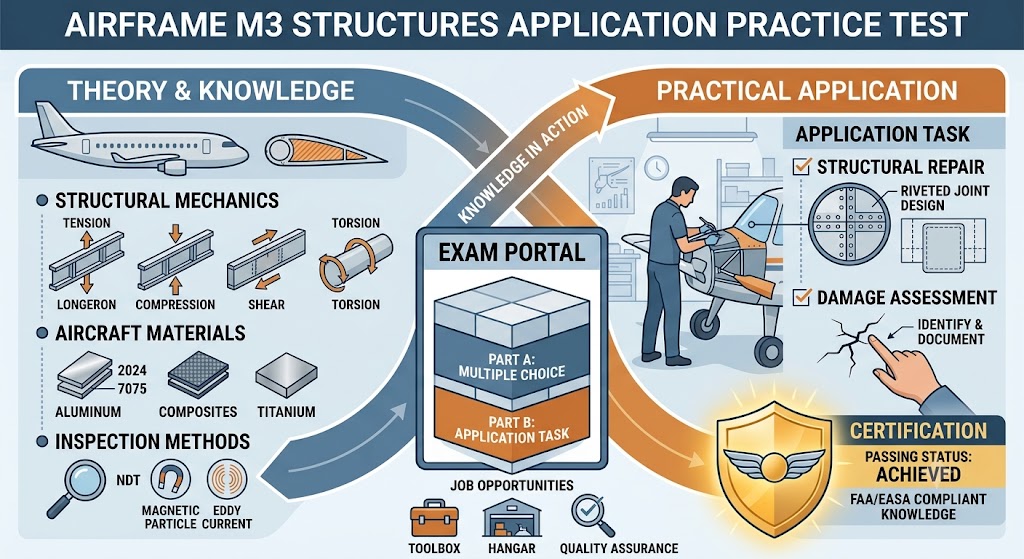
Additional Information
What the Course
Entails and Exam Details
This examination covers the core theoretical and practical
principles of aircraft construction and structural maintenance. Candidates are
tested on their knowledge of various structural designs, including monocoque,
semi-monocoque, and truss structures, as well as the identification and
function of primary, secondary, and tertiary structural members, such as spars,
ribs, frames, stringers, and bulkheads. The course syllabus places a heavy
emphasis on the application of materials and processes. This includes
understanding the properties and proper use of common aerospace materials—like
aluminum alloys (2024, 6061, 7075), composite materials, plastics, and
titanium—and knowledge of heat treatment. Furthermore, a significant portion is
dedicated to maintenance procedures and practical application: techniques for
inspection and structural health monitoring, non-destructive testing (NDT),
corrosion detection and prevention, composite repair, welding shop equipment,
and the standard practices for riveted repairs. You must demonstrate a full
understanding of structural design philosophies, like fail-safe and safe-life,
and the calculation of loads (tension, compression, shear, torsion) under
diverse aerodynamic forces.
What to Expect in the Final Exam
While individual certifying bodies have slight variations,
the final exam that this practice test simulates is generally a multi-part
process composed of two distinct components: a knowledge-based exam and a
practical assessment. The knowledge test is typically a computer-based,
multiple-choice format, designed to challenge your understanding of the
concepts and procedures. It usually consists of 70 to 100 questions, with a
strict time limit (e.g., 60 to 90 minutes). The passing score requirement is
typically 70% or higher. For full certification, once the knowledge exam is
successfully passed, you must also complete an Oral and Practical (O&P)
examination. During the practical portion, you will be required to demonstrate
real-world skills, such as performing a complex structural repair, executing
non-destructive testing on a structural joint, or interpreting a specific
manufacturer's structural repair manual (SRM). The final rules and passing
criteria are determined by your final licensing authority, such as a designated
mechanic examiner (DME) acting for the FAA or an approved EASA Part 147
training center.
How to Study and
Exam Centers
The key to passing this test is a detailed understanding and
consistent practice. First, create a thorough study plan, using the practice
test to benchmark your progress and identify weak areas. Actively engage with
the official training manuals, especially the Aviation Maintenance Technician
Handbook – Airframe and any manufacturer’s specific structural repair manuals
(SRM). Create physical or digital flashcards for key terms, material codes, and
repair standards, particularly focusing on NDT methods and common repair joint
formulas. When taking the practice exam, simulate a real test environment:
close your books, use a timer, and strive for both accuracy and speed. As for
the final exam center, you will not take the licensing exam at a practice test
portal. Instead, you must locate an authorized testing facility. This is
typically done through approved training providers or at recognized aviation
authority centers (such as an FAA-authorized Airman Knowledge Testing Center or
an EASA Part 147 training center). You will likely need to register for a
personal identifier with your certifying body (e.g., an FTN for the FAA) and
schedule an appointment in advance. The practical, application-based portion of
your certification is usually administered by a separate examiner or at a
dedicated workshop facility after the knowledge component is finalized.
Job Opportunities
from the Course
Upon achieving certification in M3 Airframe Structures, a
range of specialized career paths and high-demand roles open to you. Potential
job opportunities include:
- Aircraft
Structures Technician
- Airframe
Mechanic
- Structural
Repair Specialist (SRS)
- Composite
Repair Technician
- Aircraft
Sheet Metal Worker
- Quality
Control Inspector (Structures)
- Manufacturing
Technician (Aerospace)
- Aircraft
Restoration Specialist
Frequently Asked Questions
Reviews
5.0
Based on 0 reviews
Leave a Review
No reviews yet. Be the first to review!