
Airfield Driving Course Practice Exam
$69.00
- Buy to unlock unlimited access to all Quiz questions.
- After purchase you can print a PDF of the whole quiz at any point. The PDF will contain the questions and the correct answers.
About this Exam
The Airfield Driving Course (and its final examination) is a critical certification for individuals who need to operate ground vehicles on airport ramps, taxiways, and non-movement areas. This specialized training ensures the safety of personnel, aircraft, and property in high-stakes aviation environments. It is designed for airport employees, airline staff, ground handlers, maintenance workers, construction contractors, and anyone whose duties require them to drive inside the airport perimeter. Obtaining this certification proves you have the knowledge and situational awareness to navigate complex airfield layouts and communicate effectively, minimizing incursions and accidents. It is often the first step toward gaining essential security clearances and driving privileges within the secure areas of an airport.
Ready to test your knowledge?
Buy Now to Access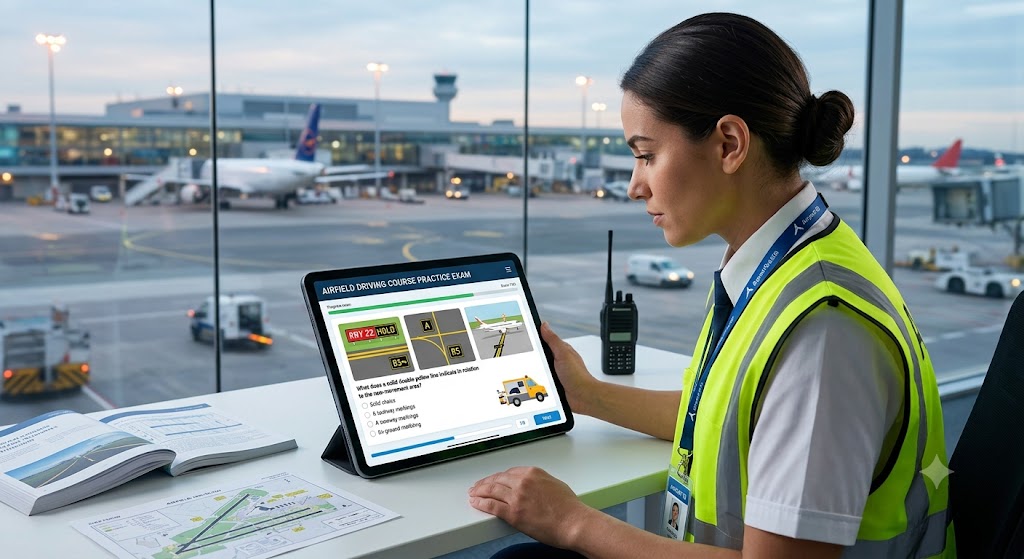
Additional Information
What the Course Entails and Exam Details
The underlying course covers a comprehensive range of topics
critical for safe operations on the airfield. Key areas typically include:
Airfield Layout and Terminology: Understanding signs,
markings, lighting, and the crucial distinction between movement areas
(controlled by ATC) and non-movement areas.
Rules and Regulations: General safety rules, speed limits,
vehicle requirements, and specific local airport operating procedures (AOPs).
Radio Communications (Phraseology): Learning the standard
language used to communicate with Air Traffic Control (ATC) and other vehicles,
including the phonetic alphabet, standard terminology, and procedures for
requesting permission. (This part is crucial for movement area driving).
Procedures for Access: Security badging, gate access, and
vehicle inspection protocols.
Emergency Procedures: How to respond to accidents,
mechanical failures, fuel spills, medical emergencies, and severe weather
conditions.
Vehicle Maintenance and Inspection: Performing daily
pre-driving checks to ensure the safety of the vehicle before entering the
airfield.
Safe Driving Practices: Tailgating rules, yield procedures,
right-of-way, avoiding runway incursions, and operating safely around aircraft.
Jet Blast and Propeller Awareness: Understanding the dangers
associated with working near aircraft engines and proper safe zones.
The exact curriculum depends on the level of certification
required (e.g., non-movement area only vs. movement area access). The details
provided in the official course materials are specific to that airport.
What to Expect in the Final Exam
The official final examination often consists of both a
written and a practical component.
Written Exam: This typically consists of 25-100
multiple-choice and true/false questions, testing your understanding of all the
course topics, including signs, markings, regulations, communications, and
emergency protocols.
Format: It is often administered via computer but can be on
paper. The questions are often randomized.
Passing Score: The passing score is usually very high,
typically ranging from 80% to 100%. Some specific sections, such as radio
communications, may require a perfect score for passing, especially for
movement area drivers. Retakes are often limited, with waiting periods.
Time Limit: You will generally be given a fixed time, often
between 30 and 60 minutes, to complete the written portion, depending on its
length.
Practical Exam (Check Ride): This is a crucial practical
component. A designated airport examiner or trainer will observe you driving a
vehicle on the airfield. You must demonstrate proper procedures, correct
navigation, adherence to all rules, situational awareness, and clear radio
communication (if applicable). This often includes performing specific tasks,
driving standard routes, and reacting correctly to scenarios.
Specific Rules: No notes or external materials are allowed
during either part of the exam. Cheating results in immediate failure and
potential disciplinary action. Review your local airport regulations for
specific exam day rules.
How to Study and
Exam Centers
Prepare thoroughly using the official training materials
provided by your airport or company.
Review the Airport's Specific Operations Manual: This is the
most crucial resource. Every airport has unique rules, layout, signage, and
traffic patterns.
Practice the Written Portion: Use all provided practice
questions, quizzes, and online review resources. Create flashcards for airfield
signs, markings, and technical terms. Focus on knowing the distinction between
movement and non-movement areas and all associated rules.
Familiarize Yourself with the Airfield: If possible, study
map layouts, watch training videos, and take "ride-alongs" with
experienced drivers to understand the traffic flow, standard routes, and visual
references. Memorize key sign sequences and critical locations.
Review Radio Phraseology (if required): Practice speaking
the standard phrases clearly and accurately. Use online simulators or record
yourself to improve clarity, brevity, and accuracy. Ensure you can understand
and respond quickly to ATC-style communications.
Get Hands-on Practice (Check Ride Preparation): Practice
driving the required routes and maneuvers with an approved trainer before your
official check ride. Perform thorough pre-driving vehicle inspections. Focus on
defensive driving, yield procedures, and overall situational awareness.
Practice standard radio communication during these training runs.
Exam Centers: The exam is almost always conducted
on-site at the specific airport where you will be working. Training
departments, safety offices, or approved training organizations within the
airport perimeter manage and deliver both the written and practical components.
This is not typically an exam taken at standard commercial testing centers like
Pearson VUE. Large airports may have their own internal online learning systems
for the written portion, but the practical element is always hands-on. Contact
your employer's training coordinator or the airport's operations office for
specific locations and scheduling.
Job Opportunities
from the Course
Successfully completing this course and passing the exam is
mandatory for a wide range of jobs within an airport environment. Career
opportunities include:
Airport Operations Agent
Ground Handler (Ramp Agent)
Aircraft Fueler
Airline Customer Service Agent (with ramp responsibilities)
Maintenance Technician (facilities, vehicles)
Security Officer (patrolling the airfield perimeter)
Construction Worker/Contractor (working on airport projects)
Airfield Inspector
Fixed-Base Operator (FBO) Staff
Emergency Services Personnel (Fire, EMS on airfield)
Cargo Agent (moving mail and freight)
De-icing Operator
Vehicle Escort
Airport Planner (often helpful background)
Airfield Electrician/Lighting Technician
Airport Safety Coordinator
Aviation Ground Support Equipment (GSE) Mechanic
Ramp Supervisor / Lead Agent
Ramp Safety Instructor
Aircraft Marshal
Pushback Operator
Catering Truck Driver
Passenger Bus Driver (within airfield)
Operations Specialist
Wildlife Control Officer
Frequently Asked Questions
Reviews
5.0
Based on 0 reviews
Leave a Review
No reviews yet. Be the first to review!