
Aircraft Electrical Practice Test
$69.00
- Buy to unlock unlimited access to all Quiz questions.
- After purchase you can print a PDF of the whole quiz at any point. The PDF will contain the questions and the correct answers.
About this Exam
This Aircraft Electrical Systems Practice Exam is designed for aspiring Aircraft Maintenance Technicians (AMTs), avionics specialists, and students preparing for their FAA (Federal Administration Administration) or EASA (European Union Aviation Safety Agency) certification exams. This practice test focuses specifically on the critical principles of electricity as applied to modern aircraft, ensuring you have the foundational knowledge required for safe aircraft operation and maintenance. It is ideal for individuals currently enrolled in AMT programs or those conducting self-study to validate their readiness for the official written knowledge tests.
Ready to test your knowledge?
Buy Now to Access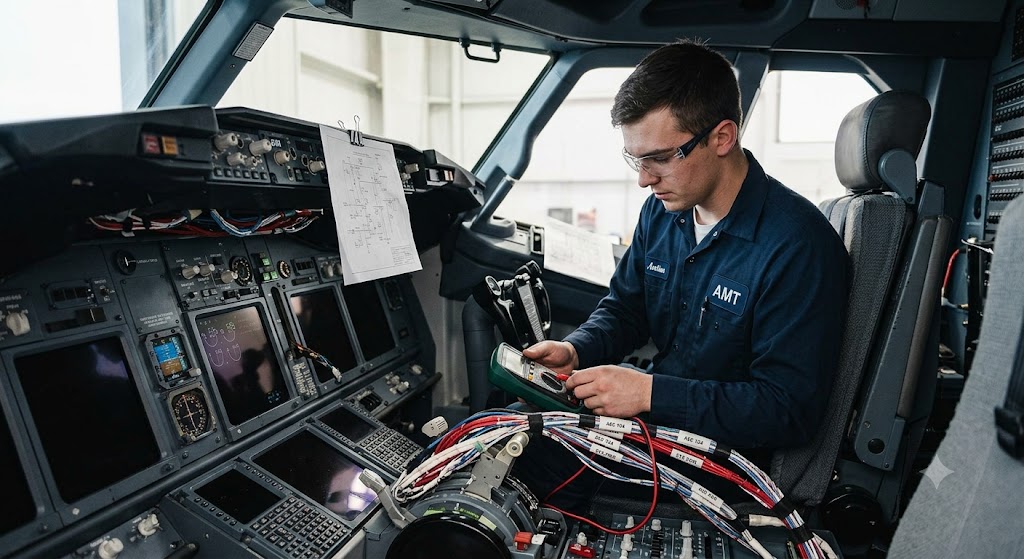
Additional Information
What the Course Entails and Exam Details
The content covered in this comprehensive practice test
mirrors the electrical systems subject matter found in standard aviation
maintenance curricula and certification standards. Key areas include:
• Basic Electricity Principles: Ohms Law, power
calculations, and DC and AC circuit theory.
• Aircraft Electrical Components: Detailed knowledge of
batteries (lead-acid and Ni-Cad), generators, alternators, motors, voltage
regulators, and circuit protection devices (fuses, circuit breakers).
• Wiring and Installation: Understanding Electrical Wiring
Interconnect Systems (EWIS) standards, wire types, splicing, and bundling
techniques.
• Troubleshooting and Testing: Application of multimeter and
testing equipment logic to diagnose common electrical faults.
• Schematics and Diagrams: Ability to read and interpret
complex aircraft electrical system schematic diagrams.
What to Expect in the Final Exam
This practice exam simulates the format and pressure of the
actual certification written tests. You should expect:
• Format: Multiple-choice questions, which is the standard
format used by regulatory bodies like the FAA for written knowledge tests.
• Focus: Questions will test both factual knowledge
(definitions, formulas) and practical application (troubleshooting scenarios, diagram
analysis).
• Scoring: While this is a practice test, a recommended
passing score of 70% or higher is advised to demonstrate readiness for the
actual FAA written exam.
• Time Limit: The practice test should ideally be taken
under timed conditions (e.g., 60-90 minutes) to practice time management for
the real exam environment.
How to Study and Exam Centers
Effective preparation is key to mastering aircraft
electrical systems. We recommend a multi-faceted approach:
• Review Official Handbooks: Study the FAA’s Aviation
Maintenance Technician Handbook—General (FAA-H-8083-30A) and Airframe
(FAA-H-8083-31A), focusing heavily on the electrical system chapters.
• Use Online Practice Portals: Regularly take this and other
online practice tests to identify knowledge gaps.
• Practical Application: If possible, engage in hands-on
practice in a lab environment—building basic circuits, measuring
voltage/resistance, and practicing troubleshooting.
• Study Circuit Diagrams: Spend significant time analyzing
various aircraft electrical schematics until you can confidently trace current
flow and identify component functions.
Regarding actual exam centers: This practice test is
administered online. However, for the official FAA Knowledge Exams (written
tests), you must schedule your test at an authorized PSI Services testing
center located throughout the United States and internationally.
Job Opportunities from the Course
Mastering aircraft electrical systems is a core requirement
for many lucrative careers in the aviation industry. Achieving certification
(such as an FAA A&P certificate) unlocks roles including:
• Aircraft Maintenance Technician (AMT) with an Airframe
Rating • Avionics Technician • Aircraft Electrician • Helicopter Mechanic •
Electrical Systems Troubleshooter • MRO (Maintenance, Repair, and Overhaul)
Technician • Aircraft Quality Control Inspector (with experience)
Frequently Asked Questions
Reviews
5.0
Based on 0 reviews
Leave a Review
No reviews yet. Be the first to review!