Question 1
What is the primary focus of targeting within the AOC framework?
Correct Answer:
Identifying high-value targets and allocating resources accordingly
Explanation:
The primary focus of targeting within the AOC framework is to identify high-value targets and allocate resources accordingly. This aspect of targeting is crucial for achieving operational objectives and operational efficiency. Within the AOC, targeting is a systematic process that involves the analysis and prioritization of targets based on their value, relevance to the mission, and the potential impact on the overall campaign. This prioritization ensures that limited resources are utilized effectively to maximize operational success. In a combat and operational context, high-value targets typically include enemy command and control centers, strategic infrastructure, and key military assets that could significantly diminish the adversary's capabilities. By focusing on these targets, the AOC can develop comprehensive plans involving air strikes, intelligence gathering, and other operations that contribute to mission success while minimizing collateral damage and unnecessary resource expenditure. While the other options involve important aspects of military operations, they do not capture the primary objective of targeting within the AOC framework. Determining aircraft landing routes, establishing troop positions, and updating evacuation plans are critical components of operational planning but do not directly relate to the targeting function, which is specifically focused on identifying and engaging strategic objectives to achieve overall mission goals.
Question 2
Which aspect of AOC operations focuses on integration and support among different military services?
Correct Answer:
Joint Task Force coordination
Explanation:
Joint Task Force coordination is critical in AOC operations as it ensures effective integration and collaboration among various military services. This aspect emphasizes the combined efforts of different branches, such as the Army, Navy, Air Force, and Marine Corps, to achieve common operational objectives. Joint Task Force coordination facilitates the sharing of resources, intelligence, and strategies, leading to improved mission execution and operational efficiency. By fostering a unified command structure and enhancing communication across services, Joint Task Force coordination ensures that all branches work towards the same goals, maximizing the effectiveness of military operations. This collaborative approach is vital in complex operational environments where joint and combined forces must seamlessly integrate their efforts.
Question 3
What is the purpose of the "AOC mission support"?
Correct Answer:
To encompass logistics, personnel, and resources for operations
Explanation:
The purpose of "AOC mission support" is to encompass logistics, personnel, and resources for operations. This function is critical in ensuring that all necessary elements are in place for successful air operations. By providing the logistical framework, managing personnel assignments, and allocating resources effectively, AOC mission support acts as the backbone of air operations, facilitating efficient execution of missions. Logistics involves the planning and coordination of supplies, maintenance, and transportation, which are essential for carrying out air operations smoothly. Personnel management is also vital, as it ensures that the right skills and capabilities are available at the right time and place. Additionally, resource allocation enables the effective use of aircraft, technology, and other equipment that are crucial for mission success. This comprehensive approach ensures that operational commands can focus on their tactical and strategic objectives without being bogged down by logistical challenges or personnel issues.
Question 4
What is the planning process used by the COMAFFOR and JFACC?
Correct Answer:
Joint Planning Process Air (JPPA)
Explanation:
The correct choice, which pertains to the planning process used by the COMAFFOR (Commander, Air Force Forces) and JFACC (Joint Force Air Component Commander), is the Joint Planning Process Air (JPPA). This process is specifically designed to support integrated air planning efforts within a joint or combined force, facilitating the effective coordination of air operations across different services and components involved in a joint operation. JPPA encompasses various stages of planning that ensure airpower is leveraged efficiently to achieve the objectives of a campaign or operation. It integrates intelligence, logistics, and operational considerations, aligning air operations with broader joint objectives. This process enables air commanders to develop air plans that support the overall strategy while adapting to the dynamic nature of combat environments. The other options represent planning concepts that, while relevant to military operations, do not specifically address the unique framework used by the COMAFFOR and JFACC in the air domain. For instance, the Operational Planning Process encompasses a broader range of operations beyond air, the Joint Mission Design Series relates to specific operational scenarios rather than the planning strategy, and the Air Operations Planning Cycle focuses on the execution of air operations rather than the overarching planning framework utilized by the key air commanders.
Question 5
What is the acronym for the organizational structure that responds to operational tasking for Air Force Forces?
Correct Answer:
AETF
Explanation:
The correct answer, AETF, stands for Air Expeditionary Task Force. This organizational structure is specifically designed to respond to operational taskings involving Air Force forces. The AETF provides a way to organize and manage airpower for a wide range of operations and missions, ensuring flexibility and rapid response in various contexts, whether in combat or humanitarian efforts. It allows the Air Force to deploy integrated capabilities and establish command and control, logistics, and support functions in a joint/combined operational environment. In contrast, the other acronyms represent different structures or concepts within the Air Force. AEF stands for Air Expeditionary Force, which focuses on the rotational deployment of forces but does not specify the operational tasking response structure as directly as AETF. AFSOC refers to Air Force Special Operations Command and is primarily concerned with special operations, not the broader organizational response. CAF stands for Combat Air Forces, which is more related to the operational units providing air combat capabilities rather than the organizational framework for responding to taskings. Thus, AETF is the most accurate representation of an organizational structure for responding to operational tasking for Air Force forces.
Question 1
Exam overview

About this Exam

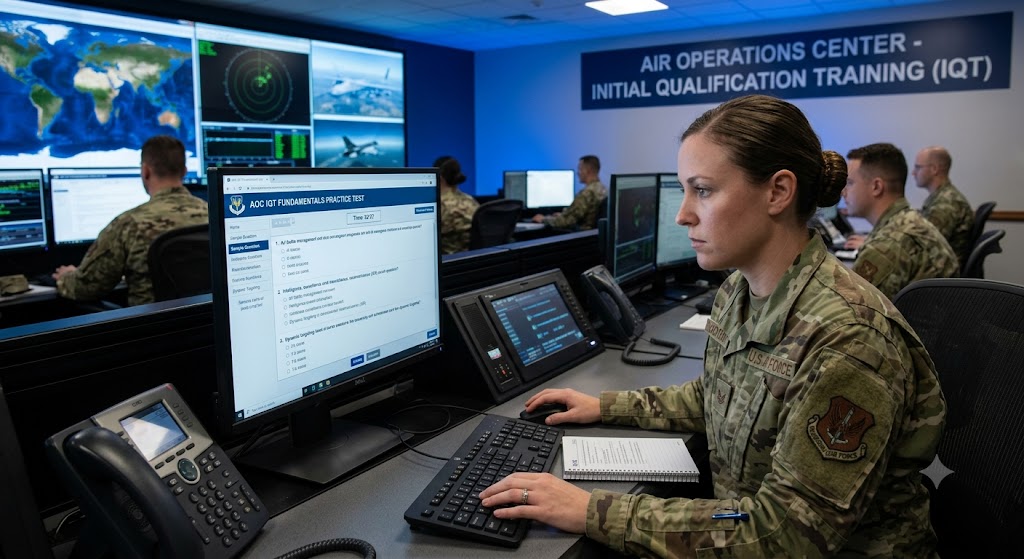
Welcome to the comprehensive study guide and practice test overview for the Air Operations Center (AOC) Initial Qualification Training (IQT) Fundamentals course. This course is a vital prerequisite for personnel assigned to any functional area within an Air Operations Center. It is designed to provide students with a foundational understanding of the structure, functions, processes, and command and control (C2) relationships inherent in a modern AOC, the nerve center for air component operations.

This qualification is primarily designed for Air Force officers and enlisted specialists from various career fields, including intelligence, operations, logistics, communications, and weather, who are selected for duty within an AOC. Understanding the fundamental language and operational concepts is crucial for seamless integration and success in real-world joint and coalition operations.

More details

Additional Information

What the Course Entails and Exam Details

The AOC IQT Fundamentals course covers an intensive syllabus that builds your understanding from the ground up. You will dive into the history, mission, and theoretical framework of Air Operations Centers, aligning with joint doctrine. Expect to cover a wide array of topics crucial for effective AOC operations.

The core curriculum includes, but is not limited to:

  • The Joint Air Estimate process and Strategy Division operations.
  • The Air Tasking Cycle, spanning from strategy development to execution.
  • Master Air Attack Plan (MAAP) development and Air Tasking Order (ATO) production within the Combat Plans Division.
  • Real-time execution monitoring and dynamic targeting processes within the Combat Operations Division.
  • The role of the Intelligence, Surveillance, and Reconnaissance (ISR) Division in all phases of the cycle.
  • Air Mobility Division functions and integration.
  • Specialty and support teams, such as weather, space, and legal support.
  • The application of key AOC systems like the Theater Battle Management Core System (TBMCS).

The actual IQT course is typically a resident course involving lectures, simulations, and group exercises. The final examination or series of evaluations aims to confirm that each student has a firm grasp of these functional areas and how they synchronize. The corresponding practice test you are preparing for mirrors these topics.


What to Expect in the Final Exam

While the exact structure can vary depending on the schoolhouse and curriculum updates, the AOC IQT Fundamentals final exam generally uses a standardized testing format to assess cognitive knowledge across all course modules.

Students can expect:

  • Format: A closed-book examination consisting predominantly of multiple-choice questions. It may also include matching or short-answer questions.
  • Content: Questions will cover concepts from every division, the operational cycle, C2 relationships, and system-specific terminology.
  • Passing Score: The standard minimum passing score for USAF initial qualification training is typically 80%.
  • Time Limit: The exam will be timed, ensuring proficiency and familiarity with the material.
  • Failure: Failure to meet the minimum standard often necessitates retraining or a re-evaluation, depending on local policy.

The practice test is your best indicator of readiness, providing exposure to the types of questions and the breadth of content you will face.


How to Study and Exam Centers

Preparing for the AOC IQT Fundamentals exam requires a disciplined and thorough study plan due to the high volume of critical information.

Here are actionable study strategies:

  • Prioritize Course Materials: Your instructor guides, presentation slides, and official reading materials provided during the resident course are the absolute priority. Do not rely on outside sources until these are mastered.
  • Understand the "Why" Behind the "What": Don't just memorize definitions; focus on why certain divisions follow specific processes and how they affect other divisions.
  • Utilize the Air Tasking Cycle: The cycle is the backbone of the AOC. Ensure you can visualize every stage and know which division is responsible for what.
  • Practice Active Recall: Review study guides and then cover the answers, testing your ability to define terms or explain concepts without prompts.
  • Use the Practice Test Repeatedly: Take the official practice test (if available) several times to get comfortable with the wording and identify weak areas.

The final IQT examination is conducted at the conclusion of the resident course at authorized training centers. These specialized facilities include:

  • The 505th Command and Control Wing at Hurlburt Field, FL, which often hosts primary AOC IQT.
  • Other major combatant command (CCMD) training locations or component air force headquarters equipped to conduct initial qualification.

For current personnel, detailed instructions on where your specific class is held will be provided by your unit or squadron training manager.


 Job Opportunities from the Course

Successfully completing AOC IQT Fundamentals is the gateway to a wide range of rewarding, high-impact career paths within the military’s sophisticated command and control structure. It is the mandatory qualification for these primary functional roles:

  • AOC Combat Plans Division (CPD) Planner (e.g., MAAP planner, ATO production).
  • AOC Combat Operations Division (COD) Duty Officer (e.g., Senior Intelligence Officer, Offensive/Defensive Operations Team).
  • AOC Intelligence, Surveillance, and Reconnaissance Division (ISRD) Analyst (e.g., Targeteer, ISR Operations planner).
  • AOC Strategy Division (SRD) Strategist.
  • AOC Air Mobility Division (AMD) Planner or Controller.
  • Unit Liaison Officer (LNO) embedded within an AOC.
  • AOC Support Team Specialist (e.g., Communications, Legal, Weather).
Quiz information

Frequently Asked Questions

The complete question count is available after full access is unlocked.
No fixed duration is currently configured for this quiz.
Question explanations are included where they are available in the quiz content, helping you review the reasoning after answering.
Yes. You can retake the practice test again as you continue studying during your available access period.
After your access is confirmed, you can continue into the complete practice exam from this quiz flow.
Unless explicitly stated otherwise, this page provides independent practice material for study and exam preparation and is not the official examination itself.
Keep studying

Related Questions