
Air Methods Critical Care Practice Exam
$69.00
- Buy to unlock unlimited access to all Quiz questions.
- After purchase you can print a PDF of the whole quiz at any point. The PDF will contain the questions and the correct answers.
About this Exam
The Air Methods Critical Care Practice Exam is an essential tool designed for healthcare professionals who are on the path to joining Air Methods, one of the leading air medical transport companies in the United States, or for current clinicians seeking to enhance their knowledge and readiness. This study aid is meticulously created to mirror the rigor and scope of the actual Air Methods critical care assessment. It is tailored for aspiring and current flight paramedics and flight nurses who must demonstrate exceptional critical care skills in high-pressure, air medical environments. This practice exam is not just about recall; it challenges your clinical judgment and ability to apply advanced critical care concepts to real-world scenarios in the transport setting.
Ready to test your knowledge?
Buy Now to Access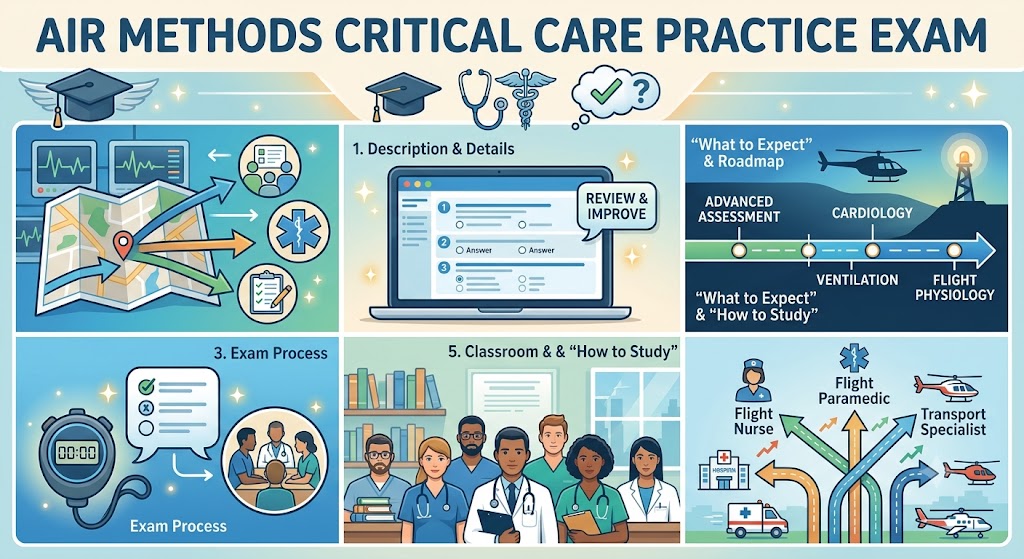
Additional Information
What the Course Entails and Exam Details
While not a standalone course itself, the practice exam
tests knowledge and skills that are fundamental to a comprehensive critical
care transport course and ongoing clinical competency at Air Methods. The core
topics reflected in the practice exam include, but are not limited to:
- Advanced
Patient Assessment and Management: Mastering complex medical and
trauma cases, focusing on multi-system analysis and dynamic intervention
strategies.
- Cardiology:
Advanced interpretation of ECGs, dynamic monitoring, and complex
pharmacology for cardiac emergencies in flight.
- Trauma
Care: Principles of prehospital trauma care, hemorrhage control, shock
management, and advanced stabilization techniques.
- Mechanical
Ventilation: In-depth understanding of ventilator settings, physiology
at altitude, and troubleshooting in a transport environment.
- Flight
Physiology: Specific knowledge on the effects of altitude and flight
on both the patient and the medical crew.
- Critical
Decision-Making: Case scenarios that require sound clinical reasoning
under stressful, time-sensitive conditions.
The practice exam typically mirrors the actual assessment’s
focus, and taking it multiple times can help identify knowledge gaps and boost
confidence before the critical, final evaluation. For the Air Methods external
candidates, the initial exam is often a rigorous Proctor-U online entry exam
followed by tabletop clinical scenarios.
What to Expect in the Final Exam
While the exact details of the final, official Air Methods
critical care assessment and ongoing competency evaluations are proprietary,
they are known for their high standards. This practice exam is structured to
give you a very realistic sense of what to expect, and can include elements that
prepare you for the typical format and content of an initial entry exam or
ongoing validation. Typically, a high level of proficiency and a passing score
are mandatory. Candidates can expect a strict time limit and a significant
number of multiple-choice questions, which often incorporate complex case
studies requiring synthesis and quick clinical judgment. The real evaluation
often includes practical components or tabletop scenarios, making deep
understanding and procedural skill critical.
How to Study and Exam Centers
Preparation for both the practice and actual exam requires
diligent study. Here are some actionable strategies:
- Take
the Practice Exam Repeatedly: Use this practice exam as a foundational
tool. Familiarize yourself with the question types and typical pacing.
Analyze the rationales provided for both correct and incorrect answers to
understand the required depth of knowledge.
- Focus
on Key Domains: The Air Methods internal assessment heavily covers
clinical areas such as Advanced Airway, Cardiology, Ventilation, and
complex trauma/medical cases, all in the context of transport medicine.
Review relevant guidelines, clinical practice protocols, and textbooks on
critical care transport.
- Review
Air Methods and Industry Standards: While Air Methods has its own
specific training, the concepts are aligned with national and
international standards in critical care and air medicine. Studying
materials related to the Certified Flight Paramedic (FP-C) or Certified
Flight Registered Nurse (CFRN) can be highly beneficial as the content
often overlaps.
- Actionable
Study Habits: Create a consistent study schedule, use flashcards for
definitions and core calculations, and actively participate in clinical
scenarios or high-fidelity simulation if available through your current
employer or training program.
- Accessing
the Practice and Real Exams: This practice exam is often accessed
through educational portals, test preparation services, or internally if
provided by Air Methods as part of the onboarding process. For the final,
official assessments (both the entry and ongoing competencies), these are
internally managed by Air Methods, often involving secure online
proctoring for initial entry tests and coordinated practical evaluations.
It is crucial to stay updated on the specific instructions provided during
your application or internal training for accurate access details. There
are no external dedicated physical exam centers like Pearson VUE for the
proprietary Air Methods internal competency tests; however, for the
external certifications (FP-C, CFRN) which can serve as great study
guides, exams are administered at various testing centers globally.
Job Opportunities from the Course
A successful performance on the Air Methods critical care
assessment and ongoing proficiency contributes to your readiness and competency
within the air medical transport field. While not an independent certification
course itself, it is a key component in securing and maintaining a career in
critical care transport. Potential roles include:
- Flight
Paramedic: A challenging role involving advanced patient care and
operational support on helicopter and fixed-wing missions.
- Flight
Nurse: Leading the clinical care and coordination for critically ill
and injured patients during air transport.
- Critical
Care Transport Specialist: Specific roles that emphasize complex,
interfacility transfers of critically ill patients.
- Air
Medical Crew Member (various roles): Contributing to the overall
safety and mission success as a skilled medical professional in the
transport environment.
- Clinical
Educator or Supervisor: In the long term, experienced flight
clinicians may advance into educational and leadership positions within
Air Methods or other air medical organizations.
By excelling in your training and mastering assessments like
the one this practice exam prepares you for, you open doors to rewarding and
highly skilled career paths in air medical transport, directly impacting
patient outcomes in critical situations.
Frequently Asked Questions
Reviews
5.0
Based on 0 reviews
Leave a Review
No reviews yet. Be the first to review!