
Air Law Practice Exam
$69.00
- Buy to unlock unlimited access to all Quiz questions.
- After purchase you can print a PDF of the whole quiz at any point. The PDF will contain the questions and the correct answers.
About this Exam
The Air Law Practice Exam is a powerful educational tool designed for aspiring aviators at all levels. Mastering aviation regulations is the critical foundation for safe and compliant flight operations. This practice exam simulates the rigorous knowledge requirements for pilot licensing (such as Private Pilot and Commercial Pilot), air traffic controllers, and other aviation professionals. It is designed to evaluate understanding of the complex legal frameworks governing global and national airspace, ensuring individuals are fully prepared for official examinations and real-world responsibilities.
Ready to test your knowledge?
Buy Now to Access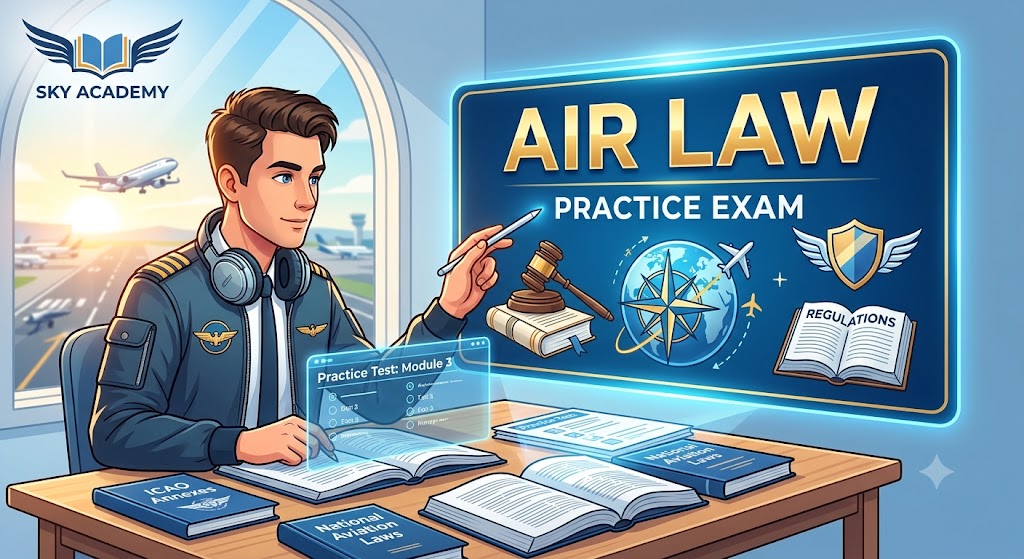
Additional Information
What the Course Entails and Exam Details
This practice resource focuses on high-yield topics
frequently encountered in official examinations mandated by civil aviation
authorities. The content is meticulously structured to build comprehensive
knowledge across several key areas: International Conventions (such as the
Chicago Convention); the organization and function of ICAO; essential National
Aviation Legislation and Regulations; fundamental Rules of the Air including
VFR and IFR procedures; detailed Airspace Classifications and services;
comprehensive protocols for Aircraft Nationality, Registration, and
Airworthiness; strict requirements for Personnel Licensing; precise procedures
for Incident and Accident Reporting; and modern Aviation Security protocols.
What to Expect in
the Final Exam
Official Air Law examinations are typically demanding
assessments that measure critical knowledge retention and application. Students
should expect a strictly proctored environment, whether administered in person
or online. The format is almost universally multiple-choice questions, covering
the full breadth of the syllabus. Exams are timed, requiring rapid recall and
accurate interpretation of regulations. Minimum passing scores are high, often
set at 75% or 80%. Electronic devices and unauthorized materials are prohibited
during the test. This practice exam allows students to acclimate to these
pressurized conditions, build speed, and identify specific knowledge gaps
before taking the official certification.
How to Study and Exam Centers
Effective preparation goes beyond simple memorization.
Candidates must understand the underlying rationale and practical application
of the rules. Study strategies should involve deep dives into official source
documents, such as ICAO Annexes and national aeronautical information
publications. Creating flashcards for key definitions and operational minima is
highly recommended. The most crucial method is repeated practice using diverse
question banks, strictly simulating timed exam conditions—the exact environment
this practice exam provides. Review all incorrect answers to target and
eliminate weaknesses.
When ready to sit for the official, final certification, candidates
must register through their relevant National Aviation Authority (e.g., FAA in
the US, EASA partners in Europe). Official exams are typically administered at
authorized physical testing centers, which may include dedicated computer-based
testing facilities or certified flight schools acting as assessment locations.
Consult the website of your Civil Aviation Authority (CAA) for specific
registration procedures and official center locations. The Air Law Practice
Exam itself is a flexible, online-accessible tool.
Job Opportunities
from the Course
A strong command of Air Law is a prerequisite and
foundational component for numerous prestigious and demanding careers in
aviation. Passing official regulatory exams unlocks extensive career pathways,
including:
- Commercial
Pilot (Airlines, Charter, Cargo)
- Private
Pilot
- Air
Traffic Controller
- Airline
Operations Manager
- Flight
Dispatcher
- Aviation
Safety Officer
- Accident
Investigator
- Regulatory
Compliance Specialist
- Civil
Aviation Authority Inspector
- Aircraft
Maintenance Engineer (Regulatory Focus)
This practice exam serves as a critical stepping stone to
achieving the necessary qualifications for these essential aviation roles.
Frequently Asked Questions
Reviews
5.0
Based on 0 reviews
Leave a Review
No reviews yet. Be the first to review!