
Air Force Tactical Communications Practice Exam
$69.00
- Buy to unlock unlimited access to all Quiz questions.
- After purchase you can print a PDF of the whole quiz at any point. The PDF will contain the questions and the correct answers.
About this Exam
Welcome to your essential first step toward mastering the Air Force Tactical Communications landscape. This practice exam is specifically designed to evaluate and enhance the readiness of Air Force personnel, potential recruits, and defense contractors aspiring to excel in specialized tactical communication roles.
The primary certification itself validates a service member's capability to deploy, operate, secure, and maintain critical communication systems in austere and dynamic tactical environments. It is designed for individuals seeking to join or advance within communication squadrons, combat communications units, or specialized teams where reliable, secure data and voice transmission is non-negotiable. Passing this practice exam and the subsequent qualification demonstrates proficiency in executing complex communication plans essential for mission success across all domains.
Ready to test your knowledge?
Buy Now to Access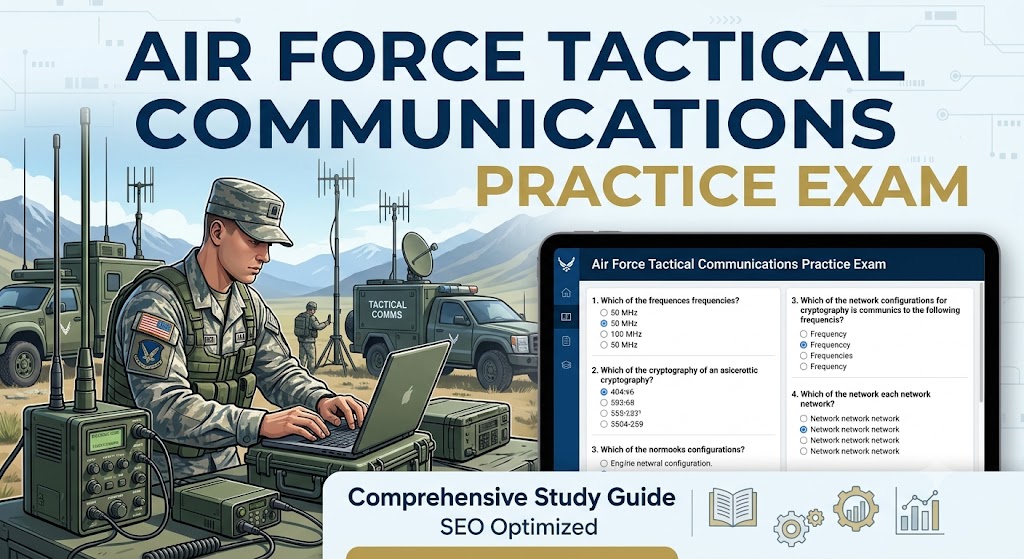
Additional Information
What the Course Entails and Exam Details
This practice assessment, mirroring the comprehensive nature
of tactical communications training, covers a wide array of vital topics.
Mastery of these areas is crucial for operating effectively in the field:
- Radio
Frequency (RF) Systems: Principles of HF, VHF, UHF, and satellite
communication (SATCOM) systems, equipment operation, and antenna theory.
- Networking
in Tactical Environments: Setting up, configuring, and maintaining
secure tactical networks, including tactical data links (TDLs) and
satellite terminals.
- Cryptographic
& Secure Communications: Implementation of advanced encryption
systems, information assurance practices, and adherence to communication
security (COMSEC) protocols.
- Satellite
Communications (SATCOM): Operation, troubleshooting, and optimization
of tactical SATCOM terminals and services.
- Troubleshooting
& Field Maintenance: Rapid diagnostics and repair of diverse
communication equipment and networks under pressure.
- Mission
Planning & Integration: Developing and executing communication
plans that integrate with broader operational directives.
- Safety
& Compliance: Strict adherence to safety standards,
electromagnetic spectrum management, and operational regulations.
What to Expect in
the Final Exam
While formats can vary, the actual Air Force Tactical
Communications qualification exam, which this practice test simulates,
typically consists of:
- Multiple-Choice
Questions: A substantial section designed to test your theoretical
knowledge, recall of specific technical details, doctrine, and
problem-solving abilities.
- Performance-Based/Practical
Application (Potentially): In many military certifications,
theoretical knowledge is paired with practical evaluation. Note: This
practice exam primarily focuses on simulating the comprehensive
multiple-choice knowledge assessment portion. The final qualification
may require you to demonstrate proficiency in configuring equipment or
networks.
- Passing
Score: The required score to pass is often rigorous, reflecting the
critical nature of the skill, typically in the range of 70% to 80% or
higher.
- Time
Limit: Expect a strict time limit (e.g., 60-120 minutes for a
comprehensive multiple-choice section), demanding efficiency and
decisiveness under pressure.
How to Study and
Exam Centers
How to Study Effectively:
Utilize This Practice Exam:
Treat each attempt as a real simulation. Analyze your results, identify weak
areas, and focus your study efforts. Retake the exam to track improvement and
build confidence.
Review Official Materials:
Deeply study all official Air Force technical manuals, doctrine documents,
training guides, and lesson plans related to tactical communications. These are
your primary sources.
Hands-on Practice:
Whenever possible, dedicate time to practical, hands-on experience with the
specific radio systems, network equipment, and cryptographic devices you will
be responsible for. Nothing replaces practical application.
Form Study Groups:
Collaborating with fellow service members can expose you to different
perspectives, problem-solving techniques, and shared knowledge.
Create Flashcards: Use
flashcards for acronyms, key frequencies, procedure steps, and technical
specifications.
Simulate Under Pressure:
As you gain confidence, try answering practice questions and performing tasks
within realistic time constraints to build speed and accuracy.
Exam Centers:
- Air
Force Testing Centers: The official qualification exam is typically
administered at dedicated testing facilities located on Air Force
installations worldwide, often managed by communication squadrons or base
education and training offices.
- Authorized
Training Schools: For service members completing relevant
communication courses (e.g., at Keesler AFB), the certification may be
part of the curriculum and administered on-site.
- Defense
Activity for Non-Traditional Education Support (DANTES): In some
cases, and for specific certifications, DANTES-sponsored testing centers
or proctors may be utilized. Always confirm the specific testing
procedures and locations with your unit training manager or education
office.
- Practice
Exam Availability: This particular practice exam is accessible
through this educational platform, allowing you to study anywhere with
internet access.
- Job Opportunities from the Course
Successfully navigating the rigorous training and
certification process in Air Force Tactical Communications unlocks significant
career paths, particularly within the military and defense sectors.
- Tactical
Communications Specialist: Directly operating and maintaining
communication systems in combat and field environments.
- Combat
Communications Officer/Enlisted: Leading or serving in units dedicated
to rapidly deploying communications infrastructure worldwide.
- Network
Systems Administrator (Tactical): Configuring and managing secure
networks in challenging operational locations.
- RF
Transmission Systems Specialist: Specialized expertise in managing and
troubleshooting radio frequency systems.
- SATCOM
Operator/Technician: Focused on deploying and maintaining satellite
communication links and terminals.
- Cyber
Systems Operations: Roles integrating cyber security practices with
tactical communication networks.
- Information
Assurance/COMSEC Manager: Ensuring the security and integrity of
sensitive communication data and encryption systems.
- Defense
Contractor/Technical Support: Post-military opportunities leveraging
your expertise to support defense industry projects or provide specialized
communication support.
- Special
Operations Communications: Highly specialized roles supporting elite
units with critical, secure communications.
By dedicating yourself to thorough preparation using this
guide and practice exam, you are taking a crucial step towards a rewarding and
vital career in Air Force Tactical Communications. Stay focused, practice
diligently, and trust in your training. Good luck!
Frequently Asked Questions
Reviews
5.0
Based on 0 reviews
Leave a Review
No reviews yet. Be the first to review!