
Air Force Munitions Management Practice Test
$69.00
- Buy to unlock unlimited access to all Quiz questions.
- After purchase you can print a PDF of the whole quiz at any point. The PDF will contain the questions and the correct answers.
About this Exam
The Air Force Munitions Management designation is a crucial component of the U.S. Air Force’s logistics and operational capability, specifically tailored for Airmen in the Munitions Systems specialty (commonly referred to as 'AMMO', AFSC 2W0X1). This certification validates an individual's proficiency in the complete lifecycle of non-nuclear munitions, guided weapons, and associated equipment. It ensures that personnel can safely and efficiently receive, identify, inspect, store, re-warehouse, handle, transport, and dispose of these critical assets, which are essential for maintaining the Air Force’s combat readiness. This program is designed for enlisted Airmen moving through their career field, typically from Apprentice (3-level) to Journeyman (5-level) and Craftsman (7-level). It signifies a high level of technical skill and commitment to safety, which is paramount when handling explosive materials in a high-stakes military environment.
Ready to test your knowledge?
Buy Now to Access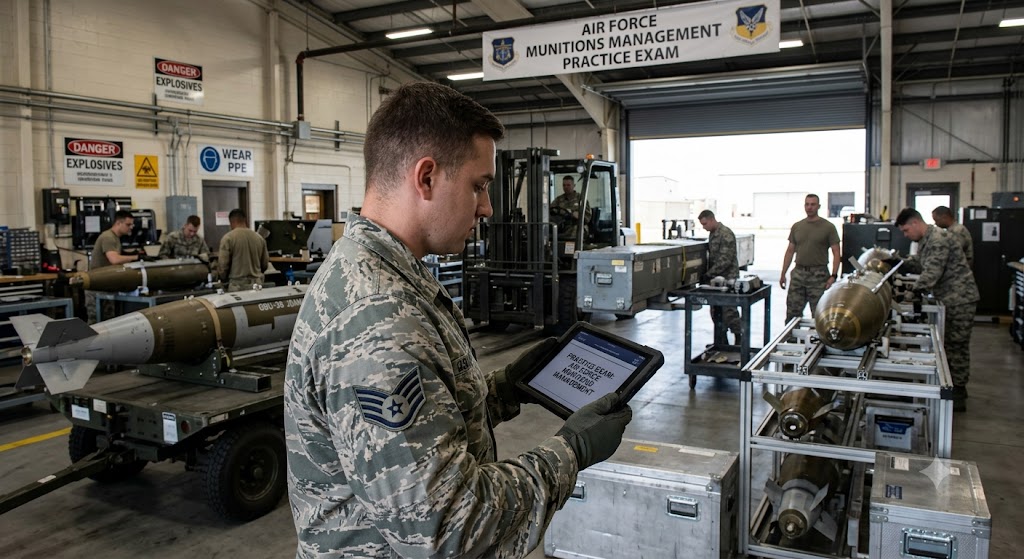
Additional Information
What the Course Entails and Exam Details
The comprehensive course curriculum covers a
vast array of technical and safety procedures detailed in extensive Technical
Orders (TOs) and Air Force Manuals (AFMANs). Core topics include:
- Munitions
Accounting and Documentation: Utilizing systems like the Combat
Ammunition System (CAS) for precise tracking and inventory control,
including FMS (Foreign Military Sales) procedures.
- Storage
and Physical Security: Implementing strict protocols for the
safe storage of diverse munitions, ensuring compliance with Net Explosive
Weight (NEW) limits, and maintaining rigorous physical security measures
for weapons storage areas.
- Inspection
Procedures: Mastering techniques for inspecting
incoming and outgoing munitions shipments, evaluating the serviceability
of components, and identifying damage or defects in sensitive guidance
systems.
- Explosive
Safety and Hazards: Deep understanding of AFMAN 91-201, Explosives
Safety Standards, including quantity-distance criteria, hazard
classification, and emergency response procedures for explosive mishaps.
- Munitions
Handling and Transportation: Utilizing specialized Ground Support
Equipment (GSE) and vehicles for the safe movement of munitions within the
base and to the flight line.
- Assembly
and Disassembly: Procedures for building up and tearing
down conventional munitions, including precision-guided bombs (like JDAMs
and GBUs) and missile systems (like AIM-9 and AIM-120).
- Maintenance
of Associated Equipment: Managing the maintenance and inspection
schedules for the specialized trailers, bomb racks, and handling gear
essential to the mission.
The course involves both significant written
study of technical publications and rigorous hands-on training (On-the-Job
Training, or OJT) under the supervision of qualified NCOs. The exam details can
vary depending on whether it is a Career Development Course (CDC) Volume Exam
or an upgrade evaluation, but it is fundamentally designed to test the
application of these concepts.
What to Expect in the Final Exam
When preparing for the final evaluation,
students should anticipate a structure designed to simulate both written
knowledge and practical application.
- Format: The
primary evaluation for the Air Force Munitions Management designation
involves multiple-choice questions administered through the Air Force's
established testing channels. These questions are based on specific
Technical Orders (TOs) and Air Force Instructions (AFIs) covered during
training.
- Practical
Component: In addition to the written exam,
successful completion of the upgrade often requires a practical hands-on
evaluation known as a "go/no-go" task evaluation, where an
Airman must flawlessly demonstrate specific tasks (like assembling a
specific munition or operating a piece of GSE) in front of an evaluator, often
a Quality Assurance (QA) inspector or a designated trainer.
- Passing
Score: The required passing score for CDC
examinations is typically 65% for satisfactory completion, but achieving
higher scores is encouraged for career progression. Practical evaluations
must be 100?curate and safe; there is no margin for error when handling
explosives.
- Time
Limits: Time limits for the written exam are
established based on the specific test volume being administered, typically
ranging from 90 minutes to several hours. Practical evaluations are
time-sensitive but emphasize safety over speed.
- Specific
Rules: Strict adherence to safety protocols is
the most critical rule during all phases of the evaluation. Failure to
follow a primary safety guideline during a practical evaluation results in
an immediate failure (a "critical bust"). The written exam is a
controlled, closed-book test.
- How to Study and Exam Centers
Preparation for this demanding evaluation
requires a proactive and multifaceted study strategy.
- Analyze
the Material: Your primary resource will be your
Career Development Courses (CDCs), Technical Orders, and AFMANs. Do not
just read; analyze. Highlight key safety steps, explosive classifications,
and procedure steps. Create acronyms and mnemonics for complex sequences.
- Complete
All Review Questions: Methodically answer every review
question and unit self-test within your CDCs. These are direct indicators
of the types of questions that will appear on the final exam.
- Maximize
On-the-Job Training (OJT): Pay extreme attention during practical
training sessions. Treat every practice run like the final evaluation. Ask
your supervisor or NCOIC for detailed feedback and run through procedures
repeatedly until they become second nature.
- Use
Flashcards and Practice Tests: Utilize authorized online flashcard
platforms or military-specific study apps that feature questions derived
from the official AFSC 2W0X1 curriculum. Practice exams are invaluable for
gauging your readiness and identifying weak points.
- Exam
Centers: CDC exams are typically administered at
your assigned installation's Base Training Office (BTO) or a designated
controlled testing facility on base. Practical evaluations take place
within your unit's functional area (the Munitions Storage Area or flight
line hanger). You must coordinate with your Unit Training Manager (UTM) to
schedule both parts of the evaluation once you are recommended by your supervisor.
- Job Opportunities from the Course
Achieving proficiency and certification in Air
Force Munitions Management opens numerous specialized career paths within the
military and eventually in the civilian sector. Successful Airmen can advance
to significant responsibilities:
- Munitions
Systems Journeyman/Craftsman (Ammo)
- Conventional
Munitions Maintenance Specialist
- Precision
Guided Munitions (PGM) Technician
- Munitions
Operations Specialist (Accounting and Documentation)
- Quality
Assurance (QA) Evaluator for Munitions
- Combat
Arms Instructor (requires additional specialized training)
- Explosive
Ordnance Disposal (EOD) Apprentice (requires cross-training and
significant additional school)
- Air
Force Logistics Plans and Integration Specialist
- Civilian
Aerospace Defense Contractor (e.g., managing logistics or maintenance for
defense companies)
- Defense
Logistics Agency (DLA) Munitions Manager
Achieving the Air Force Munitions Management
designation signifies not just technical knowledge, but a disciplined
commitment to a core combat capability, marking you as a vital asset to any
operational unit. Good luck with your preparation.
Frequently Asked Questions
Reviews
5.0
Based on 0 reviews
Leave a Review
No reviews yet. Be the first to review!