
Air Force End of Course (EOC) Practice Exam
$69.00
- Buy to unlock unlimited access to all Quiz questions.
- After purchase you can print a PDF of the whole quiz at any point. The PDF will contain the questions and the correct answers.
About this Exam
The Air Force End of Course (EOC) assessment is a critical checkpoint for many Airmen, marking the culmination of various forms of training, including technical schools and career progression courses. It serves as a formal evaluation of an individual's knowledge, skills, and readiness in a specific discipline within the United States Air Force. Crucially, these exams are not just a hurdle but a validation of required competencies, and for those in Career Development Courses (CDCs), they are often mandatory for essential skill-level upgrades, such as achieving a 5-skill or 7-skill level in a chosen career field. This study guide is designed to help you, as a motivated member of the Air Force, effectively prepare for and succeed on your Air Force EOC exam by providing insights and actionable strategies based on common practices and exam structures. Remember, a robust preparation process, which includes taking this type of practice exam, can significantly boost your confidence and chances of success on the high-stakes final test. This practice exam and study guide are not official materials from the Air Force but are created as general learning and preparation tools.
Ready to test your knowledge?
Buy Now to Access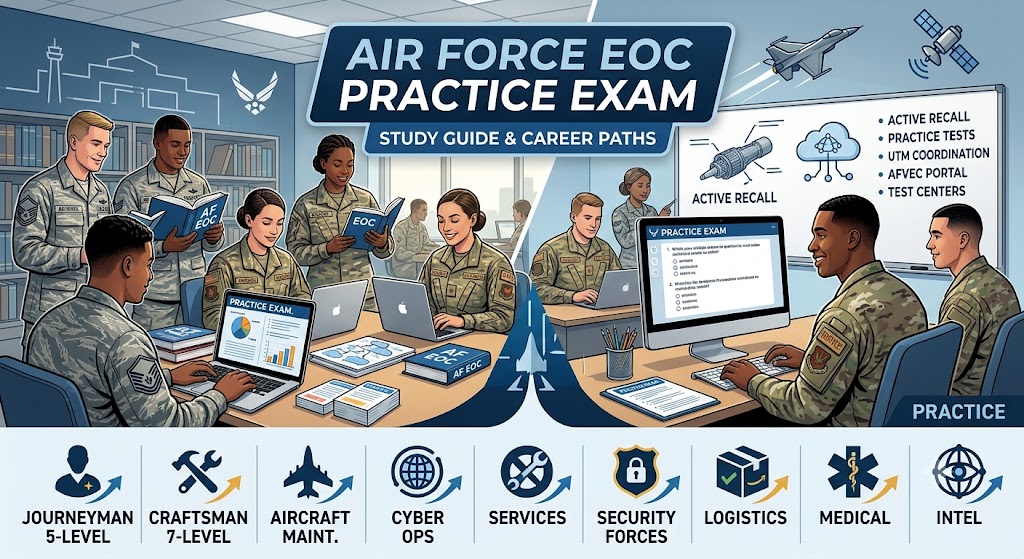
Additional Information
What the Course
Entails and Exam Details
Air Force courses culminating in an EOC exam cover a wide
and varied spectrum of subjects depending on your Air Force Specialty Code
(AFSC) and career stage. A typical structure for such an exam would involve
evaluating knowledge gained from the course's comprehensive syllabus. Common
modules might include foundational principles of aerospace, technical
proficiency in your specific role (e.g., engine maintenance, network
operations, security protocols), military history, leadership concepts, and
regulatory procedures relevant to your career field. The specific content will
align with standard specialty training and standard-level requirements, aiming
to ensure you possess the necessary theoretical understanding and practical
awareness before being certified in a new skill level or progressing in your
role. The corresponding EOC What to Expect in the Final Exam
While specific details can vary by course and command, most
Air Force EOC exams follow a structured, objective format. The core structure
is frequently multiple-choice questions, supplemented perhaps by some
true/false or scenario-based problems, all designed to rigorously test your
recall and application of the course material. You can expect a professional,
quiet testing environment, often controlled by a Test Control Facility. The
passing score is typically a set percentage, for example, 65% or higher,
although you must consult your specific course instructions for the exact
requirement. You will also be subject to a time limit, designed to assess not
only your knowledge but also your ability to recall information under standard
operational time constraints. Be aware that most EOC exams have a limited
number of allowed attempts (often two), and failing multiple times may result
in formal procedures. Therefore, it is imperative to take the first attempt
seriously and use tools like a practice exam for optimal readiness.
How to Study and
Exam Centers
Effective study for an Air Force EOC requires consistent
dedication and strategic planning. A comprehensive approach involves:
- Active
Recall: Create and use flashcards for definitions, acronyms, and key
technical steps.
- Relate
& Apply: Relate theoretical knowledge to your everyday job duties
to make it more meaningful.
- Utilize
Official Materials: Thoroughly review all assigned course volumes,
manuals, and study guides.
- Practice,
Practice, Practice: Engage with multiple practice questions and
simulated exams, like the one this guide supports, to understand question
types, test-taking pacing, and identify knowledge gaps. Re-study the areas
where you underperform.
- Stay
Organized: Create a structured study schedule and stick to it,
dedicating focused time daily.
- Seek
Clarification: Never hesitate to ask supervisors or subject matter
experts within your unit for clarification on challenging topics.
For the final exam, you will likely take it at an authorized
Test Control Facility or Education & Training Center located on your Air
Force installation. These locations are strictly controlled and often
coordinate directly with your Unit Training Manager (UTM). Some exams might be
administered through standard online portals and physical sites like specific
Pearson VUE centers for certain types of military certifications or promotional
tests, always following strict scheduling and ID verification. Always verify
your specific exam’s location, scheduling procedures, and allowed materials
with your UTM well in advance of your desired test date.
Job Opportunities
from the Course
Successfully passing your Air Force EOC exam unlocks
significant opportunities within the United States Air Force and demonstrates
capabilities transferable to the civilian world. Key career advancement points
and job opportunities include:
- Air
Force Specialty Code (AFSC) Specific Journeyman (5-Level) and Craftsman (7-Level)
Skill Upgrade Points
- Progression
to NCO and SNCO Ranks (Staff Sergeant, Technical Sergeant, Master
Sergeant, etc.)
- Specific
technical roles in Aircraft Maintenance (e.g., Jet Engine Mechanic,
Avionics Technician)
- Advanced
positions in Cyberspace Operations and Network Administration
- Leadership
roles within Services, Logistics, and Personnel management
- Specialized
duties in Medical Services and Healthcare fields
- Intelligence
Analysis and Security Forces positions
- Roles
in Engineering and Facility Management
- Post-military
technical and management positions across varied civilian industries and
government agencies. Passing these exams is the gateway to
demonstrating mastery, fulfilling essential requirements, and unlocking a
spectrum of rewarding career paths.
Frequently Asked Questions
Reviews
5.0
Based on 0 reviews
Leave a Review
No reviews yet. Be the first to review!