
Air Evacuation Practice Test
$69.00
- Buy to unlock unlimited access to all Quiz questions.
- After purchase you can print a PDF of the whole quiz at any point. The PDF will contain the questions and the correct answers.
About this Exam
This article provides a comprehensive study guide for the Air Evacuation Certification Practice Exam, a critical evaluation tool for healthcare professionals pursuing advanced qualifications in aeromedical transport.
This certification validates the specialized knowledge and skills required to provide critical care and medical transport for patients via aircraft, including helicopters and fixed-wing planes.
It is designed for registered nurses, paramedics, physicians, and other qualified medical practitioners who are looking to enter or advance within the demanding field of flight medicine or medical evacuation. Preparing with practice exams helps candidates assess their readiness and improve their chances of success on the final certification test.
Ready to test your knowledge?
Buy Now to Access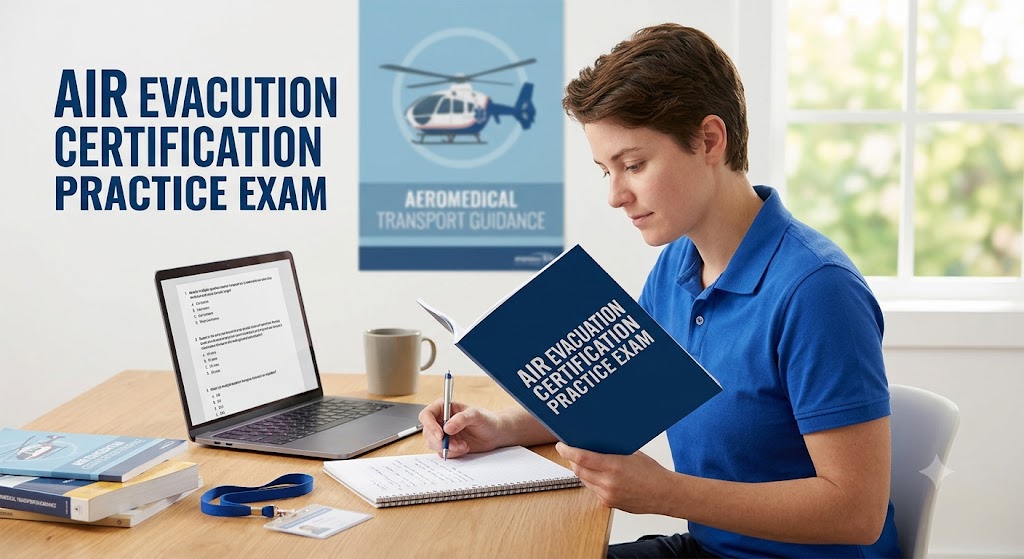
Additional Information
What the Course Entails and Exam Details
To succeed on the Air Evacuation Certification,
candidates must master a diverse curriculum that addresses the unique
challenges of the flight environment.
The foundational material typically covers advanced patient
assessment and stabilization, deep understanding of aeromedical physiology
(e.g., the effects of altitude, barometric pressure, and G-forces on patients),
and specialized medical equipment for flight transport.
Coursework also includes critical care transport protocols
for various patient populations (adult, pediatric, neonatal), aircraft safety
and operational procedures, flight crew coordination, risk management, and
ethical considerations in aeromedical operations. The exam details are
structured around assessing this range of theoretical and practical knowledge.
What to Expect in the Final Exam
The final exam for the Air Evacuation Certification
generally follows a standardized format, with variations depending on the
specific certifying body (such as CAMTS-related programs or regional
equivalents).
It is typically a timed, multiple-choice examination
designed to test theoretical knowledge, critical thinking, and application of
protocols.
The number of questions can vary, often ranging from 100 to
150. Time limits are typically set for several hours.
A specific passing score, often around 70% to 80%, is
required to receive the certification. Some certifications may also include a
practical or scenario-based assessment component, evaluating hands-on skills in
a simulated or real flight environment. Candidates are usually required to
present valid identification and may need to complete the exam at proctored
locations.
How to Study and Exam Centers
Effectively preparing for the Air Evacuation
Certification Practice Exam involves a strategic study plan.
Utilize Practice Tests:
Leverage practice exams as a core study method to identify knowledge gaps,
practice time management, and simulate the actual testing experience. Analyze
both correct and incorrect answers.
Study Core Material: Review
official study guides, textbooks, and course materials provided by the
certifying body or approved education providers. Focus heavily on aeromedical
physiology and critical care protocols.
Create Flashcards:
Memorize key formulas, acronyms, procedures, and physiological effects using
flashcards.
Join Study Groups:
Collaborate with peers also preparing for the exam to discuss challenging
concepts and share resources.Hands-on Practice: If possible, participate
in skill labs or simulation training to reinforce practical knowledge related
to flight equipment and protocols.
Candidates can take the exam through various means.
Many certifying organizations offer online proctored exams
through secure platforms. Alternatively, exams may be administered at dedicated
testing centers or authorized training institutions.
Practical assessments are often conducted at specific
training facilities. Check the official website of the certification provider
for detailed instructions on registration, scheduling, and available testing
locations.
Job Opportunities from the Course
Achieving the Air Evacuation Certification opens up
numerous specialized and rewarding career opportunities in medical transport.
The credential is often required or strongly preferred for several key
positions.
- Flight
Nurse
- Flight
Paramedic
- Flight
Physician
- Aeromedical
Transport Coordinator
- Critical
Care Transport Team Leader
- Emergency
Medical Services (EMS) Administrator
- Hospital-based
Critical Care Transport Specialist
These roles exist within various organizations, including
helicopter emergency medical services (HEMS), fixed-wing air ambulance
companies, military medical units, disaster response teams, and large
healthcare systems with dedicated critical care transport programs. Obtaining
this certification enhances employability and career progression in the field
of transport medicine.
Frequently Asked Questions
Reviews
5.0
Based on 0 reviews
Leave a Review
No reviews yet. Be the first to review!