
Air Diving Supervisor Practice Exam
$69.00
- Buy to unlock unlimited access to all Quiz questions.
- After purchase you can print a PDF of the whole quiz at any point. The PDF will contain the questions and the correct answers.
About this Exam
The Air Diving Supervisor certification is a pivotal credential for commercial divers aiming to elevate their careers and take on leadership roles in the challenging and high-stakes world of offshore and coastal diving. This certification validates a professional's competency in overseeing surface-supplied air diving operations, ensuring the safety of personnel, and managing all technical and operational aspects of a dive project. It is meticulously designed for experienced commercial air divers who have accumulated significant field experience and are ready to assume the safety-critical responsibilities of a supervisor, acting as the designated "Person in Charge" on the dive site
Ready to test your knowledge?
Buy Now to Access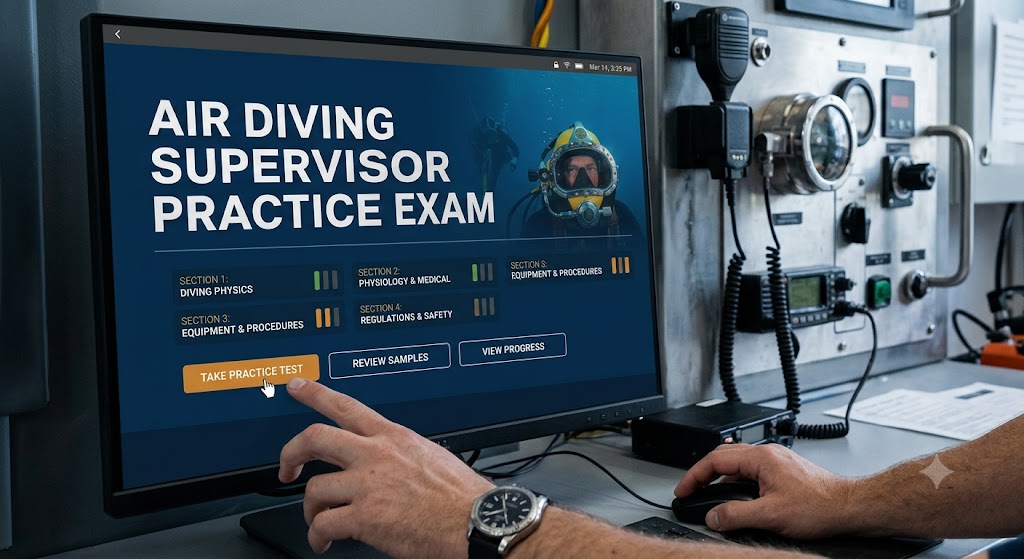
Additional Information
What the Course Entails and Exam Details
This is not a standalone course but rather a culmination of
prerequisites and a rigorous final examination. The required preparatory path
usually involves passing an approved Air Diving Supervisor training course, which
builds upon the foundation of commercial diving training. The curriculum covers
a broad and deep syllabus critical for supervisory competence. Key areas of
focus typically include advanced diving physics (such as gas laws and partial
pressures), diving physiology and the management of diving-related injuries
(like decompression sickness and barotrauma), and leadership and control of the
dive team.
Furthermore, candidates must demonstrate thorough knowledge
of working methods and safe procedures for commonly used tools and equipment,
along with personnel requirements, project management, and operational
planning. A significant portion of the syllabus is dedicated to legal and
regulatory compliance, proper documentation (such as logbooks and checklists),
and a meticulous understanding of environmental conditions that impact diving
safety. This comprehensive knowledge base ensures that a supervisor can not
only execute a dive plan but also adapt and respond effectively to emergencies.
What to Expect in the Final Exam
The final exam to become a certified Air Diving Supervisor
is notoriously challenging and is typically administered by internationally
recognized bodies such as the International Marine Contractors Association
(IMCA) or the Association of Diving Contractors International (ADCI). The
current generation of examinations, particularly those from IMCA, are generated
from a question bank, meaning no two tests are identical, and they are
frequently delivered electronically.
Candidates should expect the final exam to be primarily a
written evaluation, often structured with a significant emphasis on
multiple-choice questions (MCQs) and scenario-based assessments to test the
application of knowledge. The exam is usually divided into core sections. For
instance, the IMCA Air Diving Supervisor exam is notably split into Diving
Physics (approx. 25 questions), Diving Physiology (approx. 25 questions), and
Working Practices (approx. 50 questions). Candidates are typically required to
achieve a passing score of at least 70% in each individual section, not just as
an overall average, to demonstrate total competency. The exam will include
calculations, and candidates will be allowed the use of an online calculator in
electronic formats.
How to Study and Exam Centers
Effective preparation for this exam requires a multi-faceted
approach. First and foremost, candidates must study the core guidance documents
from the certifying body. For example, IMCA D022, "Guidance for Diving
Supervisors," and other related D-series documents are essential reading.
A thorough understanding of diving physics calculations is paramount;
candidates should be able to confidently answer any practice physics questions.
Utilizing online platforms for timed, full-length practice exams is highly
recommended. This strategy helps with time management, familiarity with the
electronic exam format, and identifying weak areas. Forming or joining a study
group can also provide diverse perspectives on operational scenarios.
Regarding exam centers, this certification requires
candidates to sit the exam in a controlled, invigilated environment. It is not
an 'at-home' online exam. Exams are hosted globally through a network of
specialized, authorized test centers or approved diving schools. These centers
are located in key commercial diving hubs around the world, such as in the
United Kingdom, the United States, Singapore, South Africa, and the United Arab
Emirates. For IMCA certifications, examinations are often coordinated in
collaboration with a specialist invigilation partner and must be applied for
through a sponsoring diving contractor.
Job Opportunities from the Course
Earning the Air Diving Supervisor certification
significantly expands a commercial diver's career potential. It is a recognized
mark of expertise and responsibility that opens doors to higher-level positions
and increased earning potential within the global subsea industry. The critical
skills and experience validated by this certification are transferable, leading
to various career pathways.
- Air
Diving Supervisor
- Offshore
Diving Supervisor
- Onshore
Diving Supervisor
- Diving
Superintendent
- Dive
Project Manager
- Diving
Operations Manager
- Dive
Safety Officer
- Life
Support Technician (LST) (with further specific training)
- Client
Representative for Diving Operations
- Diver
Medic Technician (DMT) and Trainer
- Technical
Adviser for Diving Subsea Engineering
This certification unlocks a career path where safety and
expertise are paramount, providing a platform to lead teams and manage complex
projects in the energy, construction, and marine sectors.
Frequently Asked Questions
Reviews
5.0
Based on 0 reviews
Leave a Review
No reviews yet. Be the first to review!