
Air Defense Battle Management System (MOS 14G) Training Practice Test
$69.00
- Buy to unlock unlimited access to all Quiz questions.
- After purchase you can print a PDF of the whole quiz at any point. The PDF will contain the questions and the correct answers.
About this Exam
The Air Defense Battle Management System Operator (MOS 14G) role is a critical position within the United States Army. It involves the integration, operation, and maintenance of some of the military's most advanced technology to protect ground forces and vital assets from aerial, missile, and drone threats.
Ready to test your knowledge?
Buy Now to Access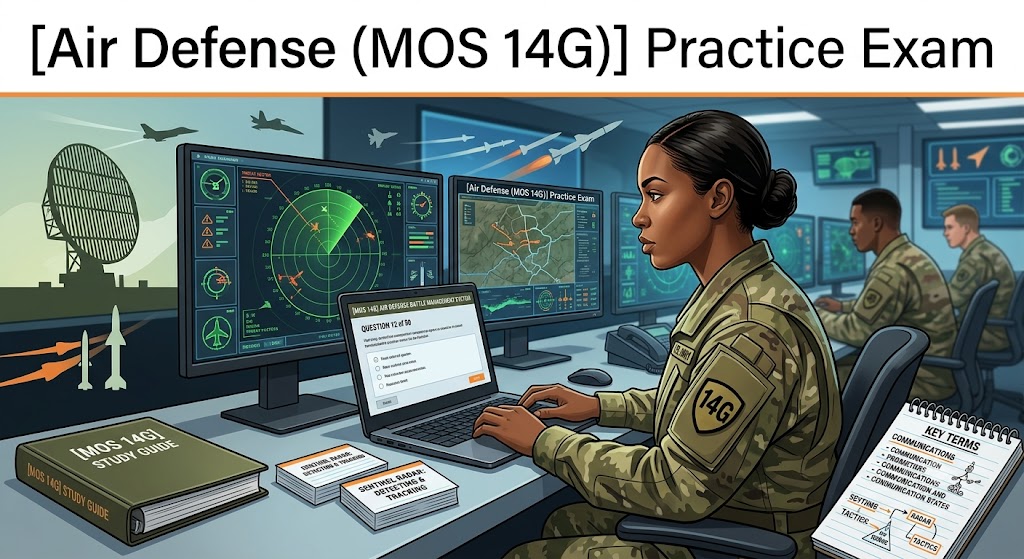
Additional Information
What the Course Entails and Exam Details
The MOS 14G training sequence is an intensive program
involving classroom instruction and field simulations. The subsequent exams and
practice tests are designed to evaluate proficiency in several key domains:
- System
Operations: Demonstrating in-depth knowledge of how to operate and
troubleshoot critical systems like the Sentinel Radar and associated
battle command systems (e.g., FAAD, C-RAM). This includes system
initialization, mode selection, configuration, and data management.
- Networking
and Communications: Understanding and implementing tactical data
links, local and wide area networks (LAN/WAN), and various communication
protocols to ensure seamless sharing of information within the air defense
network and with joint or allied services.
- Threat
Identification and Analysis: Developing the ability to interpret
complex radar data, evaluate intelligence, and distinguish between
friendly, hostile, and unknown targets.
- Airspace
Management and Rules of Engagement: Applying understanding of airspace
control measures, deconfliction procedures, and established military rules
for engaging detected threats.
- Tactics,
Techniques, and Procedures (TTPs): Demonstrating fluency in Air
Defense Artillery tactics and standard operational procedures required for
success in varied combat environments.
What to Expect in
the Final Exam
While a final exam practice test is designed to
simulate this final challenge, it's essential to understand the typical
structure of the official Army evaluation you will encounter at the end of your
MOS 14G training:
- Multiple-Choice
Component: This section will test your knowledge of theoretical
concepts, specific system technical details, Army regulations, tactics,
and operational procedures. Questions will range from system specs and
maintenance routines to scenario-based application of rules. Expect
detailed, fact-based questions demanding accuracy.
- Practical
or Simulated Component: A significant part of the evaluation involves
demonstrating your ability to physically (or via a realistic simulation)
operate and troubleshoot the equipment. You may be asked to initialize a
system within a time limit, manage a simulated battle scenario, configure
a network, or diagnose a specific fault. These are hands-on, high-pressure
assessments.
- Passing
Score and Time Limits: Military exams typically have strict passing
standards, often requiring a substantial score (e.g., 80% or higher, and
sometimes 100% on safety-critical tasks) to ensure readiness. Both the
multiple-choice and practical sections are likely to have time limits to
simulate the real-world operational pressure of the MOS 14G role. Prepare
to work efficiently.
- Strict
Security and Protocol: Official military exams are administered under
strict control to maintain test integrity and ensure consistent standards.
Access to reference materials is usually restricted, and adherence to
specific military procedures is paramount. A good practice test will
mimic this structured, rigorous environment and the pressure of working
within these constraints.
How to Study and
Exam Centers
Preparation for the MOS 14G exams requires a multifaceted
approach:
Actionable Study Strategies:
- Utilize
Official Materials: Focus your studying on provided Army Field
Manuals, Technical Manuals, training guides, and classroom materials.
These are the gold standard of information.
- Take
Detailed Notes and Create Flashcards: Document key concepts, system
procedures, technical specifications, and procedural steps during training
and when reviewing materials. Flashcards are excellent for memorizing
technical details and protocols.
- Engage
in Simulation Training: Military training programs often utilize
advanced simulations. Take every opportunity to practice system operations
and scenario-based decision-making in a virtual environment.
- Form
Study Groups: Collaborating with your peers allows you to test each
other, review difficult topics from different perspectives, and practice
procedural verbalization.
- Review
and Retake Practice Tests: This is one of the most effective
strategies. Continuously utilize quality practice questions and
full-length practice exams to simulate the exam experience, identify weak
points, and build confidence.
Exam Centers and Procedures:
- Location:
The actual MOS 14G training, subsequent exams, and many associated
practice assessments are administered exclusively at specific United
States Army training installations and within assigned military units
(such as the Fires Center of Excellence at Fort Sill, Oklahoma, or later
operational bases). They are not taken at civilian testing centers or
general online portals like Pearson VUE.
- Process:
Your training command will schedule your official exams as you progress
through the course modules and towards final certification. Access to any
relevant practice materials or tests is typically provided through
official military study platforms or directly by your instructors and
chain of command during training. Utilize these official channels
effectively. Consult your training schedule and command for specific
dates and procedures. Practice tests are most effectively used throughout
training as a way to continuously evaluate your understanding before the
high-stakes final evaluation.
Job Opportunities
from the Course
Upon successful completion of the MOS 14G training and
passing all associated evaluations, a soldier is qualified to work as an Air
Defense Battle Management System Operator and opens various career paths and
leadership opportunities:
- MOS
14G Operator
- Air
Defense Systems Specialist
- Air
Defense Team Leader
- Air
Defense Squad Leader
- Air
Defense Platoon Sergeant
- Transition
roles (potentially with experience and relevant certifications):
- Radar
Systems Technician
- Air
Traffic Controller (requiring FAA certification)
- Network
Operations Analyst
- Defense
Contractor Roles (technical, operational)
- System
Technical Support & Maintenance
Encouragement:
<!--[if mso & !supportInlineShapes & supportFields]> SHAPE \* MERGEFORMAT <![endif]--><!--[if gte vml 1]>
Congratulations on pursuing this challenging and crucial
specialization in the US Army! Preparation and mastery of the complex systems
you operate are paramount. Remember that your training, and the testing you
encounter, is structured to ensure your excellence and safety, and that of your
fellow soldiers. Use these tools, stay dedicated, utilize your resources, and
approach your exams with the confidence and precision required of an Air
Defense expert. Good luck!
Frequently Asked Questions
Reviews
5.0
Based on 0 reviews
Leave a Review
No reviews yet. Be the first to review!