
Air Assault School Phase 2 Practice Test
$69.00
- Buy to unlock unlimited access to all Quiz questions.
- After purchase you can print a PDF of the whole quiz at any point. The PDF will contain the questions and the correct answers.
About this Exam
Master Air Assault Phase 2 with this complete study guide. Welcome to the challenge of Air Assault School's daunting second phase! If you've conquered the physical and academic demands of Phase 1, you're now stepping into the practical application where true skill and precision are forged. Air Assault School Phase 2 is designed specifically for dedicated military personnel aiming to become experts in rapid helicopter deployment techniques, focusing heavily on slingload operations and rappelling. It’s an intense, hands-on testing ground where safety, speed, and exact execution are paramount, separating those who know from those who can do. This guide is your crucial companion, preparing you for the rigorous practical exams that await you in this demanding and rewarding phase.
Ready to test your knowledge?
Buy Now to Access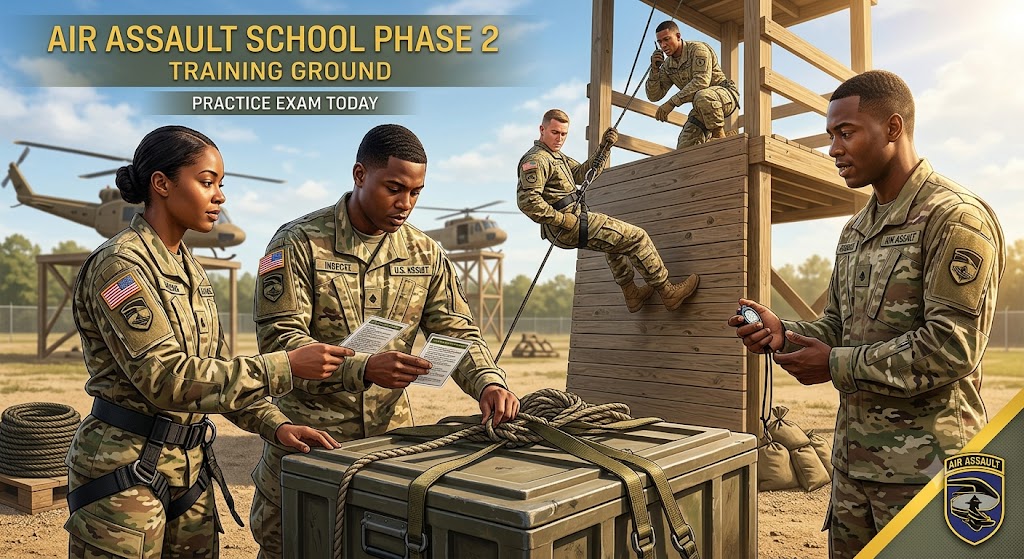
Additional Information
What the Course Entails and Exam Details
This section of Air Assault School strictly focuses on
critical practical skills required for air assault operations. You will move
from classroom learning to demanding field environments, where every move is
watched and graded. The core topics covered in Phase 2 include:
- Slingload
Operations: This is a massive component. You will learn to properly
prepare, inspect, and connect various types of equipment (like vehicles,
water trailers, or cargo nets) for external lift by helicopter. This
involves understanding rigging procedures, identifying component
deficiencies, and ensuring secure hookups under time pressure.
- Rappelling
Techniques: You will master individual rappelling, moving down
different types of structures (like towers, cliffs, or simulated
aircraft/fast-rope procedures) safely and efficiently. You’ll practice
proper equipment use (ropes, harnesses, descent devices), braking techniques,
and controlled descents in various scenarios.
- Hand-and-Arm
Signals: You will be drilled on the precise visual communication
signals used to direct aircraft during slingload operations,
approach/departure, and rappelling activities, ensuring clear commands
without verbal communication.
- Aircraft
Knowledge: Gain practical familiarity with various helicopters
commonly used in air assault, focusing on features relevant to slingloads,
rappelling, and ground operations safety.
The exam for Phase 2 is almost entirely practical and
performance-based, not multiple choice. You must physically demonstrate your
proficiency in these skills under the scrutiny of instructors. There are
distinct, timed, graded events for each major task. Expect separate stations
and detailed criteria for everything from individual rappelling to correctly
identifying faults in a mock slingload setup.
What to Expect in the Final Exam
Prepare yourself for a high-stress, precision-focused
practical examination where every step matters. There are no partial points for
guessing; you either successfully complete each task according to standards
within the given time limits and safety parameters, or you do not. Here’s what
to anticipate:
- Practical
Stations: The final exam is a series of practical tests. You will
rotate through various stations, each focusing on a specific skill. One
station might require you to perfectly inspect and prepare a HMMWV for a
slingload, identifying all preset deficiencies within five minutes.
Another station will see you descending a 30-foot tower smoothly and
safely in multiple rappels, demonstrating proper technique and control.
- Strict
Time Limits: Time is a relentless adversary in Phase 2 testing. You
will have a precise amount of time allotted for completing critical
actions, from rigging a complex load to executing a flawless rappel.
Failing to complete a task within the designated time window is often an
automatic failure for that specific event. Efficiency, speed, and accuracy
must all come together perfectly.
- Go/No-Go
Grading: Each practical task is graded on a strict Go/No-Go basis. Instructors
will evaluate your performance based on a detailed checklist of critical
points. A single missed check or safety violation results in a 'No-Go' for
that specific attempt. Consistency and perfection are the only paths to
success.
- Safety
Violations: This is non-negotiable. Major safety violations are
automatic failures for the entire phase, potentially leading to being
dropped from the course immediately. Instructors prioritize safety above
all else; any action deemed unsafe can be devastating to your score and
standing.
- High
Performance Standards: To achieve a passing score for Phase 2, you
must demonstrate near-perfection in every graded task within the required
time and safety boundaries. Expect rigorous evaluation and feedback on
every single movement you make. There’s little room for error.
How to Study and Exam Centers
Preparation for Air Assault Phase 2 must be immersive and
hands-on. You cannot solely study manuals; you must physically train. Here are
actionable strategies to prepare:
- Maximize
Hands-on Practice: Utilize any available resources for practice. Get
your hands on ropes and practice rigging procedures constantly. If
possible, use mock slingloads or practice towers to build critical muscle
memory for every step. Visualize the correct sequence of actions for each
task and practice executing them flawlessly without hesitation.
- Study
Available Manuals Diligently: Thoroughly read and understand the
official Army manuals (like FM 3-21.8 or relevant school-specific
material) and understand exactly what criteria instructors look for
during evaluations. Learn every check and correct procedure inside and
out.
- Seek
Mentorship: Talk to graduates of the course. Ask for specific tips,
common mistakes made by previous students, and strategies for managing the
immense pressure. Learning from someone who has successfully navigated the
challenges is invaluable.
- Train
Under Pressure: Practice tasks with timers. Get used to executing
complex actions efficiently and accurately under strict time constraints.
Introduce controlled pressure by having fellow soldiers observe and
provide critiques, simulating an evaluation environment.
- Focus
on Safety Procedures: Make safety your top priority in every single
practice session. Practice and perfect safe techniques for rigging,
rappelling, and aircraft operations. Instill a deep understanding of why
specific safety checks are critical so you never overlook them under
pressure.
- Visualize
Each Task: Mentally rehearse every single step of your required
actions for slingload inspection, rigging, and rappelling. Close your eyes
and perfectly visualize yourself performing the entire sequence
flawlessly, building confidence and mental clarity.
- Understand
Evaluation Criteria: Familiarize yourself with the checklists used by
instructors for grading each task. Know exactly what you will be evaluated
on for each specific skill, so you can train with precision.
Air Assault School and its Phase 2 components are not widely
offered courses you can just take anywhere. They are specialized military
training programs conducted only at specific locations. Official Air Assault
School courses, including both Phase 1 and Phase 2, are held at designated US
Army installations and authorized training facilities. The primary hub for the
Air Assault School is Fort Campbell, Kentucky (home of the 101st Airborne
Division). Other installations, such as Fort Drum or designated National Guard
sites with approved programs, may also host the course occasionally. You cannot
simply sign up for this course online or at a local testing center; it is only
accessible to active duty, Guard, and Reserve service members through official
military training channels and application processes. Once enrolled in the
physical course, you will be tested on Phase 2 material directly within the
intensive training environment over several weeks. Talk to your unit leadership
and check official Army training channels for specific location details and
application procedures. Use online study aids to enhance your physical
preparation, but understand that taking the actual course and exam requires
attending a physical location and passing all prior stages.
Job Opportunities from the Course
Successfully completing Air Assault School and Phase 2
significantly enhances your qualifications and desirability within various
military roles. While not opening doors to distinct civilian career paths in
the same way some technical certifications might, being an Air Assault
qualified Soldier unlocks numerous specialized opportunities within the Army
and other branches. Here are specific roles and career advantages:
- Enhanced
Combat Readiness: All Soldiers, particularly those in combat arms
(Infantry, Armor, Field Artillery, etc.), become dramatically more
effective and valuable to their units. You will be uniquely qualified for
a wide range of air assault missions, rapid insertion/extraction via
helicopter, and complex slingload operations in support of ground
maneuvers.
- Specialized
Combat Roles: You will be eligible for consideration for placement in
specialized units that rely heavily on air assault capabilities, such as
Airborne, Ranger, and other elite formations. These units often prioritize
candidates with demonstrated proficiency in air assault skills.
- Increased
Leadership Potential: Demonstrating successful completion of a
physically and mentally demanding course like Air Assault School showcases
maturity, discipline, tactical competence, and physical toughness. This
strongly highlights your leadership potential and can positively impact
your promotion opportunities and chances for leadership positions within
your platoon, company, and beyond.
- Specialized
Training Cadre: In time, and with extensive experience and further
qualifications, you might pursue roles as an Air Assault School
instructor, training future generations of Soldiers. This career path
allows you to leverage your expertise and play a crucial role in developing
the next wave of airborne and air assault capabilities.
- Improved
Evaluation Reports: Successful completion of a demanding, high-standards
course like Air Assault is a significant achievement and will be
prominently documented on your military evaluation reports, demonstrating
your dedication to professional development and mastery of critical combat
skills.
Earning that coveted Air Assault badge is more than just
passing a series of tests; it's a mark of excellence, a symbol of specialized
skill, and an acknowledgement of your commitment to being the most effective
warrior possible. Master Phase 2, embrace the challenge, and unlock new levels
of opportunity in your military career.
Frequently Asked Questions
Reviews
5.0
Based on 0 reviews
Leave a Review
No reviews yet. Be the first to review!