
Air Assault School Phase 1 Written Practice Test
$69.00
- Buy to unlock unlimited access to all Quiz questions.
- After purchase you can print a PDF of the whole quiz at any point. The PDF will contain the questions and the correct answers.
About this Exam
The Air Assault School Phase 1 Written Practice Test is a critical tool for U.S. Army soldiers and candidates striving to earn the prestigious Air Assault Badge. This badge signifies a service member's qualification to conduct complex military operations supported by rotary-wing aircraft. The Air Assault School is a ten-day, three-phase course known for its rigorous physical and mental challenges. Phase 1, the "Combat Assault Phase," is the foundational component, focusing on the tactical and academic knowledge essential for safely employing helicopter assets in training and combat scenarios. This practice exam is designed to build the confidence and competence required to pass the first major academic hurdle of the school.
Ready to test your knowledge?
Buy Now to Access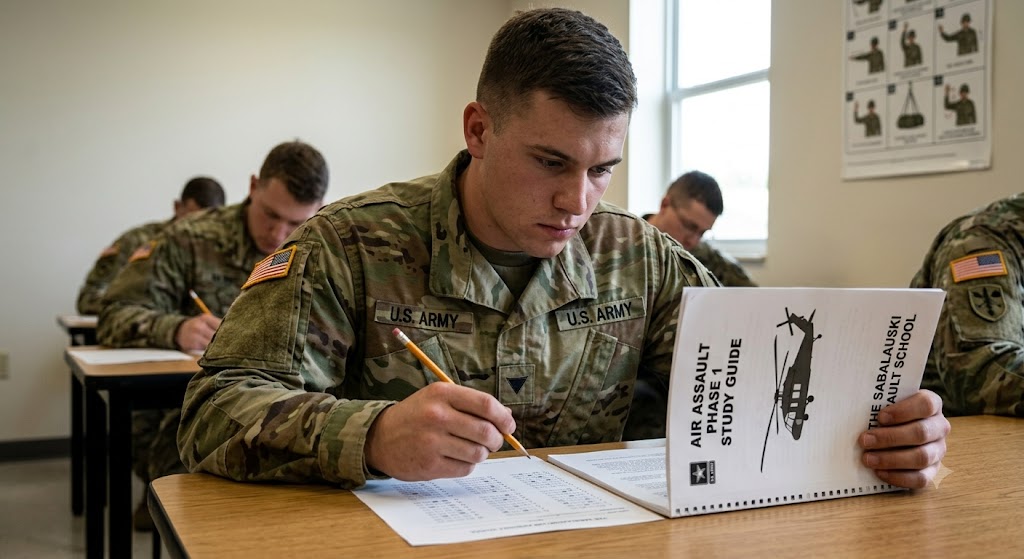
Additional Information
What the Course Entails and Exam Details
The Air Assault course is designed to train soldiers in air
assault operations, sling-load operations, and rappelling. Phase 1 specifically
delves into the general information required for these operations. The key
areas of study include: Aircraft Safety, Aircraft Orientation
(understanding the characteristics, capabilities, and limitations of various
Army aircraft such as the UH-60 Blackhawk, CH-47 Chinook, AH-64 Apache, and
LUH-72 Lakota), Aero Medical Evacuation (procedures for requesting and
managing MEDEVAC/CASEVAC operations, including the 9-line request and
understanding patient precedence), and Pathfinder Operations (the
selection, marking, and control of Landing Zones (LZs) and Pickup Zones (PZs)
for day and night missions involving multiple aircraft). The exam tests a
candidate's recall of technical specifications, operational procedures, safety
protocols, and standard terminology.
What to Expect in
the Final Exam
Upon completing the classroom instruction for Phase 1,
students are required to pass a final, comprehensive written examination. The
exam typically consists of 50 multiple-choice questions derived from the
lectures, practical exercises, and official reference materials. Students must
achieve a score of 70% or higher to receive a "GO" on the
test. This written exam is immediately followed by a visual, hands-on test of 10
standard hand-and-arm signals, of which candidates must correctly execute
at least 7 to pass. A failure on either portion allows for one retest.
Students who fail the retest will be dropped from the course.
How to Study and
Exam Centers
Effective study strategies are essential for success in
Phase 1. Actionable methods include: creating flashcards for key
technical data like aircraft speeds, weights, Available Cargo Loads (ACL),
tensile strengths of equipment, and the steps for 9-line MEDEVAC. Utilizing
official Army Study Guides and manuals, such as FM 3-04 (Army Aviation)
and TM manuals, and taking repeated practice exams like this one to
identify weak points and build speed. The visual signal test requires physical
practice and memorization, often best done by creating visual cues and
physically executing the signals with a partner. These exams and the course
itself are administered at authorized Army schools, most notably The
Sabalauski Air Assault School (TSAAS) at Fort Campbell, Kentucky, and at
other specific, physical Army testing centers or mobile training teams.
Job Opportunities
from the Course
Successfully completing Air Assault School and Phase 1 not
only unlocks unique career paths but also enhances a soldier’s tactical value
and leadership potential within their unit. Key roles and career paths include:
- Air
Assault Operations Officer/Planner
- Pathfinder
Operations Specialist
- Sling
Load Inspection Officer
- Rappel
Master (requires further training)
- MEDEVAC
Operations Coordinator
- Aviation
Unit Leadership Roles
- Combat
Engineer (with specialized deployment)
- Special
Operations Support Personnel
Frequently Asked Questions
Reviews
5.0
Based on 0 reviews
Leave a Review
No reviews yet. Be the first to review!