
AIPB Mastering Adjusting Entries Practice Test
$69.00
- Buy to unlock unlimited access to all Quiz questions.
- After purchase you can print a PDF of the whole quiz at any point. The PDF will contain the questions and the correct answers.
About this Exam
Welcome to your comprehensive study guide for the American Institute of Professional Bookkeepers (AIPB) Mastering Adjusting Entries exam. This specific course and its associated test are essential components of the national Certified Bookkeeper (CB) designation. The Mastering Adjusting Entries program is designed for professional bookkeepers, accounting clerks, and students who want to master the crucial skill of making period-end accounting adjustments. By focusing solely on this advanced topic, the course ensures you have the expertise required to take an unadjusted trial balance and transform it into an accurate, adjusted trial balance that can be used to generate reliable financial statements. Earning this proficiency demonstrates to employers and clients your commitment to accuracy and high-level bookkeeping standards.
Ready to test your knowledge?
Buy Now to Access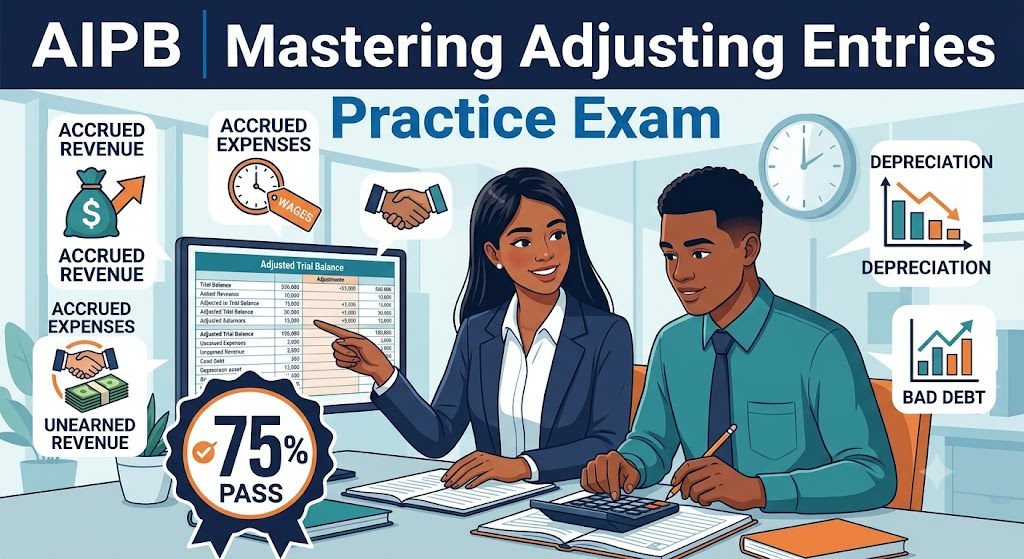
Additional Information
What the Course Entails and Exam Details
The AIPB Mastering Adjusting Entries course is a deep dive into the mechanics and logic of period-end adjustments under the accrual basis of accounting. It moves beyond basic transaction recording to focus on the timing of revenue and expense recognition. The core topics covered in this detailed syllabus include:
Introduction to Adjustments: A fundamental understanding of why adjustments are necessary and the primary categories of accruals and deferrals.
Accrued Revenue: How to identify, compute, and record revenue that has been earned but not yet received or recorded. This includes interest receivable and service revenue.
Accrued Expenses: The methods for identifying and recording expenses that have been incurred but not yet paid or recorded, such as interest payable, wages payable, and utilities.
Revenue Collected in Advance (Unearned Revenue): Proper handling of cash received before a service is performed or a good is delivered, and the process of recognizing that revenue over time.
Prepaid (Deferred) Expenses: Techniques for recording payments made in advance for assets like insurance and rent, and subsequently expensing them as they are consumed.
Other Adjusting Entries: This section covers specific complex adjustments, including those for bad debt expense, depreciation expense, and accounting for various cash and inventory-related adjustments.
The Adjusted Trial Balance and Financial Statements: The final critical steps of combining all adjustments with the unadjusted trial balance to create the adjusted trial balance, which is the foundational document for the income statement and balance sheet.
What to Expect in the Final Exam
While "Mastering Adjusting Entries" is a standalone workbook, its exam is officially known as "Test 1" within "Part 1: Adjustments and Error Correction" of the national Certified Bookkeeper (CB) examination. This means that to get credit for mastering adjustments toward your CB certification, you must sit for a formal, computer-based test at an authorized center.
Here are the key details of what you must prepare for in this high-stakes final exam:
Format: The exam is computer-based and consists of multiple-choice questions. It does not include practical, "write-out-the-entry" problems, but you must select the correct debits, credits, and account names from given options based on realistic accounting scenarios.
Time Limit: Candidates are typically given 2 hours (120 minutes) to complete this portion of the exam.
Passing Score: To pass this section of the national exam, you must achieve a score of at least 75%.
Special Rules: The test on adjustments is not open-book. Unlike other portions of the CB exam (specifically Parts 3 and 4), you are not permitted to use your workbook or other study materials during this session.
Calculator: You may use a non-printing, non-programmable, self-powered calculator during the test.
How to Study and Exam Centers
Preparation is paramount for the Mastering Adjusting Entries exam. Because it is closed-book and highly technical, you must move beyond passive reading to active practice. Here is a winning strategy:
Leverage the Double-Quizzes: The core of your preparation should be the official AIPB Mastering Adjusting Entries workbook. Every section concludes with "double-quizzes" designed to mimic the national exam questions. Mastery of these quizzes is the single best predictor of success on the actual test.
Simulate Test Conditions: When taking practice tests or the double-quizzes, time yourself and work without using the solutions or your workbook. This builds the speed and recall skills required for the closed-book, timed exam.
Focus on the "Why" and "When": Do not just memorize entries. Understand the core principles: When is revenue earned? When is an expense incurred? Why must we record this entry now, and how does it impact the income statement and the balance sheet? Use T-accounts to visualize the flow.
Schedule Your Exam: Once you are consistently scoring above 80% on all practice materials under simulated conditions, schedule your test. The "Adjustments and Error Correction" part of the Certified Bookkeeper exam must be taken in person at a designated testing center. The current partner for administering these exams is Prometric Test Centers, which has hundreds of locations worldwide. You must register through AIPB, after which you will receive an eligibility ID to schedule your specific session with Prometric.
Job Opportunities from the Course
Earning proficiency in adjusting entries is a decisive way to advance your accounting career. It signals that you are capable of full-charge bookkeeping, not just data entry. For those pursuing the Certified Bookkeeper (CB) designation, this is a mandatory step that unlocks significant opportunities. AIPB reports that 54% of Certified Bookkeepers received a new job, promotion, or higher-level responsibilities after certification.
By mastering adjusting entries, you will be qualified for advanced roles such as:
Certified Bookkeeper (CB)
Full-Charge Bookkeeper
Lead Bookkeeper
Accounting Manager
Office Manager (with accounting oversight)
Financial Assistant
Accounting Clerk (focused on period-end processes)
Tax Preparer (Adjustments are vital for tax accuracy)
Independent Bookkeeping Business Owner
With this crucial skill, you provide employers and clients with the accurate financial data they need to make informed business decisions, making you an indispensable part of their team.
Frequently Asked Questions
Reviews
5.0
Based on 0 reviews
Leave a Review
No reviews yet. Be the first to review!