
AIM Materials and Processing Practice Exam
$69.00
- Buy to unlock unlimited access to all Quiz questions.
- After purchase you can print a PDF of the whole quiz at any point. The PDF will contain the questions and the correct answers.
About this Exam
The AIM Materials and Processing certification, offered by the American Injection Molding (AIM) Institute, is a prestigious, industry-recognized credential for professionals in the plastics injection molding field. It is designed to validate a comprehensive understanding of the entire injection molding process, from foundational material science to final part production. The program targets a wide range of individuals, including process engineers, mold designers, part designers, quality control technicians, and manufacturing managers who seek to elevate their expertise, solve complex problems, and advance their careers in the plastics industry. The certification confirms mastery of the four core pillars of injection molding, as defined by the AIM Institute.
Ready to test your knowledge?
Buy Now to Access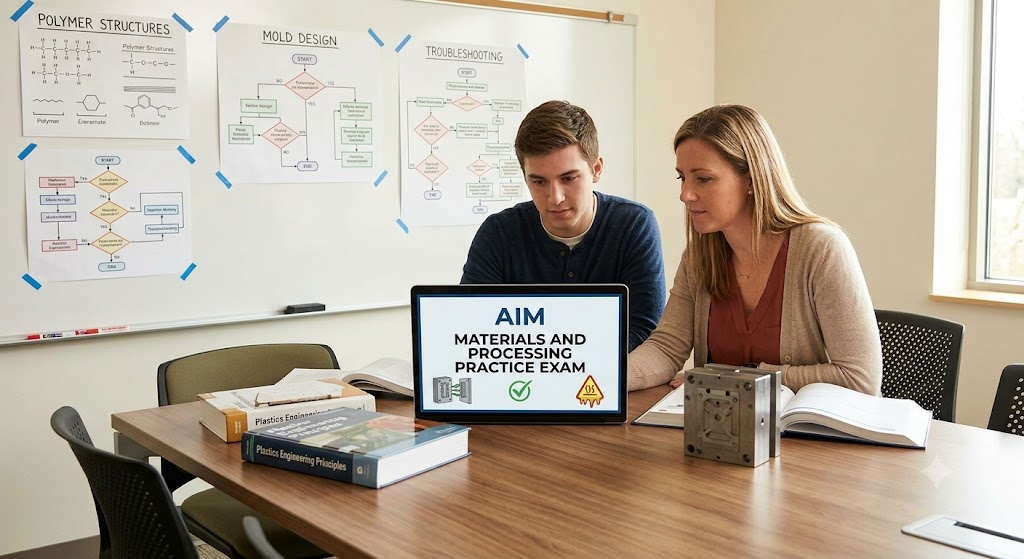
Additional Information
What the Course Entails and Exam Details
The course of study leading to the AIM Materials and Processing certification is rigorous and covers four primary disciplines in depth. These core topics form the syllabus for the exam:
Plastic Materials: Understanding the structure, properties, and behavior of various polymers, including the effects of molecular weight, rheology, and crystallinity, and how these factors impact processing and final part performance.
Mold Design & Engineering: Learning about mold types, components, five key systems, and the engineering principles essential for creating functional and efficient injection molds.
Injection Molding Processing: Gaining mastery over injection molding machinery, process development, troubleshooting, and advanced processing techniques using research-backed approaches.
Part Design: Focusing on design for manufacturability (DFM), performance over a product's lifespan, and the critical relationships between part design, mold complexity, and cost.
The examination structure is designed to test both theoretical knowledge and practical application, with a strong emphasis on the intersection of these four disciplines.
What to Expect in the Final Exam
The final certification exam is a comprehensive assessment that goes beyond simple knowledge retention. Candidates should expect a challenging, proctored exam. While specific details on the number of questions may vary slightly, the exam generally consists of:
Format: A significant portion of the exam is a multiple-choice component, but it may also include practical or scenario-based questions that require applying knowledge to solve real-world problems.
Time Limits: The exam has a strict time limit, requiring candidates to manage their time effectively across all sections.
Passing Score: The AIM Institute establishes a specific minimum passing score to ensure that only those with a high level of proficiency earn the designation of "Plastics Technology & Engineering Professional."
Rules: Standard examination rules apply, and the exam must be taken in a live, proctored environment, whether online or at a physical location.
How to Study and Exam Centers
Effective preparation is key to success on the AIM Materials and Processing exam. The AIM Institute's unique learning model provides a built-in roadmap:
Utilize All Course Materials: Your foundation must be the proprietary lessons, course books, and resources provided during the AIM Institute's training courses.
Complete All Homework: The program includes extensive homework assignments between courses. These are crucial for reinforcing concepts.
Participate in Online Reviews: Take full advantage of the weekly, interactive online review meetings, which offer a chance to clarify doubts and learn from instructors and peers.
Practice with Mock Exams: Seek out AIM Materials and Processing practice exams to become familiar with the question types, level of difficulty, and time pressure.
Develop Critical Thinking: The exam tests your ability to think through the entire process, so focus on the "why" behind concepts and the connections between materials, design, and processing.
Regarding exam centers, the AIM Institute provides flexible options:
In-Person Testing: Candidates often take the exam at the AIM Institute’s state-of-the-art facility in Erie, PA.
Online Proctored Exams: The exam can also be taken remotely, using an approved live proctoring service, giving candidates the convenience of testing from their home or office. Contact the AIM Institute directly for the most current information on exam delivery and scheduling.
Job Opportunities from the Course
Earning the AIM Materials and Processing certification significantly boosts your professional profile and opens doors to exciting career advancement. The "Plastics Technology & Engineering Professional" designation unlocks numerous specialized roles:
Injection Molding Process Engineer
Mold Design Engineer
Plastic Part Designer
Quality Control Specialist / Manager for Plastics
Manufacturing Engineer
Project Manager, Injection Molding
Plastics Operations Manager
Technical Sales Engineer (Plastics)
This certification demonstrates a level of expertise that enables you to lead teams, improve production quality, reduce costs, and innovate, making you an invaluable asset to any plastics manufacturing organization.
Frequently Asked Questions
Reviews
5.0
Based on 0 reviews
Leave a Review
No reviews yet. Be the first to review!