
AIDS Certified Registered Nurse (ACRN) Certification Practice Exam
$69.00
- Buy to unlock unlimited access to all Quiz questions.
- After purchase you can print a PDF of the whole quiz at any point. The PDF will contain the questions and the correct answers.
About this Exam
The AIDS Certified Registered Nurse (ACRN) certification is a prestigious credential for Registered Nurses who have chosen to specialize in the complex and rewarding field of HIV/AIDS care. Designed by the HIV/AIDS Nursing Certification Board (HANCB) in collaboration with the Association of Nurses in AIDS Care (ANAC), this certification validates a nurse's comprehensive understanding, skill, and commitment to providing optimal health outcomes for individuals living with HIV and AIDS. By earning the ACRN credential, nurses demonstrate their advanced knowledge across the entire continuum of HIV care, from prevention and diagnosis to treatment, chronic condition management, and psychosocial support.
This certification is specifically tailored for Registered Nurses with current licensure and professional experience in HIV/AIDS nursing.
Ready to test your knowledge?
Buy Now to Access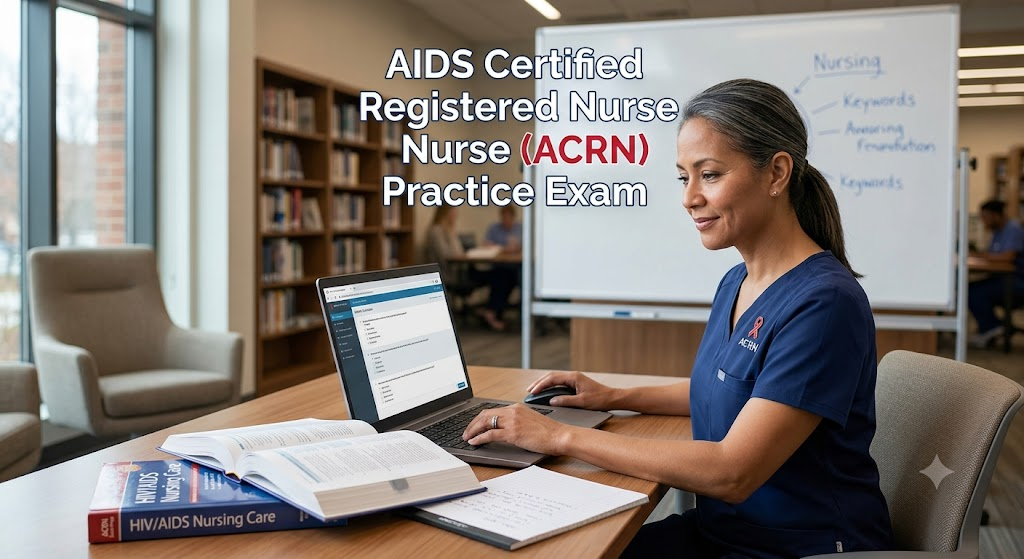
Additional Information
What the Course Entails and Exam Details
The core focus of the ACRN certification, rather than being linked to a single 'course,' is a comprehensive validation of knowledge acquired through education and, ideally, professional practice. Candidates preparing for the assessment process, which is often integrated with or validated through a curriculum such as the National HIV Curriculum, will be assessed on their knowledge in critical areas:
HIV/AIDS Pathophysiology & Transmission: Understanding the biology, stages of infection, and modes of transmission of HIV.
Epidemiology and Prevention: Analyzing the population-level impact of HIV and implementing effective prevention strategies, including PEP, PrEP, and harm reduction.
Testing and Diagnosis: Knowledge of testing methods, diagnostic criteria, and interpretation of results.
Anti-Retroviral Therapy (ART): Extensive understanding of different ART drug classes, regimens, side effects, interactions, resistance, and adherence support.
Opportunistic Infections (OIs) and Co-occurring Conditions: Managing common complications like tuberculosis, hepatitis, cancer, and metabolic issues.
Nursing Management & Care Across the Lifespan: Providing age-appropriate, compassionate care for diverse populations, including adults, pediatrics, and elderly patients.
Psychosocial & Cultural Considerations: Addressing the unique mental health needs, stigma, cultural backgrounds, and social determinants of health affecting patients.
Ethical, Legal, & Advocacy Issues: Navigating complex issues around confidentiality, discrimination, and advocating for patient rights and quality care.
Research & Professional Issues: Keeping current with advancements in HIV care and engaging in professional development.
The actual assessment and certification process, reflecting modern practices and accessibility, has significantly evolved. Currently, certification is frequently conducted through an online, self-paced curriculum program in partnership with recognized educational resources and the certifying body (HANCB). The assessment involves demonstrating proficiency through a combination of quizzes, module completions, and potentially a final cumulative evaluation. It is crucial to consult the official ANAC/HANCB website for the most precise, current details on the specific curriculum, lesson structure, quiz requirements, and assessment components.
What to Expect in the Final Exam
The concept of a traditional, in-person sit-down exam has largely transitioned. The current assessment process for ACRN certification is typically structured around an online educational platform:
Format: Candidates can expect a series of multiple-choice quizzes following individual lessons or modules within the designated online curriculum. A final assessment, which may also be online and computer-based, is generally part of the comprehensive evaluation.
Question Count & Types: While the exact number of questions can vary by curriculum structure, a final assessment could potentially include a significant number (e.g., around 100 questions, mirroring previous exam lengths in content scope, but integrated differently). Questions are typically scenario-based, multiple-choice, testing application of knowledge.
Passing Score/Requirements: Passing criteria are typically specified as achieving a minimum correct percentage on quizzes (e.g., at least 4 out of 5 for multiple lessons in some tracks) and successfully completing all program elements. For any distinct final assessment, a specified passing rate (e.g., 80% or higher) is common.
Time Limits: While self-paced in overall program completion within a specific period (e.g., up to 6 months), specific quizzes and particularly a potential final assessment may have a designated, online-proctored or time-limited completion window.
Access: Registration and assessment components are accessed securely through the authorized online portal of the certifying body/educational partner. Proctoring requirements, if any, will be outlined.
It is absolutely imperative to refer directly to the HANCB and the specified online curriculum provider for the most up-to-date and specific details regarding the structure, questions, and passing standards for the current ACRN certification path.
How to Study and Exam Centers
Successfully achieving ACRN certification via the modern online curriculum-integrated pathway requires structured preparation and consistent dedication:
Utilize Official Resources: Your primary and most critical resource is the designated National HIV Curriculum and any associated study guides or resources provided by HANCB/ANAC.
Active Engagement with the Curriculum: Don't just read through the materials. Complete all lessons thoroughly, take notes, engage with interactive content, and review rationales for all quiz questions.
Spaced Repetition & Recall: Build in regular review sessions. Practice recalling key concepts, drug information, treatment guidelines, and critical nursing interventions.
Practice with Curriculum Quizzes: The quizzes within the curriculum are the most direct practice for the type of assessment and level of understanding required. Review any questions you get wrong in depth.
Join Learning Groups: If available, participating in study groups or forums linked to the curriculum can provide support, clarify doubts, and offer different perspectives.
Exam 'Centers': As the assessment is primarily online and integrated into a digital program, there are generally no physical exam centers. The program and any final assessments are accessed via the official authorized online portal, allowing you to take them from a convenient, appropriate location with internet access. Ensure your computer and internet connection meet any technical requirements specified by the platform.
Job Opportunities from the Course
Obtaining the AIDS Certified Registered Nurse (ACRN) credential significantly enhances career prospects and earning potential, unlocking opportunities in various healthcare settings focused on HIV/AIDS care, including:
HIV/AIDS Specialist Nurse: Leading nursing care for patients in dedicated clinics or hospital wards.
HIV Clinic Registered Nurse: Providing direct patient care and support in ambulatory care environments.
Infectious Disease Case Manager: Coordinating complex care, treatment plans, and resources for patients with HIV/AIDS.
Public Health Nurse (Focus on HIV/AIDS): Engaging in community outreach, prevention programs, and disease surveillance.
HIV Research Nurse: Contributing to clinical trials and studies improving HIV care and treatment.
Nurse Educator (Specializing in HIV/AIDS): Developing and delivering educational programs for other healthcare providers or the public.
Community Outreach Nurse: Working directly in communities for HIV testing, education, and support.
Policy Advocate: Influencing healthcare policy and advocating for resources and support for the HIV/AIDS community.
Clinical Nurse Specialist (CNS): Providing expert care, guidance, and leadership in specialized practice areas after further advanced practice training and certification.
Achieving ACRN certification clearly demonstrates specialized expertise and a powerful commitment to this vital area of nursing, distinguishing you as a highly qualified and compassionate professional in HIV/AIDS healthcare.
Frequently Asked Questions
Reviews
5.0
Based on 0 reviews
Leave a Review
No reviews yet. Be the first to review!