
AICE Psychology Paper 2 Practice Exam
$69.00
- Buy to unlock unlimited access to all Quiz questions.
- After purchase you can print a PDF of the whole quiz at any point. The PDF will contain the questions and the correct answers.
About this Exam
Welcome to your essential resource for the AICE Psychology Paper 2 Practice Exam. This study guide is meticulously designed for high school students currently enrolled in the Cambridge International AS & A Level Psychology (9990) course. The Advanced International Certificate of Education (AICE) is a prestigious international qualification, and Paper 2 is a critical component that tests your fundamental understanding of how psychological research is conducted. For students aspiring to pursue a degree in psychology, medicine, law, or social sciences, excelling in this exam demonstrates the analytical and critical thinking skills required at the university level.
Ready to test your knowledge?
Buy Now to Access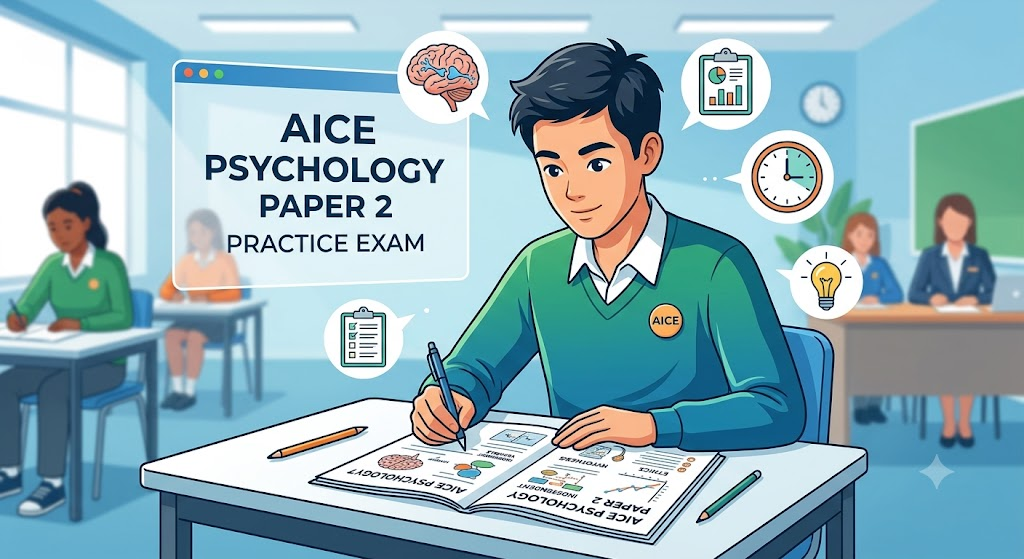
Additional Information
What the Course Entails and Exam Details
The AICE Psychology AS Level course, which includes Paper 2, shifts focus from simply learning what psychologists have found to examining how they found it. While Paper 1 focuses on key core studies, Paper 2 is entirely dedicated to Research Methods.
The core syllabus topics you must master for this exam include:
Experimental Methods: Understanding laboratory, field, and natural experiments. Mastering concepts like independent variables, dependent variables, extraneous variables, and experimental designs (repeated measures, independent measures, matched pairs).
Non-Experimental Methods: Comprehensive knowledge of self-reports (questionnaires, interviews), observations (participant/non-participant, overt/covert, structured/unstructured), correlations, case studies, and longitudinal studies.
Formulating Research: How to create aims, operationalize variables, and write directional (one-tailed), non-directional (two-tailed), and null hypotheses.
Sampling Techniques: Evaluating opportunity, random, volunteer, and stratified sampling.
Data Analysis: Interpreting qualitative versus quantitative data, descriptive statistics (mean, median, mode, range), and knowing how to construct and interpret various graphical representations (bar charts, histograms, scatter graphs).
Methodological Issues: Critically evaluating reliability (test-retest, inter-rater), validity (internal, external/ecological, construct), generalizability, and subjectivity/objectivity.
Ethics: A comprehensive understanding of the ethical guidelines for both human and animal research, including informed consent, deception, protection from harm, and confidentiality.
What to Expect in the Final Exam
The AICE Psychology Paper 2, "Research Methods," is a written exam that is proctored in a formal environment. Knowing the format is the first step to conquering exam anxiety.
Here are the key exam details:
Format: The exam consists of structured questions that are compulsory—there are no optional questions. You will be required to write your answers directly on the question paper.
Duration: You have 1 hour and 30 minutes to complete the exam.
Total Marks: The paper is worth a total of 60 marks.
Types of Questions: You will encounter three distinct sections.
Section A: Short-answer questions that test your foundational knowledge of research methods terminology, definitions, and concepts.
Section B: Questions based on novel research scenarios. You will be given a hypothetical study description and must apply your knowledge to evaluate its methodology, suggest improvements, form hypotheses, or interpret hypothetical data.
Section C: A major design-a-study question. This requires you to plan, from scratch, a complete psychological study based on a given topic, detailing your method, sample, procedure, data analysis, and ethical considerations.
Passing Score: AICE exams are graded on a scale from A* to E for full A Level, and a to e for AS Level. A score of 'e' is considered a pass at the AS Level, but competitive university programs typically look for grades 'c' or higher. There is no predetermined single "passing score" in terms of percentage, as grade boundaries are adjusted for each exam series based on difficulty.
How to Study and Exam Centers
Studying for Paper 2 requires a active, practical approach. You cannot simply memorize definitions; you must practice applying them.
Active Application: Use the official syllabus to create flashcards, but don't just write the definition of "ecological validity." Write a mini-scenario and explain how to increase its ecological validity.
Scenario-Based Practice: Actively seek out past papers. Cover the answers and practice analyzing the novel scenarios provided in Section B. Identify independent variables, critique the sample, and check the ethical guidelines.
The Design-A-Study Drill: Practice Section C questions regularly. Give yourself a topic (e.g., "design a study to investigate the effect of music on concentration") and write a full, methodological plan within a timed constraint (e.g., 20-25 minutes). Use a rubric or check against sample answers.
Past Papers and Mark Schemes: The Cambridge International website is your best resource. Download past papers from the last 5 years along with their examiner reports and mark schemes. Analyzing how examiners award marks for Section B and C answers is crucial.
Understand Command Words: Know exactly what 'describe,' 'evaluate,' 'suggest,' 'outline,' and 'compare' require you to do in your answer.
Exam Centers:
AICE exams are high-stakes, standardized assessments and cannot be taken online at home. They must be taken at an authorized Cambridge International school or testing center. If you are already enrolled in an AICE course, your school will register you and administer the exam. If you are a private candidate, you must find an authorized school in your region that accepts private candidates and register through them. You can search for registered centers directly on the Cambridge International website.
Job Opportunities from the Course
An AICE Psychology qualification is a significant academic achievement, but it is important to remember that it is a pre-university qualification. While the completion of this course alone does not qualify you to practice as a psychologist, it is a crucial stepping stone. It provides a competitive advantage for admission into prestigious university programs.
A university degree in psychology (followed by postgraduate specialization) can lead to the following direct and related career paths:
Clinical Psychologist: Assessing and treating mental health disorders in clinical settings.
Neuroscientist/Researcher: Conducting scientific studies on brain function and behavior in academic or private labs.
Industrial-Organizational Psychologist: Applying psychological principles to improve workplace productivity and employee well-being.
Counselling Psychologist: Helping individuals manage life challenges, relationships, and emotional difficulties.
Forensic Psychologist: Applying psychology to legal issues, including criminal profiling and competency assessments.
Social Worker/Counsellor: Providing support and guidance to vulnerable populations and families.
Educational Psychologist: Working within schools to support students' learning, emotional, and behavioral needs.
Human Resources Specialist: Utilizing knowledge of human motivation and behavior for recruitment, training, and employee relations.
Market Research Analyst: Analyzing consumer behavior and trends to inform marketing strategies.
Good luck with your preparation for the AICE Psychology Paper 2 exam. Your dedication to understanding research methods is the foundation for your future success in this fascinating field!
Frequently Asked Questions
Reviews
5.0
Based on 0 reviews
Leave a Review
No reviews yet. Be the first to review!