
AICE Psychology Paper 1 Practice Exam
$69.00
- Buy to unlock unlimited access to all Quiz questions.
- After purchase you can print a PDF of the whole quiz at any point. The PDF will contain the questions and the correct answers.
About this Exam
The AICE Psychology Paper 1 Practice Exam is an essential tool designed to help high school students successfully prepare for the Cambridge Assessment International Education Advanced Subsidiary (AS) Level examination. This specific exam serves as the foundation for the entire AICE Psychology qualification, introducing learners to the core approaches, theories, and studies in psychology. It is tailored for ambitious students seeking to develop a comprehensive understanding of human behavior, motivations, and the scientific methods used in psychological research. Successfully navigating this practice test is a crucial step toward achieving the prestigious AICE diploma and demonstrating college-level readiness in this fascinating field of study.
Ready to test your knowledge?
Buy Now to Access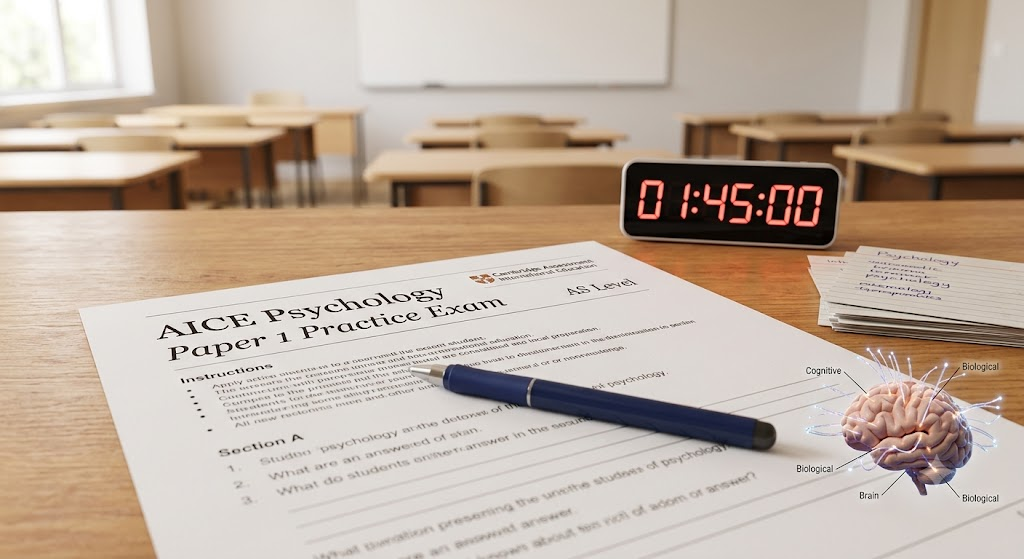
Additional Information
What the Course Entails and Exam Details
The AICE Psychology curriculum for Paper 1 covers the core topics that form the bedrock of psychological inquiry. Students will deeply explore four primary approaches: the Cognitive, Social, Biological, and Learning viewpoints. This course focuses on understanding the methodologies, key theories, and applying this knowledge to core research studies identified within each area. You will learn about experimental design, ethics, and data analysis as you dissect fundamental studies that have shaped our understanding of subjects such as memory, obedience, and psychological disorders. This course is not just about memorization; it's about building strong analytical and application skills that universities highly value.
What to Expect in the Final Exam
The official AICE Psychology Paper 1 final exam is a comprehensive written assessment designed to test both your theoretical knowledge and your ability to apply it. The exam typically consists of multiple sections, requiring a mix of concise, fact-based answers and longer, more detailed essay responses. Students can expect to see questions that ask for definitions, explanations of psychological concepts, comparisons of different studies, and critical evaluations of research methods and theories. The final exam has a maximum duration of 1 hour and 45 minutes. Understanding specific details of the core studies from your syllabus is mandatory, as is managing your time effectively between the various question formats. Your responses are graded by Cambridge Examiners according to their strict marking criteria, and students receive an AS Level grade ranging from A to E.
How to Study and Exam Centers
Effectively preparing for AICE Psychology Paper 1 requires a strategic approach. We highly recommend utilizing this specific AICE Psychology Paper 1 Practice Exam multiple times to familiarize yourself with the question structure and build stamina under timed conditions. Deeply study each of the four psychological approaches, focusing heavily on the assigned core studies; summarize their aims, methods, findings, and conclusions. Create structured revision notes and flashcards for key terms, methodologies, and ethical considerations. Discussing complex theories and studies with study partners can also reveal new perspectives. Finally, practicing with past papers and analyzing official mark schemes is one of the single best ways to understand exactly what examiners are looking for. The actual AICE examinations are only administered through official, registered Cambridge Assessment International Education centers. Most students take these exams at their own high school or college, provided it is an authorized center. You cannot take this particular, rigorous, official written exam through generic online portals, although digital practice materials are available.
Job Opportunities from the Course
While this AICE Psychology qualification is an entry point, it provides an outstanding foundation for various career pathways that often require further university study and specialization. Here is a clear list of potential career fields and roles that this knowledge can open:
Clinical Psychologist (requires doctoral degree)
Educational Psychologist (requires higher education)
Forensic Psychologist (requires doctoral degree)
Industrial-Organizational Psychologist (requires Master’s or doctoral degree)
Sports Psychologist (requires Master’s or doctoral degree)
Human Resources (HR) Specialist or Manager
Market Research Analyst
Mental Health Counselor (requires Master's degree)
Research Assistant in psychology or social sciences
Social Worker or Social Service Assistant
Career Counselor
High School Teacher or University Professor (requires further education)
Frequently Asked Questions
Reviews
5.0
Based on 0 reviews
Leave a Review
No reviews yet. Be the first to review!