
AICE Marine Science Paper 2 Practice Exam
$69.00
- Buy to unlock unlimited access to all Quiz questions.
- After purchase you can print a PDF of the whole quiz at any point. The PDF will contain the questions and the correct answers.
About this Exam
Welcome to your essential guide for the AICE Marine Science Paper 2! This highly regarded international qualification, part of the Cambridge Advanced International Certificate of Education (AICE) program, is designed for senior high school students who have a passion for the world’s oceans and their complex ecosystems. The AICE Marine Science course aims to provide a thorough understanding of marine environments, biological diversity, ecological processes, human impacts, and sustainable management of ocean resources. Specifically, Paper 2 is a crucial component of the Advanced Subsidiary (AS) Level and the full A Level, focusing not just on theory, but on the practical application of knowledge, critical data handling, and investigative skills. This guide will help you understand how to approach your practice and the structure of the final assessment so you can achieve your best results.
Ready to test your knowledge?
Buy Now to Access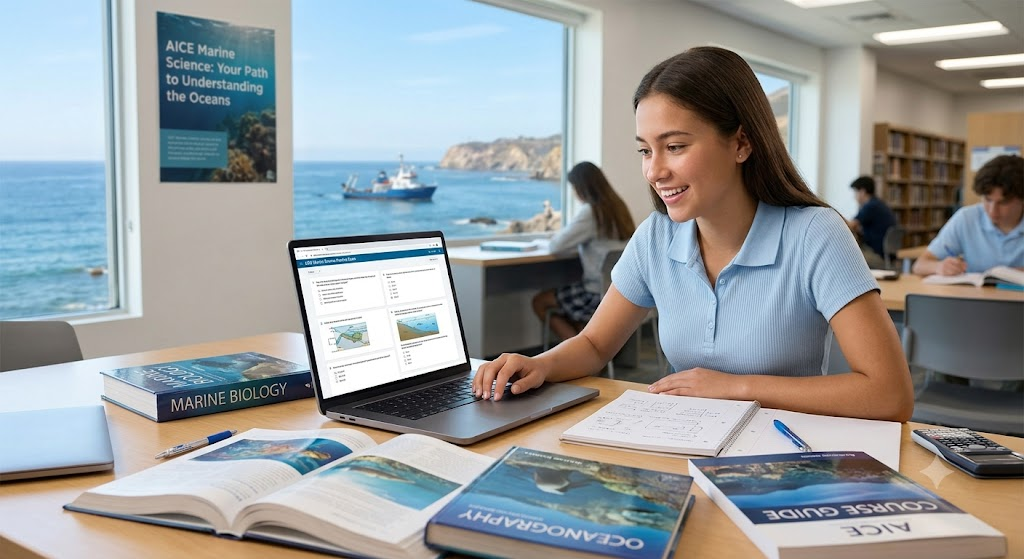
Additional Information
What the Course Entails and Exam Details
The full AICE Marine Science course (9693) covers a vast range of topics, including marine ecosystems, organism classification and biodiversity, energy flow, earth processes, human impacts, and aquaculture. You will develop an in-depth understanding of biological, physical, and chemical oceanography.
The specific "AICE Marine Science Paper 2" focus, which you will prepare for through rigorous practice exams and materials, is explicitly centered around Data Handling and Investigative Skills. While you need the underlying theoretical knowledge from the course, Paper 2 puts that knowledge into practice. It is a mandatory component for both the AS Level and the A Level qualification. The core aspects you will need to master through dedicated study are:
Experimental Design: You will be expected to demonstrate your understanding of the scientific method. This includes the ability to design valid and reliable experiments, select appropriate equipment and techniques, identify variables (independent, dependent, control), state hypotheses, and describe safety considerations.
Data Collection and Presentation: You must know how to accurately collect and record experimental and fieldwork data. This includes understanding appropriate sampling methods, constructing clear tables, and presenting your findings through various graphical formats (line graphs, bar charts, histograms, scatter plots, biological drawings).
Data Analysis and Interpretation: This is a key skill. You will need to calculate statistical measures (means, medians, modes, ranges, percentages, percentage changes). You must also understand and be able to apply relevant indices like Lincoln’s Index (for estimating population size), Simpson's Index of Diversity (for ecological studies), and statistical tests such as Spearman’s Rank Correlation and Chi-squared tests (where appropriate for A Level). You will interpret patterns in data and draw valid conclusions.
Critical Evaluation: You must demonstrate critical thinking by evaluating experimental procedures, data, and conclusions. This involves identifying potential sources of error, understanding the limitations of methods, suggesting improvements to experimental designs, and evaluating the validity and reliability of evidence and scientific claims.
A high-quality practice exam will mimic these demands, providing you with data sets, graphical inputs, and scenarios where you must apply these specific practical and investigative skills to marine science contexts.
What to Expect in the Final Exam
While you are preparing with practice materials, understanding the format of the official AICE Marine Science Paper 2 (Data-handling and Practical Skills) is essential. The specific details of the final exam, based on current Cambridge International standards, are:
Mandatory Component: This paper is a required part of the examination. For those taking the AS Level qualification, Paper 2 accounts for 50% of the total AS marks (with Paper 1, the theory paper, accounting for the other 50%). For full A Level candidates, Paper 2 contributes 25% of the total A Level mark. Failing to sit for Paper 2 will disqualify you from receiving a grade.
Structure: The exam consists entirely of structured questions. There are typically 4 to 6 extended questions, and you are required to answer all of them. Each question is based on various aspects of data handling, practical skills, experimental design, or critical evaluation, always rooted in marine science topics.
Duration: The exam is typically 1 hour and 45 minutes. Effective time management is key, and dedicated practice under timed conditions is highly recommended.
Marks: The paper is out of a total of 75 marks. Each question and part-question will have a designated number of marks, allowing you to gauge the depth of response required.
Command Words: Pay close attention to the specific command words used in questions (e.g., "describe," "explain," "evaluate," "calculate," "state," "draw"). Your responses must align precisely with what the command word is asking for. Practice exams are the best place to become familiar with these.
Practical Work Foundation: Many questions are based on or related to core practical activities outlined in the syllabus. A deep understanding of the principles behind these practicals (e.g., water quality testing, organism dissection/observation, ecological sampling techniques) will significantly boost your performance.
How to Study and Exam Centers
How to Study for AICE Marine Science Paper 2
Effective study for this practical-based paper requires more than just memorization. Focus on these actionable strategies to sharpen your skills:
Master Past Papers: The absolute best way to prepare is to practice extensively with official Cambridge past papers for Paper 2. Not only should you complete the papers, but you must also carefully review the corresponding mark schemes and examiner's reports. Understanding how answers are graded, which common mistakes to avoid, and the expected standard of response is invaluable. Focus on Papers from the last several years to ensure familiarity with the current style of questions.
Understand the Syllabus: Refer consistently to the detailed syllabus (9693) for Marine Science. Pay specific attention to the learning objectives related to practical skills and data handling. Ensure you can perform all listed calculations and describe all outlined experimental/fieldwork techniques.
Hone Practical Skills: While the exam is written, your deep understanding must stem from hands-on (or at least conceptually understood) practical work. Actively participate in all school-based labs. If possible, engage in virtual labs, watch high-quality practical demonstrations online, or review the underlying principles behind required core practicals. Practice biological drawings, ensuring you use the correct style and labels.
Practice Calculations: Be confident with your math skills. Practice all calculations specified in the syllabus (percentages, means, Lincoln's Index, Simpson's Index, statistical tests). Understand when and why to use each calculation and how to interpret the results. Always show your workings and include appropriate units in your answers.
Refine Graphical Skills: Develop precision in drawing graphs. Practice plotting data accurately, labeling axes correctly with units, choosing appropriate scales, drawing distinct lines/bars, and including descriptive titles. Know when to use different graph types. Also, practice interpreting various graphical representations, including complex data sets and multiple plotted lines or bars.
Review Core Concepts: While Paper 2 is skill-focused, you still need a strong foundation in the core theoretical concepts (biodiversity, ecosystems, etc.) to successfully apply them to investigative scenarios. Re-read key textbook sections, review your notes, and use flashcards for essential terms and classifications.
Practice Under Time Pressure: As you approach your final revision and practice exams, simulate exam conditions. Allocate 1 hour and 45 minutes to complete a practice paper, and resist the temptation to check notes or mark schemes until you are finished. This will improve your speed, accuracy, and time management.
Form a Study Group: Collaborate with other AICE Marine Science students. Discuss past paper questions, practical procedures, and challenging concepts. Teaching a topic to others or hearing different perspectives can deepen your own understanding.
Ask for Feedback: Review your practice answers with your teacher, or compare them rigorously to official mark schemes. Identify your areas of weakness and dedicate focused study to improve them.
Exam Centers
The official AICE Marine Science exams, including Paper 2, are administered by Cambridge Assessment International Education and are not taken online through private portals or platforms. You must be registered as a candidate at an authorized Cambridge International examination center, which is typically your high school or an approved testing institution.
To ensure you can take the exam:
Check with Your School: The vast majority of AICE candidates are registered and take their exams through their own school, which functions as an established Cambridge International examination center. Your school’s AICE Coordinator, science department, or guidance counselors will manage the registration process and inform you of exam dates, times, fees, and location.
Find a Center: If you are a private candidate, you must find and contact an authorized Cambridge International examination center. You can use the official Cambridge International database to find a center near you that is open to private candidates and offers the Marine Science exam.
Adhere to Registration Deadlines: There are strict deadlines for registering for Cambridge exams (typically well in advance of the May/June and October/November exam series). It is your responsibility to ensure you are registered through your center by the required date.
Be Aware of Costs: There will be associated fees for each exam component you sit. For full information on costs, deadlines, and center details, consult with your school or your chosen exam center well in advance of the testing period.
Job Opportunities from the Course
A strong performance in AICE Marine Science, culminating in success in Paper 2, demonstrates not only knowledge but also valuable practical and analytical skills that are highly sought after in many marine and environmental fields. While this qualification is often a stepping stone to further specialized university study (e.g., in Marine Biology, Oceanography, Environmental Science), it can also open doors directly to entry-level positions and career paths. A list of specific job opportunities and career directions that this qualification can unlock include:
Marine Biology Technician: Assist researchers and scientists with experiments, fieldwork, data collection, and laboratory work.
Oceanographic Assistant: Work alongside oceanographers, managing equipment, analyzing water samples, and assisting with data management and research cruises.
Environmental Consultant Assistant: Support efforts to assess environmental impact, conduct ecological surveys, and develop conservation strategies in coastal and marine areas.
Aquarium/Aquaculture Assistant: Assist in the daily operations of aquariums or aquaculture facilities, which could involve water quality testing, care of marine life, and educational roles.
Fisheries Technician: Assist in monitoring and managing fish populations, collecting catch data, and helping to enforce sustainable fishing practices.
Marine Educator: Share your knowledge and passion for the marine world as an educator in nature centers, science museums, or conservation organizations.
Coastal Resource Management Support: Assist in managing and protecting coastal zones, monitoring ecosystems, and contributing to sustainable development plans.
Marine Pollution Analyst Assistant: Work in laboratories testing water and tissue samples for various types of pollution, assisting in monitoring the health of marine ecosystems.
Wildlife Conservation Support: Contribute to the protection of marine endangered species and habitats through roles in non-profit organizations or government agencies.
Sustainable Resource Development: Apply your understanding of marine resources to entry-level positions focused on the sustainable extraction of energy, minerals, and other materials from the ocean.
By following this guide, utilizing comprehensive practice materials, and dedicating yourself to understanding both the theory and the crucial practical skills of AICE Marine Science, you will be well on your way to success in Paper 2. Best of luck in your studies and preparation!
Frequently Asked Questions
Reviews
5.0
Based on 0 reviews
Leave a Review
No reviews yet. Be the first to review!