
AICE International History Practice Exam
$69.00
- Buy to unlock unlimited access to all Quiz questions.
- After purchase you can print a PDF of the whole quiz at any point. The PDF will contain the questions and the correct answers.
About this Exam
The AICE International History qualification, part of the prestigious Cambridge Advanced International Certificate of Education (AICE) diploma, is designed for high school students seeking a rigorous, college-level understanding of global historical events and processes.
This curriculum goes beyond simple memorization, challenging students to think critically about cause and effect, evaluate diverse historical interpretations, and analyze complex global interactions.
It is ideal for students aiming to develop advanced analytical and communication skills, preparing them for higher education and careers that require a sophisticated understanding of international relations and historical context.
Ready to test your knowledge?
Buy Now to Access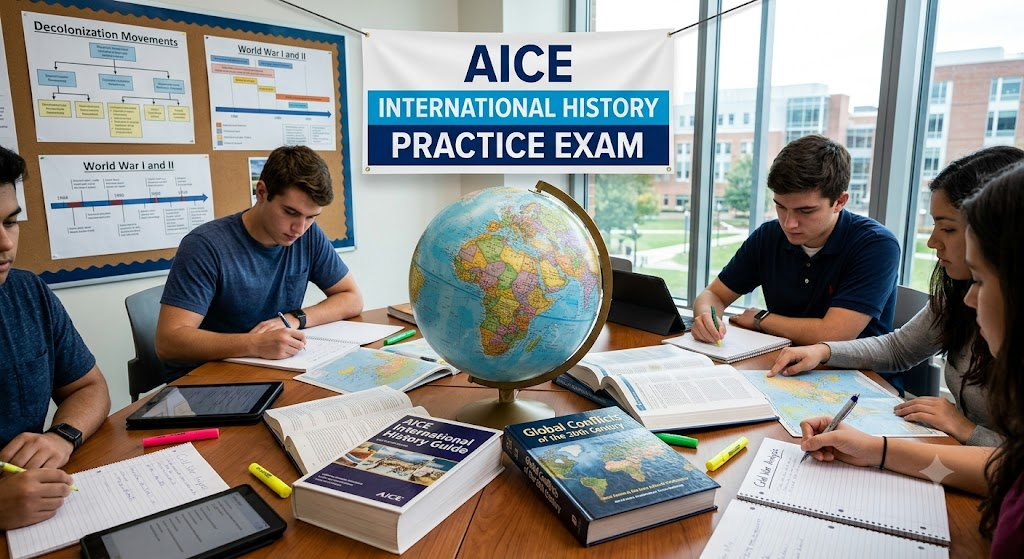
Additional Information
What the Course Entails and Exam Details
The AICE International History course typically covers significant global developments from approximately 1870 to the present day.
The syllabus focuses on key themes and regions, often organized into optional components such as Modern European History, History of the USA, or International History.
Core topics frequently include:
The causes and consequences of major conflicts, including World War I and World War II.
The development of international relations in the 20th century, including the Cold War.
The rise and fall of global empires and the process of decolonization.
Significant political, social, and economic shifts in key nations and regions.
The study of international organizations and attempts at global cooperation.
Students are expected to engage deeply with primary and secondary source materials, learning to evaluate bias, reliability, and differing historical perspectives.
What to Expect in the Final Exam
The AICE International History final exam is renowned for its essay-based format, emphasizing analytical writing rather than multiple-choice responses.
The assessment structure typically includes multiple components or "papers":
Paper 1 (Source-based): This component requires students to analyze a collection of historical documents related to a specific topic, such as the origins of the First World War. They must compare, contrast, and evaluate these sources within their historical context.
Paper 2 (Essay-based): Students choose several essay questions from various thematic options. These questions demand detailed historical knowledge, a clear argument, and the ability to synthesize information effectively.
The time limits are strict, often allowing approximately 1 hour and 15 minutes to 1 hour and 45 minutes per paper.
The passing standard is rigorous, and achieving high marks requires not only a command of historical facts but also sophisticated critical thinking and excellent communication skills.
How to Study and Exam Centers
Preparing effectively for the AICE International History exam requires consistent, active engagement with the course material throughout the academic year.
Practice Past Papers: This is crucial. Familiarize yourself with the types of questions asked and the specific assessment criteria used by examiners. Practicing under timed conditions is essential for time management.
Develop Strong Essay Skills: Focus on crafting clear theses, organizing arguments logically, and supporting points with specific historical evidence. Analyze sample high-scoring essays to understand what examiners look for.
Master the Syllabus: Deeply understand the core themes, events, and key historical figures specified in your course syllabus.
Engage with Source Analysis: Regularly practice analyzing primary and secondary sources. Question bias, reliability, and the intended purpose of historical documents.
Create Detailed Timelines and Mind Maps: Visualize connections between events, causes, and effects.
Exam Centers:
AICE exams are administered by registered Cambridge International schools. They are not typically taken at general testing centers like Pearson VUE. Students enrolled in AICE courses take the exams at their own high schools, which serve as the authorized exam centers. Private candidates must find a registered Cambridge school willing to accept their entry.
Job Opportunities from the Course
While a single high school qualification doesn't guarantee specific jobs, the AICE International History course develops critical skills highly valued in many career paths.
It serves as excellent preparation for university studies and future careers such as:
Lawyer
Diplomat or Foreign Service Officer
Intelligence Analyst
Political Scientist
Journalist (especially international correspondence)
Museum Curator or Archivist
Historical Researcher
Teacher or Professor (with further qualifications)
Policy Analyst
Public Relations Specialist (in international organizations)
Frequently Asked Questions
Reviews
5.0
Based on 0 reviews
Leave a Review
No reviews yet. Be the first to review!