
AICE Geography Practice Exam
$69.00
- Buy to unlock unlimited access to all Quiz questions.
- After purchase you can print a PDF of the whole quiz at any point. The PDF will contain the questions and the correct answers.
About this Exam
The Cambridge AICE (Advanced International Certificate of Education) Geography exam is a globally recognized qualification that demonstrates a student's profound understanding of physical and human geography. This rigorous exam, often taken as a series of papers, challenges learners to analyze complex spatial relationships, interpret diverse data sources, and evaluate global issues through a geographical lens. The AICE Geography course is designed for high school students seeking advanced academic challenge and a head start on college credit, particularly those interested in environmental science, urban planning, international relations, or sustainable development. It fosters critical thinking and a deep, empathetic awareness of the world's interconnected systems and cultures.
Ready to test your knowledge?
Buy Now to Access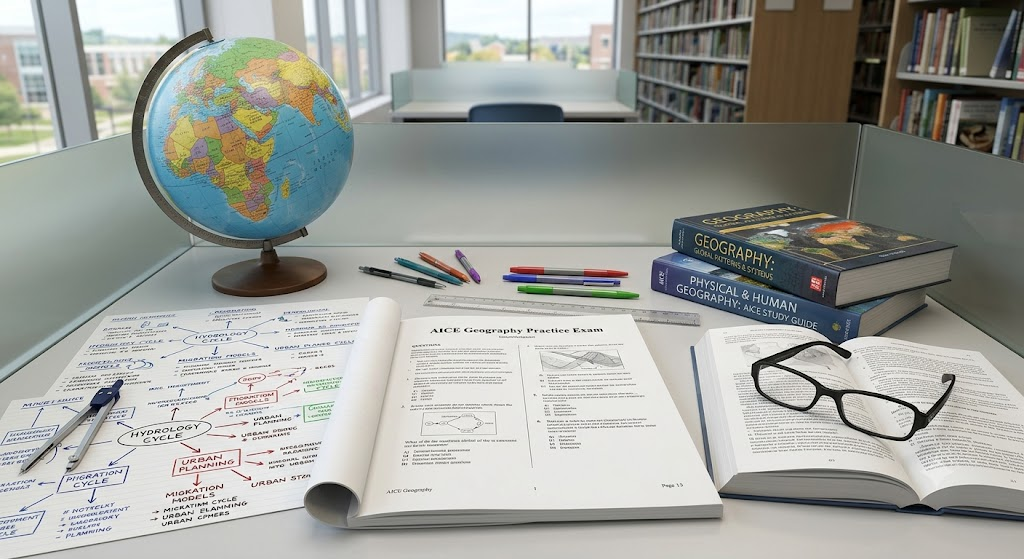
Additional Information
What the Course Entails and Exam Details
The AICE Geography curriculum is extensive, divided between a core curriculum and advanced specializations. At the Advanced Subsidiary (AS) level, students typically focus on the Core Geography syllabus, which includes both physical and human components. The Core Physical topics encompass 'Hydrology and Fluvial Geomorphology,' 'Atmosphere and Weather,' and 'Rocks and Weathering.' The Core Human topics cover 'Population,' 'Migration,' and 'Settlement Dynamics.'
For those pursuing the full Advanced (A) Level, candidates must also study two options from Advanced Physical Geography and two options from Advanced Human Geography. Advanced Physical options include 'Tropical Environments,' 'Coastal Environments,' 'Hazardous Environments,' and 'Hot Arid and Semi-Arid Environments.' Advanced Human options include 'Production, Location and Change,' 'Environmental Management,' 'Global Interdependence,' and 'Economic Transition.' Throughout the entire course, geographical skills, such as cartography, data interpretation, and statistical analysis, are integrated into all topics.
What to Expect in the Final Exam
The AICE Geography final assessment is not a single test but a series of timed, written papers. A student's performance across these papers determines their overall grade. Typically, AS Level candidates sit for two papers: Paper 1 (Core Physical Geography) and Paper 2 (Core Human Geography). Full A Level candidates must sit for these two papers and add Paper 3 (Advanced Physical Options) and Paper 4 (Advanced Human Options).
The specific exam details for each paper are as follows:
Paper 1 (Core Physical Geography) & Paper 2 (Core Human Geography): Each is 1 hour and 30 minutes, worth 60 marks, and accounts for 50% of the standalone AS Level or 25% of the A Level. Both follow a two-section structure. Section A requires answering all data response questions, which are resource-based. Section B requires selecting and answering one longer, structured question from a choice of three.
Paper 3 (Advanced Physical Options) & Paper 4 (Advanced Human Options): Each is 1 hour and 30 minutes, worth 60 marks, and accounts for 25% of the full A Level. In these papers, students choose two of the four optional topics and must answer one resource-based question and one essay question for each chosen topic.
There are no specified passing scores, as Cambridge uses an A*-E grading scale. Success is highly dependent on effective time management, a detailed knowledge of case studies, and the ability to structure coherent arguments under pressure.
How to Study and Exam Centers
Preparation for the AICE Geography exam must go beyond simple memorization. Active engagement with the material is crucial.
First, master geographical skills. Practice sketching maps, interpreting graphs, analyzing aerial photographs, and understanding satellite imagery; these skills are tested across all papers.
Second, develop and use varied case studies. Examiners look for specific, well-developed examples from your local, national, or regional context to support generalized concepts. A single, rich case study is far more effective than several vague ones.
Third, practice with past exam papers. This is perhaps the most critical strategy. Become comfortable with the command words (e.g., 'describe,' 'explain,' 'discuss,' 'evaluate') and the marking schemes to understand exactly what assessors are looking for in each question type.
AICE exams are not taken through open public portals like Pearson VUE. Students must be enrolled in a registered Cambridge International School or an authorized examination center. If you are not in a registered AICE school, you must locate an authorized local center that accepts private candidates for the specific 'June' or 'November' exam series.
Job Opportunities from the Course
A strong performance in AICE Geography opens doors to numerous career paths that require spatial analysis, environmental understanding, and a global perspective. This qualification is highly valued by universities and employers as proof of complex problem-solving and critical reasoning abilities.
Here are specific job opportunities and career paths:
Urban and Regional Planner
Environmental Consultant
Geographic Information Systems (GIS) Officer/Analyst
Cartographer and Photogrammetrist
Conservation Officer
Economic Development Officer
International Aid/Development Worker
Market Research Analyst
Transportation Planner
Sustainable Development Officer
Demographer
Hydrologist
Meteorologist
Teacher (Geography/Social Studies)
Frequently Asked Questions
Reviews
5.0
Based on 0 reviews
Leave a Review
No reviews yet. Be the first to review!