
AICE Environmental Management Practice Exam
$69.00
- Buy to unlock unlimited access to all Quiz questions.
- After purchase you can print a PDF of the whole quiz at any point. The PDF will contain the questions and the correct answers.
About this Exam
The AICE Environmental Management course is a challenging pre-university qualification designed for students interested in understanding the relationship between humans and the natural world. It bridges the gap between environmental science, geography, and social studies, preparing students for higher education in sustainable fields. This exam evaluates a student's grasp of ecological processes, resource management strategies, and the impact of human activities on global systems. Taking a structured practice exam is a crucial step for students aiming to identify knowledge gaps, refine their time management skills, and build confidence before the official Cambridge assessment.
Ready to test your knowledge?
Buy Now to Access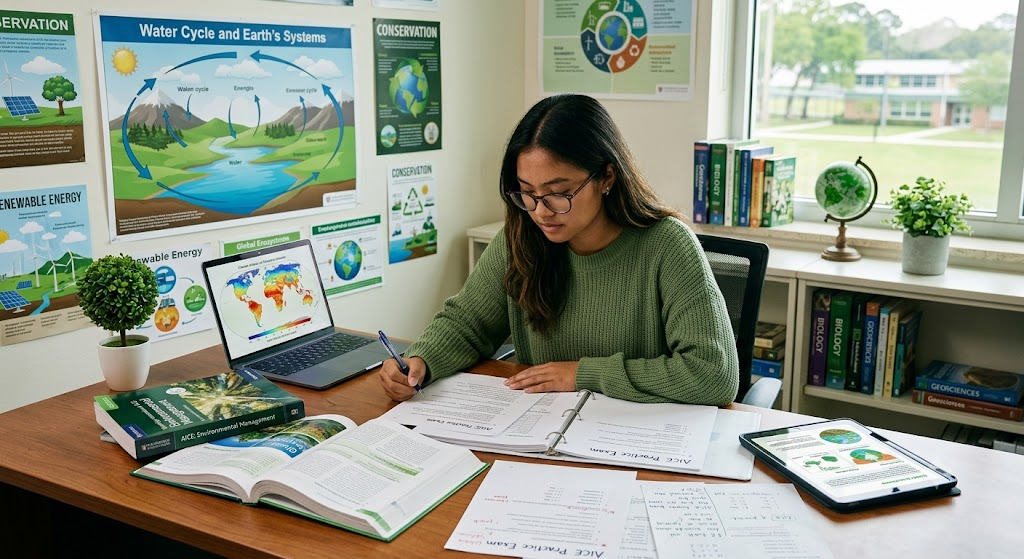
Additional Information
What the Course Entails and Exam Details
The AICE Environmental Management syllabus is divided into several core themes that emphasize sustainable development.
Key areas covered in the course and assessment include:
The Earth’s Systems: Understanding geological processes, the atmosphere, hydrology, and biomes.
Ecosystems and Biodiversity: Studying population dynamics, energy flow, and conservation methods.
Resource Management: Evaluating the sustainable use of water, energy, and soil.
Global Environmental Challenges: Analyzing pollution, climate change, population growth, and urban sprawl.
Sustainable Management Strategies: Examining international agreements, environmental impact assessments, and conservation laws.
Students will be tested on their ability to interpret data, apply scientific principles, and construct balanced arguments about complex environmental issues.
What to Expect in the Final Exam
The official Cambridge International AICE Environmental Management exam is typically structured in two parts, rather than a single digital practice test format.
AICE Exam Format Structure:
Paper 1: Lithosphere and Atmosphere (Structured and Essay Questions): This paper focuses on geological systems, soils, and atmospheric science. It is usually 1 hour 30 minutes.
Paper 2: Hydrosphere and Biosphere (Structured and Essay Questions): This paper addresses water resources, ecosystems, and biodiversity. It is also usually 1 hour 30 minutes.
Exam Details:
Question Types: Both papers feature sectioned, structured questions based on data and diagrams, as well as extended essay questions requiring in-depth analysis.
Passing Score Requirements: Cambridge utilizes a grading system (A* to E). A passing score generally means achieving a minimum defined percentage across both papers, which is set annually.
Time Limits: Students must adhere strictly to the 1 hour 30 minute time limit for each paper.
Rules: Standard examination rules apply, including no outside resources or electronic devices.
How to Study and Exam Centers
How to Study Effectively for the Exam:
Master the Syllabus: Download and review the exact Cambridge syllabus for your exam year. It contains all essential topics.
Utilize Past Papers: This is critical. Regularly practicing with official past exam papers helps you understand the specific wording of questions and common data interpretation styles.
Focus on Case Studies: AICE examiners value detailed examples. Prepare robust case studies of real-world environmental management initiatives (e.g., specific water management projects, ecosystem restorations).
Timed Practice: Mimic exam conditions by timing yourself when completing practice papers to build speed and stamina.
Active Recall: Use flashcards and diagrams to memorize geological cycles and ecological definitions.
Exam Centers:
AICE exams cannot be taken at random public centers. They are administered exclusively through authorized Cambridge International schools. Students are registered by their school's Cambridge coordinator.
If you are a private candidate, you must locate an authorized Cambridge school in your region that is willing to accept private entries. This information can be found via the "Find a Cambridge school" tool on the Cambridge International website.
Job Opportunities from the Course
Achieving a qualification in AICE Environmental Management is a valuable stepping stone toward numerous career paths in sustainability, science, and policy. This qualification demonstrates a foundational understanding of the environment and strong analytical skills.
Career paths and job opportunities include:
Environmental Scientist (Entry Level)
Conservation Officer
Urban and Regional Planner (Sustainability Focus)
Geoscientist Technician
Policy Analyst (Environmental Sector)
Sustainability Consultant
Geographical Information Systems (GIS) Technician
Wildlife Biologist (Entry Level)
Hydrologist Assistant
Frequently Asked Questions
Reviews
5.0
Based on 0 reviews
Leave a Review
No reviews yet. Be the first to review!