
AI Prompt Engineering and Key Concepts in Machine Learning and NLP Practice Test
$69.00
- Buy to unlock unlimited access to all Quiz questions.
- After purchase you can print a PDF of the whole quiz at any point. The PDF will contain the questions and the correct answers.
About this Exam
The AI Prompt Engineering and Key Concepts in Machine Learning and NLP Practice Test is designed as a foundational milestone for professionals, students, and AI enthusiasts aiming to validate their expertise in the rapidly evolving field of generative artificial intelligence. This exam bridges the gap between technical understanding and practical application. It ensures you have the knowledge required not only to build and understand these models but also to communicate effectively with them to drive business value. It is crafted for aspiring AI specialists, data scientists, machine learning engineers, and any professional seeking to leverage the power of Large Language Models (LLMs) in their daily workflow. This practice test helps you identify knowledge gaps and ensures you are fully prepared for the final certification challenge.
Ready to test your knowledge?
Buy Now to Access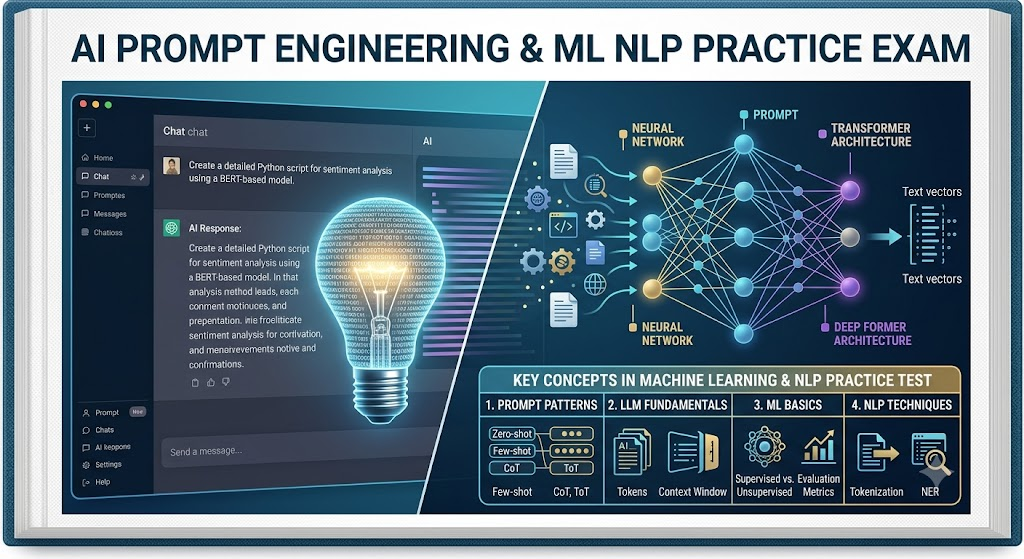
Additional Information
What the Course Entails and Exam Details
This comprehensive practice test covers a blend of theoretical knowledge and practical applications essential for modern AI practitioners. The core domains include:
Prompt Engineering Techniques: Mastering standard design patterns including zero-shot, few-shot, chain-of-thought, tree-of-thought, and generated knowledge prompting. You will also learn to refine prompts for specific constraints, output formats, and desired tones.
Large Language Model (LLM) Fundamentals: Understanding the underlying architecture of LLMs, the concept of tokens and context windows, and how model parameters influence output variability.
Key Concepts in Machine Learning (ML): Validating a foundational understanding of the machine learning lifecycle, supervised versus unsupervised learning, neural network basics, and deep learning principles.
Key Concepts in Natural Language Processing (NLP): Demonstrating competency in text preprocessing (tokenization, stemming, lemmatization), sentiment analysis, named entity recognition (NER), and information retrieval concepts.
Ethical and Responsible AI: Recognizing the ethical implications of AI deployment, including the detection and mitigation of bias, hallucination, and data privacy risks.
The exam itself is a structured assessment, simulating the pressure and format of a final certification.
What to Expect in the Final Exam
While actual exam specifications can vary, this practice test prepares you for a common final certification format. A standard comprehensive exam generally adheres to the following parameters:
Format: Typically administered as a multiple-choice, single-response, and multiple-response assessment. This allows for a broad and fair evaluation of conceptual knowledge.
Practical Component: Some versions may include scenario-based questions that ask you to debug a failing prompt or choose the best prompting pattern for a given business goal.
Passing Score Requirements: Candidates often need to achieve a score of approximately 70% to 75% to pass the certification.
Time Limits: You should expect to complete the entire assessment within 90 to 120 minutes.
Specific Rules: Final exams are usually delivered via online proctoring, requiring a clear testing space and stable internet connection.
How to Study and Exam Centers
Preparation is the absolute key to success on a foundational exam like this. Effective strategies include:
Review Official Documentation: Study the syllabus of the relevant certification body or training provider extensively.
Take Multiple Practice Tests: Do not stop after a single pass. Repetition is essential for identifying patterns and mastering new concepts.
Engage in Hands-on Practice: Use free or low-cost credits from platforms like OpenAI, Google Cloud, or AWS to build simple projects applying zero-shot, few-shot, and chain-of-thought techniques to real problems.
Study Key Definitions: Build a glossary of terms for essential ML and NLP concepts like "overfitting," "f1 score," "transformer model," and "embeddings."
When you are ready to take the final exam, most modern AI certifications are taken remotely. They are typically administered via secured, online proctoring portals. Examples of such systems include Pearson VUE, or specific proprietary learning management systems provided by the certifying body. While physical testing centers still exist, the overwhelming majority of candidates now opt for the convenience of remote testing. You can schedule your slot at any time from your authorized student dashboard.
Job Opportunities from the Course
A certification in AI Prompt Engineering and machine learning concepts opens doors to numerous career paths across industries desperate for AI literacy. The specialized skills you validate are directly transferable to roles such as:
AI Prompt Engineer: A dedicated specialist who designs, refines, and optimizes prompts to maximize the performance of large language models for various tasks.
Machine Learning Engineer: An engineer who designs and builds the machine learning models and systems that power AI applications.
NLP Specialist: A specialist focused on the interaction between computers and human language, developing tools for translation, sentiment analysis, and chat.
Data Scientist: A professional who uses advanced analytics and machine learning to extract insights from complex datasets, including text.
AI Content Specialist: A modern content professional who builds automation tools using generative AI to produce and optimize high-quality content at scale.
AI Product Manager: A manager who oversees the development and strategy of AI-powered products, defining use cases and feature requirements.
Frequently Asked Questions
Reviews
5.0
Based on 0 reviews
Leave a Review
No reviews yet. Be the first to review!