
AI in Education: Trends, Usage, and Future Strategies Practice Test
$69.00
- Buy to unlock unlimited access to all Quiz questions.
- After purchase you can print a PDF of the whole quiz at any point. The PDF will contain the questions and the correct answers.
About this Exam
Welcome to your essential preparation resource for the [AI in Education: Trends, Usage, and Future Strategies] certification. This forward-looking exam is designed for educators, instructional designers, educational administrators, and technology professionals who are ready to lead the integration of Artificial Intelligence into learning environments.
It validates your understanding of how AI is reshaping pedagogy, personalizing student learning experiences, and optimizing administrative workflows. If you are looking to become a certified expert in navigating the ethical and practical landscape of AI in schools and universities, this is the crucial first step. This practice test helps you gauge your readiness for the official certification exam.
Ready to test your knowledge?
Buy Now to Access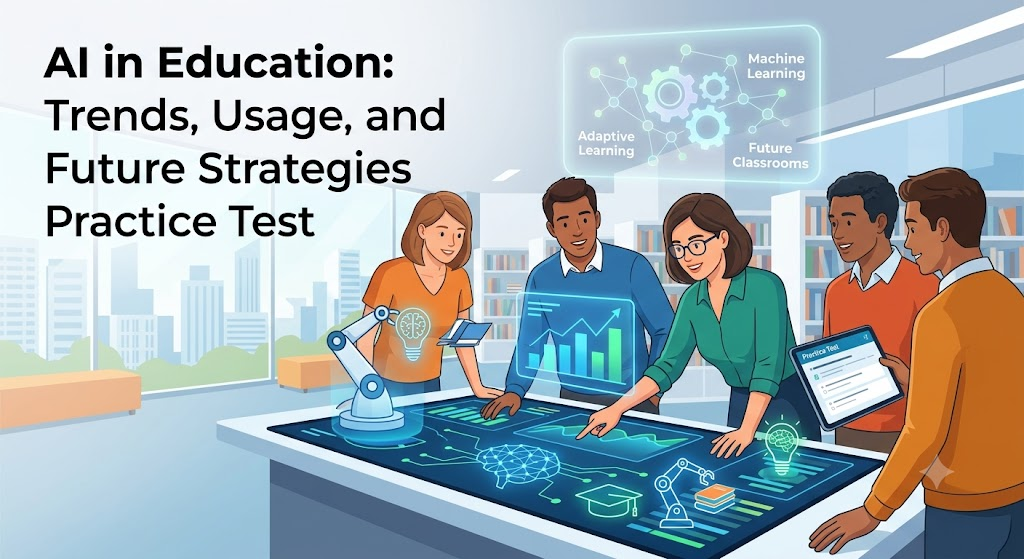
Additional Information
What the Course Entails and Exam Details
This comprehensive certification covers the critical intersection of modern technology and educational theory. The curriculum focuses on understanding the current trends, historical context, and immediate applications of AI tools in classrooms and curriculum development.
Core topics and skills covered include:
Foundations of AI in Education: Understanding Machine Learning, Natural Language Processing, and Generative AI within an educational framework.
Adaptive Learning Platforms: How to use AI to create personalized learning paths for diverse student populations.
AI for Administrative Efficiency: Utilizing chatbots, automated grading, and predictive analytics for enrollment and retention.
Ethics and Equity: Addressing data privacy, algorithmic bias, and ensuring equitable access to AI-driven educational resources.
Future Strategies: Developing long-term plans for implementing AI technology in educational institutions.
What to Expect in the Final Exam
The formal certification exam is a rigorous assessment of both theoretical knowledge and practical scenario analysis. It mimics the challenges you will face when deploying AI solutions in real-world educational settings.
Exam Format:
Type of Questions: The exam consists primarily of multiple-choice questions and scenario-based problem-solving tasks.
Time Limit: Candidates typically have 90 minutes to complete the exam.
Passing Score: A passing score of 75% or higher is generally required to achieve certification.
Delivery: The exam is delivered in a proctored environment, ensuring integrity and standardizing the testing experience for all candidates.
How to Study and Exam Centers
Effective preparation for this exam requires a blend of conceptual study and practical application review. This practice test is an excellent starting point to identify knowledge gaps.
Study Strategies:
Review the Official Syllabus: Prioritize your study time based on the weightage given to different domains in the official exam blueprint.
Analyze Case Studies: Look for real-world examples of successful (and unsuccessful) AI implementations in education to understand practical challenges.
Take Multiple Practice Tests: Familiarize yourself with the questioning style and time constraints.
Stay Updated on Trends: The field of AI moves rapidly. Supplement your study with recent articles and whitepapers on educational technology.
Exam Centers:
The final certification exam can be taken through authorized testing partners. Candidates have two primary options:
Online Proctored Exams: You can take the exam from your home or office using a computer with a webcam and a stable internet connection, under the supervision of a remote proctor.
Physical Testing Centers: You may schedule your exam at authorized Pearson VUE testing centers or affiliated educational institutions globally.
Job Opportunities from the Course
Earning this certification signals to employers that you possess the specialized knowledge needed to navigate the future of learning. It opens doors to several high-impact roles in the evolving education sector.
Instructional Designer (with AI Specialization): Creating curriculum and learning materials that leverage AI tools for personalization and engagement.
EdTech Specialist / AI Integration Lead: Guiding schools and districts in the selection, implementation, and management of educational technology platforms.
Learning Analytics Administrator: Using AI-driven data to analyze student performance trends and improve institutional outcomes.
Director of Academic Technology: Overseeing the strategic adoption of technology, including AI, across an educational institution.
AI Educator / Trainer: Training faculty and staff on the effective and ethical use of AI tools in their teaching practice.
Frequently Asked Questions
Reviews
5.0
Based on 0 reviews
Leave a Review
No reviews yet. Be the first to review!