
Ahpcsa Practice Test & Exam Prep | South Africa
$69.00
- Buy to unlock unlimited access to all Quiz questions.
- After purchase you can print a PDF of the whole quiz at any point. The PDF will contain the questions and the correct answers.
About this Exam
The Allied Health Professions Council of South Africa (AHPCSA) holds a crucial role in regulating a diverse range of allied health professions across the country.
This [AHPCSA Practice Test & Exam Prep | South Africa] study guide is specifically designed for aspiring practitioners in these fields who are preparing for their required AHPCSA registration examinations. Successful completion of these examinations is a fundamental requirement to gain registration and legally practice within these vital healthcare disciplines in South Africa.
Ready to test your knowledge?
Buy Now to Access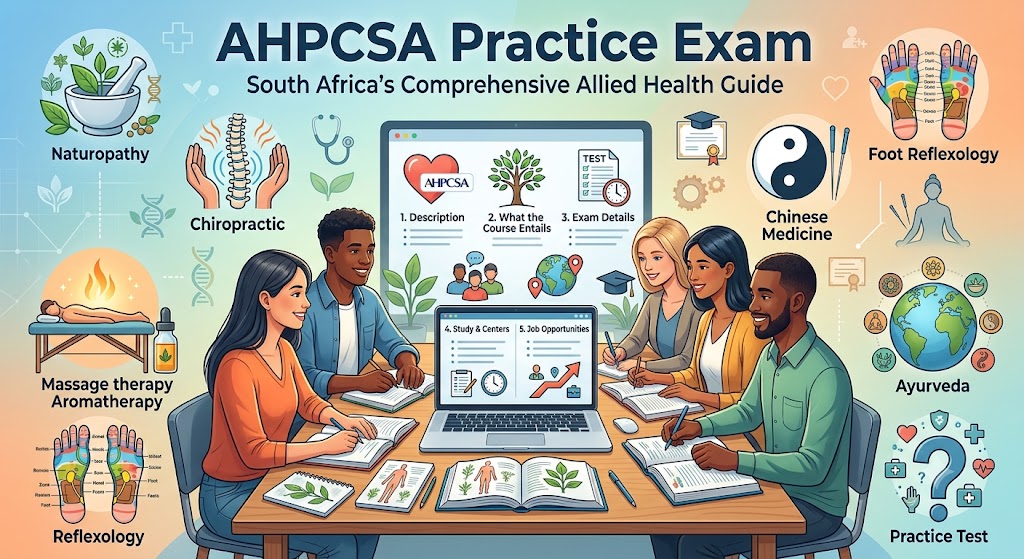
Additional Information
What the Course
Entails and Exam Details
Preparing for the AHPCSA exams requires a deep understanding
of the core topics and skills within your chosen allied health discipline. The
knowledge and expertise you have built throughout your formal education and
training will be the foundation of your exam preparation.
While the specific contents of each examination are tailored
to the individual professional board and the field itself (e.g., a Chiropractic
exam will focus on spinal health and adjustment, while an Acupuncture exam will
assess knowledge of meridians and point location), certain core areas are
typically covered in a generalized sense and are vital for professional
practice.
These essential domains often include:
- Human
Anatomy and Physiology: A comprehensive understanding of the body's
structure and function.
- Pathology
and Diagnostics: The study of diseases, their causes, and the
knowledge required to understand patient conditions, particularly relevant
for diagnostic practitioners.
- AHPCSA
Code of Ethics and Professional Conduct: Crucial rules and guidelines
regarding ethical behavior, patient confidentiality, and proper practice.
- South
African Health Legislation: Awareness of the legal framework within
which allied health professionals must operate, including the Allied
Health Professions Act.
- Discipline-Specific
Theory and Practice: Deep knowledge of the principles, methods, and
clinical applications of your specific field (Homeopathy, Massage Therapy,
etc.).
- Clinical
Skills and Patient Management: The practical application of your
knowledge, from initial assessment to treatment planning and follow-up.
It is important to understand that there is no single
"AHPCSA Course" that leads to the exam. The exam assesses the
knowledge gained from your approved, accredited educational qualifications in
your specific allied health field. Therefore, the detailed syllabus, required
skills, and core knowledge base are defined by the specific professional board
corresponding to your discipline and the educational institutions from which
you graduated. Students must refer to the specific information provided by
their relevant professional board within the AHPCSA for the exact breakdown of
examinable topics.
What to Expect in the Final Exam
AHPCSA final exams are comprehensive and designed to test
both theoretical understanding and, for some disciplines, practical/clinical
competency. The specific format, number of questions, and structure are
determined by each individual professional board. It is essential to
proactively consult the specific guidelines for your particular field.
Generally, however, you can expect elements of the following:
- Format:
The exams may incorporate a mix of written (often multiple-choice, short
answers, or essay questions) and potentially practical/clinical
components. Some boards might include a viva voce (oral examination).
- Theoretical
Component: This section typically tests your recall, application, and
analysis of core knowledge – including ethics, legislation, anatomy, and
your specific discipline's theory. Written exams are often multiple-choice
question format (MCQ), but can include structured short answers or essays.
- Practical/Clinical
Component: For certain professions (especially diagnostic
practitioners like chiropractors or therapeutic fields), a practical exam
or a series of clinical assessments may be required. This allows you to
demonstrate your clinical reasoning, assessment skills, treatment
planning, and practical application of techniques on a simulated patient
or in a real-world clinical setting.
- Passing
Score: The required passing score is set by the relevant professional
board and can vary. It is essential to confirm the specific pass mark for
your exam directly from AHPCSA communications or the specific board's
documentation. Generally, a high level of competency is expected.
- Time
Limits: All components of the exam, whether written or practical, will
have specified time limits. This emphasizes the importance of effective
time management and thorough preparation.
- Rules
and Regulations: The AHPCSA and individual boards have strict rules
regarding conduct, identification, required documentation (such as
transcripts and photos, as found in the registration guidelines), and the
consequences of any academic misconduct. These are in place to ensure
fairness and maintain the integrity of the examination process. You will
receive detailed instructions from the AHPCSA regarding the process when
you are scheduled to take your exam.
How to Study and
Exam Centers
Effective study and clear guidance on where to take the exam
are keys to success. Here are actionable study strategies and essential
information on the examination process:
Study Strategies:
Use Official Resources:
Start with any study guides, syllabi, or candidate handbooks provided directly
by the AHPCSA or your specific professional board. These are the most accurate
sources of what will be covered.
Review Course Materials:
Go back through your lecture notes, textbooks, and clinical training manuals
from your formal education. Focus on key concepts and areas highlighted in your
curriculum and in line with potential exam topics.
Prioritize Core Subjects:
Ensure a very strong grasp of foundational knowledge (Anatomy, Physiology,
Pathology, Ethics, Legislation). These are universally essential.
Practice on Past Papers (if
available): While previous AHPCSA papers may not always be widely public,
check official channels or your educational institution if they can provide
illustrative examples or similar past papers for practice. Practice under timed
conditions if possible.
Form Study Groups:
Collaborating with fellow students can provide different perspectives, help
clarify difficult concepts, and offer valuable emotional and motivational
support.
Practice Clinical Skills (if
applicable): If your exam includes a practical component, devote
significant time to practicing assessments, clinical reasoning, and techniques
with peers or in a supervised clinical setting.
Manage Your Time: Create a
detailed study schedule that covers all examinable topics. Don't leave your
studying to the last minute; consistency and well-distributed study sessions
are more effective.
Understand Ethics and
Legislation: Do not underestimate the importance of the professional code
of ethics and health law in South Africa. Thoroughly review these specific
sections, as they often have separate, highly significant assessment
components.
How to Take the Exam and Exam Centers:
- Registration
Process: The entire exam process is initiated by registering as a
student or aspiring practitioner with the AHPCSA in your relevant field.
This typically requires submitting specific documentation, photos,
academic transcripts, and paying relevant fees. Once registered, the
council/board will provide information and notification regarding
scheduling and eligibility for the actual exam.
- Exam
Notification: All information regarding examination dates, formats,
locations, and fees will be communicated officially by the AHPCSA and your
specific professional board directly to registered candidates. You will
receive clear details on how to register for the specific exam itself
and the steps involved.
- Exam
Delivery: Exams are typically managed and conducted in a formal
environment. For some professions and sections (e.g., written MCQs), these
might be facilitated through standardized testing centers (like dedicated
physical centers or, in some specific cases and depending on the board,
possibly via secure online platforms).
- Physical
Testing Centers: Many AHPCSA exams, especially those with practical
components or those in fields like Chiropractic and Homeopathy, are
traditionally held at physical locations such as specified educational
institutions, major hospitals, or purpose-built examination centers across
key regions in South Africa (e.g., Gauteng, Western Cape, KwaZulu-Natal).
- Online
Portals & Communication: Be sure to keep your contact details
updated with the AHPCSA and regularly check their official website,
student portals, and your direct email for any updates or instructions. The
AHPCSA's primary method of communication regarding exams and other
registration requirements is through their official channels. Always rely only
on direct information provided by the AHPCSA rather than third-party or
unauthorized sources.
Job Opportunities from the Course
Passing the AHPCSA registration examination and successfully
registering with the council unlocks a wide range of career opportunities
across various complementary and allied health professions. Successful
registration allows you to practice as:
- Acupuncturist
- Ayurvedic
Practitioner
- Chiropractor
- Homeopath
- Naturopath
- Osteopath
- Phytotherapist
(Western Herbal Medicine)
- Therapeutic
Aromatherapist
- Therapeutic
Massage Therapist
- Therapeutic
Reflexologist
- Traditional
Chinese Medicine Practitioner
Registered practitioners in these fields can choose from
diverse working environments, including:
- Private
Practice: Establishing and running your own allied health clinic or
practice.
- Hospitals
and Healthcare Facilities: Collaborating in multi-disciplinary teams
within public and private healthcare settings.
- Wellness
and Spas: working within wellness centers, retreats, or dedicated
therapeutic spas (especially therapeutic therapists).
- Research
and Education: Contributing to academic research or teaching in the
field.
- Corporate
Wellness: Designing and delivering wellness programs for corporate
clients.
- Specialized
Clinics: Focusing on specific patient populations or types of
conditions within specialized clinics.
Your professional registration with the AHPCSA gives you the
legal standing and public trust required to build a fulfilling and impactful
career in your chosen area of healthcare, contributing to the health and
well-being of the South African population. Always remember to stay updated
with your continuing professional development (CPD) requirements after
registration. Good luck with your studies and preparation
Frequently Asked Questions
Reviews
5.0
Based on 0 reviews
Leave a Review
No reviews yet. Be the first to review!