
AHA PALS Final Exam Questions and Answers
$69.00
- Buy to unlock unlimited access to all Quiz questions.
- After purchase you can print a PDF of the whole quiz at any point. The PDF will contain the questions and the correct answers.
About this Exam
The American Heart Association (AHA) Pediatric Advanced Life Support (PALS) certification is a vital credential for healthcare providers responsible for managing critically ill or injured children and infants.
This advanced course goes beyond Basic Life Support (BLS) to focus on a comprehensive, systemic approach to pediatric assessment, stabilization, and advanced resuscitation.
It is specifically designed for professionals who work in emergency medicine, intensive care, critical care units, and pre-hospital settings, including physicians, nurses, paramedics, and respiratory therapists.
By completing this certification, you demonstrate the specialized skills and knowledge required to improve outcomes for pediatric patients in respiratory distress, shock, or cardiac arrest.
Ready to test your knowledge?
Buy Now to Access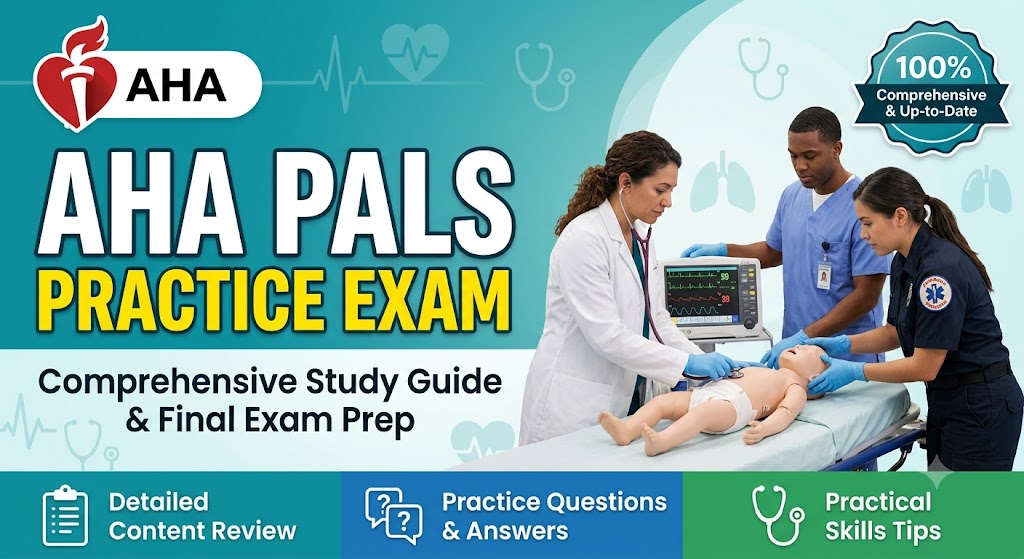
Additional Information
What the Course Entails and Exam Details
The PALS course structure balances theoretical knowledge with hands-on skill mastery.
Core topics covered in the curriculum include the systematic approach to pediatric assessment (using the ABCDE model), the recognition and management of respiratory emergencies, and the treatment of different types of shock.
Participants also receive intensive training in pediatric cardiac arrest algorithms, the management of arrhythmias such as tachycardia and bradycardia, and the appropriate use of pediatric pharmacology and electrical therapy (defibrillation/cardioversion).
Crucially, the course emphasizes the importance of effective team dynamics and communication during high-stress resuscitation events.
The certification is usually granted upon the successful completion of two main components: a practical skills evaluation and a written final exam.
What to Expect in the Final Exam
The PALS Final Exam is designed to rigorously test your ability to apply the AHA guidelines to real-world scenarios.
The written portion of the exam typically consists of multiple-choice questions—often around 50 questions—testing your knowledge of algorithms, medication dosages, and rhythmic interpretation.
A passing score of 84% or higher is generally required to secure your certification card.
This exam is usually timed, and while policy can vary, the final exam may be an open-resource assessment, meaning you can consult your provider manual; however, this requires high efficiency and familiarity with the material.
The most critical part of the final exam process, however, is the practical skills session, known as the "Megacode."
During the Megacode scenario, you will be required to lead a resuscitation team through a complex pediatric emergency, demonstrating not only perfect execution of the algorithms but also strong leadership, delegation, and clear communication under pressure.
How to Study and Exam Centers
Preparation is paramount for PALS success, as the final exam requires split-second application of complex medical protocols.
The official AHA PALS Provider Manual is your definitive resource; you must read it thoroughly and focus intensely on the core treatment algorithms.
Consistent practice is key: use the practice questions and case scenarios available online through authorized training sites to familiarize yourself with the decision-making patterns the exam demands.
Creating study tools, such as EKG rhythm flashcards and medication dosage charts (weight-based), can help cement the specific details you will need to recall quickly.
You should practice the 1- and 2-person CPR techniques for infants and children, and the use of a bag-mask device and an AED, well before your physical skills session.
When you are ready to take the final exam, you will need to locate an authorized AHA Training Center or an approved testing site.
These are often hospital education departments, community colleges, or specialized medical training schools.
Many providers offer hybrid options where the written, multiple-choice cognitive test can be completed through an online portal (e.g., eCards), but the practical Megacode evaluation and skills verification must always be completed in person with a certified PALS instructor.
Job Opportunities from the Course
A PALS certification is not just a regulatory requirement; it is a significant asset that can expand your professional horizons and unlock advanced career paths within healthcare.
Many institutions require this certification as a prerequisite for hiring into specialized units.
A list of specific job titles and career opportunities unlocked by this certification includes:
Pediatric Emergency Room Nurse (RN)
Pediatric Intensive Care Unit (PICU) Nurse
Neonatal Intensive Care Unit (NICU) Nurse or Practitioner
Paramedic
Emergency Medical Technician (EMT-P/Critical Care)
Respiratory Therapist
Emergency Medicine Physician
Pediatrician
Anesthesiologist (focus on pediatric cases)
Flight Nurse or Flight Medic (Pediatric Transport)
Critical Care Transport Specialist
Pediatric Surgical Nurse
Frequently Asked Questions
Reviews
5.0
Based on 0 reviews
Leave a Review
No reviews yet. Be the first to review!