
Aha CPR Practice Test & Exam Prep
$69.00
- Buy to unlock unlimited access to all Quiz questions.
- After purchase you can print a PDF of the whole quiz at any point. The PDF will contain the questions and the correct answers.
About this Exam
The American Heart Association (AHA) Cardiopulmonary Resuscitation (CPR) certification is a foundational life-saving credential designed for anyone who might encounter a cardiac arrest emergency. It is the gold standard for CPR training globally. This certification validates your ability to recognize a life-threatening emergency, perform high-quality chest compressions, deliver appropriate rescue breaths, and utilize an Automated External Defibrillator (AED). The exam and its preparatory courses are tailored for two distinct groups: healthcare professionals needing Basic Life Support (BLS) certification (e.g., nurses, doctors, EMTs) and "lay rescuers" requiring Heartsaver certification for workplace or personal readiness (e.g., teachers, lifeguards, parents). Successfully passing this exam demonstrates your competence and confidence to act during critical moments to help save a life.
Ready to test your knowledge?
Buy Now to Access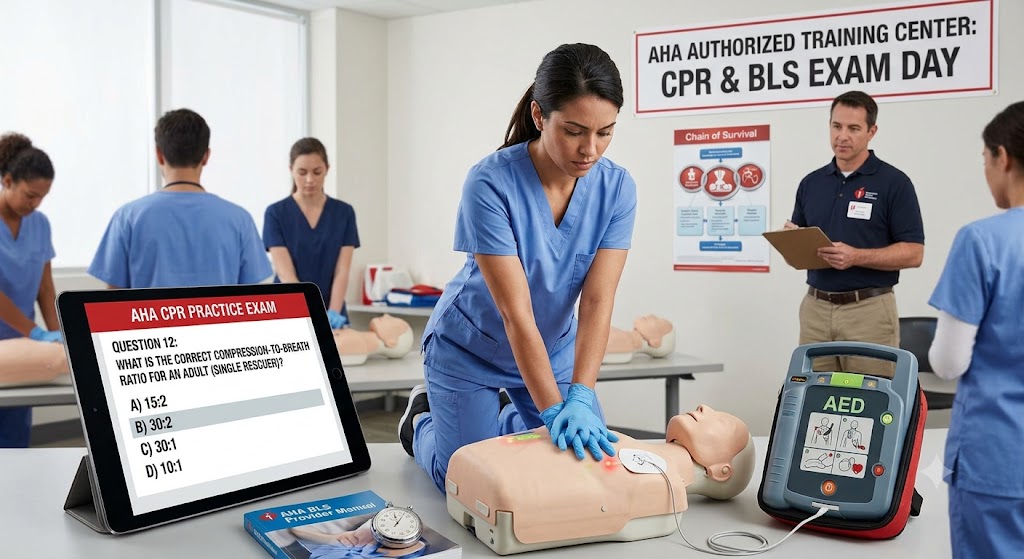
Additional Information
What the Course Entails and Exam Details
The course and final exam cover comprehensive protocols
developed by the AHA, based on the latest science for cardiopulmonary
resuscitation and emergency cardiovascular care. Whether you are taking the BLS
or Heartsaver path, the core skills you must master are similar, but the depth
of assessment and team dynamics differ. The exam tests your critical knowledge
and practical proficiency in several key areas. You must understand the Chain
of Survival, which includes early recognition of cardiac arrest, rapid
activation of emergency response, and starting CPR immediately. You will learn
the correct techniques for adult, child, and infant CPR, including the proper
depth and rate of chest compressions (100–120 per minute) and the correct ratio
of compressions to rescue breaths (30:2 for single rescuers). Additionally, you
will be trained on the proper and safe use of an AED, including pad placement
and following the device's voice prompts. Airway management and choking relief
for conscious and unconscious victims of all ages are also crucial components
covered by the exam.
What to Expect in
the Final Exam
The final certification exam from the AHA consists of two
required parts that you must pass: a written cognitive exam and a practical
hands-on skills assessment. For the written portion, you will encounter
multiple-choice questions that evaluate your knowledge of the CPR and AED
algorithms, appropriate techniques for different age groups, and special
resuscitation scenarios. In some authorized training centers, this written test
may be scenario-based to test your decision-making abilities. The second, and
equally critical, component is the hands-on skills test. Under the direct
supervision of an AHA-certified instructor, you must demonstrate proficiency in
high-quality CPR on adult, child, and infant manikins. This includes performing
correct compressions, providing ventilation using a barrier device (like a
pocket mask or bag-mask device for BLS), and correctly operating an AED with
minimal interruption. To achieve certification, you typically need a score of
84% or higher on the written exam and must successfully demonstrate all
critical steps in the skills evaluation. While individual course times can
vary, the combined test generally takes between 1.5 to 3 hours, and specific
authorized training center rules will be provided at the start of your session.
How to Study and
Exam Centers
Effective preparation is key to success on the AHA CPR exam,
which is designed to ensure you can perform under pressure. The absolute best
resource is the official AHA Provider Manual for your specific course (either
BLS for Healthcare Providers or Heartsaver CPR AED). Read this guide thoroughly
and use the included skills checklists. Utilize visual aids by watching AHA
instructional videos and other high-quality demonstrations to lock in the
proper rhythm and technique, especially for chest compressions and ventilation.
Your training program will provide opportunities for hands-on practice, and you
should take advantage of this time to build muscle memory on the manikins.
Taking practice tests is highly recommended. These practice exams simulate the
real test environment, help identify areas where you need further review, and
familiarize you with the wording and logic of the AHA guidelines. The final
exam must be taken in person at an authorized AHA Training Center (TC). You can
locate an authorized provider near you using the "Find a Course"
locator on the official American Heart Association website (cpr.heart.org).
Many centers offer blended learning options, allowing you to complete the
cognitive portion online and then attend a focused "skills session"
for testing.
Job Opportunities from the Course
A current AHA CPR or BLS certification is a mandatory
prerequisite for numerous professional paths and can be a significant advantage
in many other fields. This single credential opens doors across the healthcare,
public safety, education, and service industries.
Here is a partial list of the job opportunities unlocked by
this course:
- Registered
Nurse (RN) and Licensed Practical Nurse (LPN)
- Emergency
Medical Technician (EMT) and Paramedic
- Physical
Therapist and Occupational Therapist
- Dental
Hygienist and Dental Assistant
- Physician
Assistant and Medical Assistant
- Home
Health Aide and Certified Nursing Assistant (CNA)
- Lifeguard
and Water Safety Instructor
- Daycare
Provider and Preschool Teacher
- K-12
School Teacher and Administrator
- Coach
and Athletic Trainer
- Fitness
Instructor and Personal Trainer
- Police
Officer and Sheriff's Deputy
- Firefighter
- Security
Guard and Event Security Staff
- Flight
Attendant and Cruise Ship Staff
- Construction
Site Safety Officer
- Office
Safety Coordinator
Frequently Asked Questions
Reviews
5.0
Based on 0 reviews
Leave a Review
No reviews yet. Be the first to review!