
AHA ACLS Post Test Answer Key 2026
$69.00
- Buy to unlock unlimited access to all Quiz questions.
- After purchase you can print a PDF of the whole quiz at any point. The PDF will contain the questions and the correct answers.
About this Exam
The American Heart Association’s (AHA) Advanced Cardiovascular Life Support (ACLS) course is an essential certification for healthcare professionals involved in the management of cardiovascular emergencies.
It goes beyond Basic Life Support (BLS) to provide advanced skills for recognizing and intervening in cardiopulmonary arrest, acute dysrhythmias, stroke, and acute coronary syndromes.
This dynamic course is designed for a wide range of personnel, including physicians, nurses, paramedics, respiratory therapists, and other healthcare providers who may need to respond to a cardiovascular emergency.
Ready to test your knowledge?
Buy Now to Access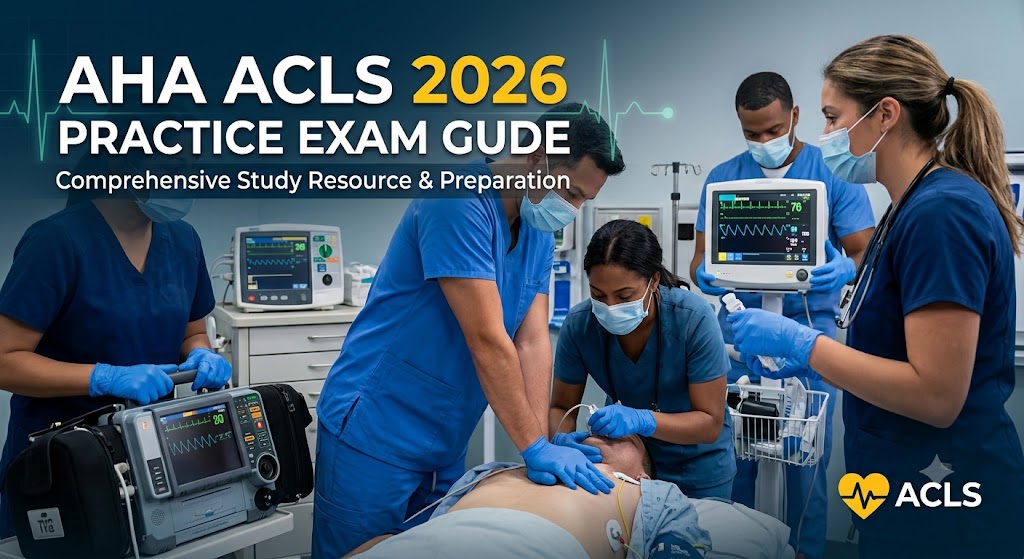
Additional Information
What the Course Entails and Exam Details
Before diving into ACLS, students are generally expected to
demonstrate proficiency in Basic Life Support (BLS) skills, including
high-quality CPR.
The core curriculum of the course covers critical areas such
as rhythm recognition and interpretation of common cardiac dysrhythmias like
Ventricular Fibrillation, Pulseless Ventricular Tachycardia, PEA, Asystole,
Bradycardia, and Tachycardia.
You will also learn about the indications and dosages of key
emergency medications, proper advanced airway management techniques, and the
effective application of standardized treatment algorithms.
Furthermore, a significant emphasis is placed on effective
teamwork and communication during high-performance resuscitation efforts,
including post-cardiac arrest care.
What to Expect in the Final Exam
The final evaluation typically consists of two primary
components that you must successfully complete to achieve certification.
First, there is a cognitive multiple-choice exam, which
often includes around 50 questions covering the key concepts and algorithms
learned in the course.
You will generally have a specific time limit, such as 60
minutes, to complete this part of the assessment, and a standard passing score,
often in the range of 84%, is required.
The second part is the practical skills testing, often
referred to as the "Megacode" scenario, where you will be required to
lead a resuscitation team and manage a simulated cardiac arrest from start to
finish.
Your performance will be evaluated based on your ability to
apply the correct algorithms, use equipment properly, and effectively
coordinate with your team members in a dynamic, time-pressured environment.
How to Study and Exam Centers
Preparation is key to succeeding in your ACLS course and
exam.
Your primary resource should be the official AHA ACLS
Provider Manual; ensure you read it thoroughly, take notes, and understand all
the concepts.
Many courses offer online pre-course work or modules, which
provide valuable practice questions and scenarios; utilize these resources to
test your knowledge as you study.
Familiarize yourself with the core algorithms for cardiac
arrest, bradycardia, and tachycardia; they are the heart of ACLS and you should
be able to apply them efficiently.
Practice your hands-on skills with mannequins if possible,
or work through simulated megacode scenarios with colleagues to improve your
confidence and team-leading abilities.
When taking practice tests, focus on understanding the
rationale behind each correct and incorrect answer to reinforce your learning;
don’t just memorize answers, but understand why the treatments are
indicated.
You won't take your ACLS exam at a standard Pearson VUE
center like many other professional licensing exams; instead, testing is
conducted as part of your training at an American Heart Association Authorized
Training Center.
These training centers can be found in a variety of
settings, including hospital education departments, community colleges,
university medical schools, and private educational organizations specializing
in healthcare certifications.
You can find authorized training centers and course
schedules through the AHA website and online portals.
Job Opportunities from the Course
Possessing an active ACLS certification is a mandatory
requirement for many healthcare roles and a highly valuable asset in countless
others, often leading to enhanced career opportunities and mobility.
Many registered nurses (RNs), particularly those working in
acute care settings like the emergency department, intensive care unit, cardiac
catheterization lab, and telemetry units, are required to be ACLS certified.
Physicians across various specializations, including
emergency medicine, cardiology, anesthesiology, internal medicine, and critical
care, must maintain this certification.
Paramedics and other advanced Emergency Medical Technicians
(EMTs) rely on ACLS skills daily and are always required to hold active
certification.
Respiratory therapists, anesthesia providers, medical
residents, and nurse practitioners often need ACLS to practice in their
respective environments.
Additionally, having this certification demonstrates your
commitment to providing high-quality care during life-threatening situations
and can make you a more competitive candidate for jobs and advancements.
Frequently Asked Questions
Reviews
5.0
Based on 0 reviews
Leave a Review
No reviews yet. Be the first to review!