
Agriculture Associate Certification Practice Exam
$69.00
- Buy to unlock unlimited access to all Quiz questions.
- After purchase you can print a PDF of the whole quiz at any point. The PDF will contain the questions and the correct answers.
About this Exam
The Agricultural Mechanics End of Pathway Assessment (EOPA) is the capstone examination designed for students who have completed a structured career and technical education (CTE) pathway in Agricultural Mechanics. This comprehensive assessment serves as a rigorous validation of the foundational knowledge and technical skills accumulated throughout the course of study. It is intended for high school and some post-secondary students seeking to demonstrate job-ready competency to potential employers in the agricultural industry. Earning this certification signifies that an individual possesses the prerequisite skills to safely and effectively work with, maintain, and repair the complex machinery and systems that power modern agriculture.
Ready to test your knowledge?
Buy Now to Access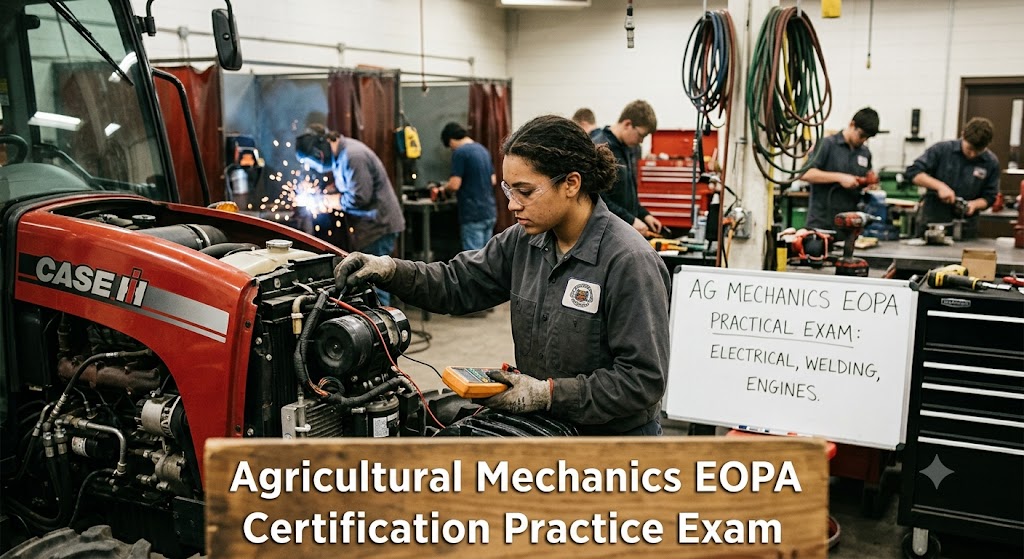
Additional Information
What the Course Entails and Exam Details
A standard Agricultural Mechanics pathway curriculum, which
the EOPA is built upon, is extensive and integrates theoretical learning with
intensive hands-on application.
Core topic areas covered in the course and assessment
include:
Safety and Shop
Management:
- Comprehensive
understanding of personal protective equipment (PPE) and its proper
application.
- Identifying
and mitigating physical, chemical, and electrical hazards in a workshop.
- Safe
handling and operation of hand tools, power tools, and stationary shop
equipment.
- Understanding
safety color coding, fire prevention, and emergency response procedures.
Power Systems and
Machinery:
- Small
Engines: Theory of operation, maintenance, troubleshooting, and
rebuilding of internal combustion engines used in lawn and garden
equipment.
- Large
Agricultural Equipment: Diagnosis and repair of systems on tractors,
combines, and implements, including diesel engines, power trains, and
advanced electrical systems.
- Hydraulics:
Principles of fluid power, identifying components, and reading hydraulic
schematics.
- Electrical
Systems: Basic DC circuits, use of multimeters for diagnostics, and
interpreting wiring diagrams for machinery and structures.
Metal Fabrication and Construction:
- Welding:
Instruction and practice in various processes, including SMAW (Shielded
Metal Arc Welding/Stick), GMAW (Gas Metal Arc Welding/MIG), and Oxy-fuel
cutting and welding.
- Structural
Systems: Principles of carpentry and construction, including basic
framing, roofing, and blueprint reading.
- Plumbing
and Irrigation: Understanding plumbing materials, fittings, and the
design and maintenance of agricultural irrigation systems.
Agribusiness and
Career Readiness:
- Applying
basic economic principles to agricultural operations and equipment
decisions.
- Maintaining
accurate records for business and maintenance schedules.
- Developing
professional skills such as customer service, teamwork, and
problem-solving.
- Navigating
career paths, resume writing, and interview preparation within the
agricultural mechanics field.
What to Expect in the Final Exam
While the exact structure can vary slightly depending on the
state and the specific testing provider (e.g., NOCTI or state-specific
developed exams), the Agricultural Mechanics EOPA typically consists of two
distinct parts to fully evaluate a student’s capability.
The Written Examination:
This portion is designed to test your technical knowledge
and is almost always delivered in a multiple-choice or true/false format, often
via an online testing platform. It includes questions spanning every major
curriculum domain. Students are generally allotted a set amount of time, such
as 60 to 90 minutes, to complete 45 to 60 questions. This part
requires quick, accurate recall of facts, safety protocols, and troubleshooting
procedures.
The Practical (Performance) Examination:
This critical component requires students to demonstrate
their ability to perform hands-on tasks in a controlled shop environment. Under
the observation of a trained evaluator (proctor), students must successfully
complete several pre-defined jobs within specified time limits. Examples of
performance tasks include:
- Measuring
engine components (crankshaft) with precision instruments.
- Diagnosing
a fault in an electrical circuit.
- Creating
a specific type of weld to industry standards.
- Adjusting
or calibrating an agricultural implement.
To successfully pass and earn the certification, students
must meet or exceed a predetermined passing score set by the state or
testing organization, which is typically calculated as a combined percentage
from both the written and practical portions. Standard rules include a strictly
proctored environment, no use of unauthorized notes or materials, and a
requirement to strictly adhere to all safety protocols; safety violations often
result in automatic failure.
How to Study and Exam Centers
Preparation for the EOPA should be continuous throughout
your coursework. Here are key strategies for success:
- Review
Class Materials: Systematically review all curriculum task lists,
standard operating procedures, and textbook content. Pay close attention
to definitions, safety standards, and operational sequences.
- Use
Study Guides and Blueprints: Most testing organizations provide
specific "blueprints" or "task lists" that outline
exactly which skills and knowledge areas will be assessed. Align your
study efforts with these documents.
- Prioritize
Hands-On Practice: Spend as much time as possible in the laboratory. Practice
every task listed on the examination blueprint until you can perform it
correctly, safely, and within the expected time frame.
- Take
Practice Exams: Utilize available EOPA practice tests to
familiarize yourself with the phrasing of questions, the online testing
interface, and the time constraints. This helps to reduce test anxiety and
identify knowledge gaps.
Exam Centers:
It is important to note that you do not register for and
take the EOPA at public testing centers like Pearson VUE in the way you might
for some professional certifications. Instead, the EOPA is typically
administered directly within your authorized high school or CTE center.
Your instructor or a designated school test coordinator will arrange the
specific date, time, and proctor for both the written and practical portions of
your assessment using a dedicated state or provider-specific testing platform.
Job Opportunities from the Course
A certification in Agricultural Mechanics opens doors to a
wide array of rewarding career paths. Graduates are equipped with the diverse
skills and the work ethic that the modern agricultural and technical industries
demand. This certification demonstrates that you are ready for entry-level
positions and sets a strong foundation for continued specialization.
This certification unlocks the following career
opportunities:
- Agricultural
Equipment Technician (Tractor Mechanic)
- Diesel
Engine Mechanic
- Welder/Fabricator
in Agricultural Manufacturing
- Hydraulic
System Specialist
- Small
Engine and Outdoor Power Equipment Technician
- Farm
Equipment Sales and Service Representative
- Irrigation
System Installer and Technician
- Parts
and Service Associate for Agricultural Dealerships
- Precision
Agriculture Technician
- Farm
Manager or Operator with enhanced technical capacity
- General
Agricultural Laborer with specialized mechanics skills
Frequently Asked Questions
Reviews
5.0
Based on 0 reviews
Leave a Review
No reviews yet. Be the first to review!