
Agricultural Biotechnology Certification Practice Exam
$69.00
- Buy to unlock unlimited access to all Quiz questions.
- After purchase you can print a PDF of the whole quiz at any point. The PDF will contain the questions and the correct answers.
About this Exam
The Agricultural Biotechnology Certification validates the essential skills and knowledge required to apply biological concepts and biotechnological tools in the context of modern agriculture. It is an industry-recognized credential that signals to employers that you have a strong foundational understanding of genetics, genetic engineering, crop enhancement, sustainable practices, and the relevant regulations. This certification is ideal for individuals entering the biotech sector, recent graduates in biological sciences or agriculture, and experienced professionals seeking to formalize their expertise and advance within their current roles. It covers key areas such as molecular biology techniques, gene editing, tissue culture, bioprocessing, and the ethical, legal, and social implications (ELSI) of agricultural biotechnology.
Ready to test your knowledge?
Buy Now to Access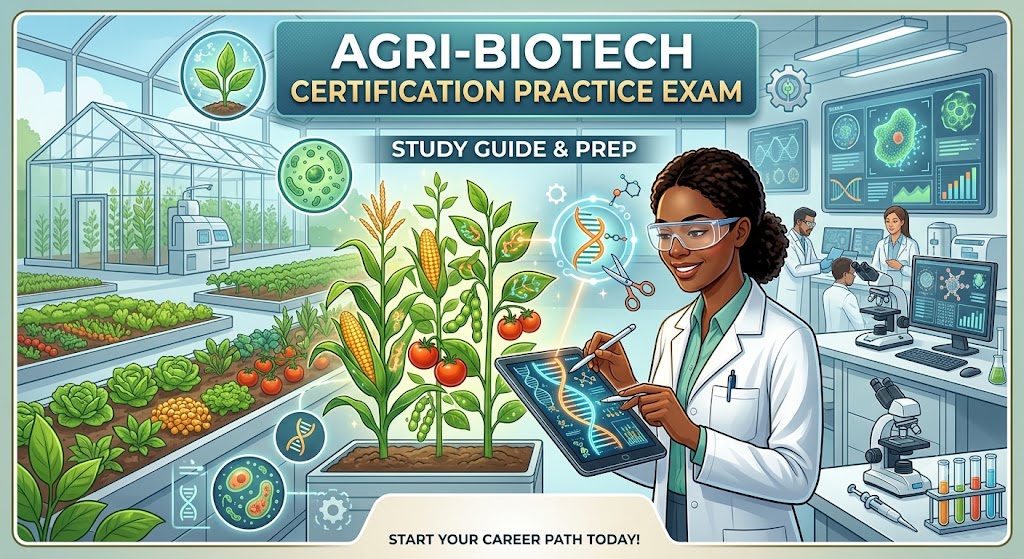
Additional Information
What the Course Entails and Exam Details
A comprehensive Agri-Biotech certification program typically
covers a wide range of theoretical and practical topics.
The core syllabus and skills you will encounter include:
- Principles
of Genetics and Molecular Biology: Fundamental knowledge of DNA
structure, replication, gene expression, and inheritance patterns.
- Plant
and Animal Breeding: Traditional and modern methods for improving crop
yields, resistance to pests and diseases, and enhancing nutritional
content.
- Tissue
Culture and Micropropagation: Laboratory techniques for generating
disease-free plants, preserving valuable genetics, and scaling up plant
production.
- Genetic
Engineering and Gene Editing: Understanding the methods of creating
transgenic organisms, and cutting-edge techniques like CRISPR-Cas9, to
modify desired traits.
- Agricultural
Applications: Specific applications of biotechnology in improving crop
resilience to abiotic stresses (drought, salinity), producing
biopesticides, and enhancing animal health.
- Biosafety
and Biosecurity: Guidelines and practices to ensure the safe handling
of modified organisms and to prevent unintended environmental and health
impacts.
- Bioinformatics
in Agriculture: The use of computational tools to analyze complex
biological data, particularly in genomics and breeding programs.
- Regulatory
Frameworks and Ethics: Knowledge of the relevant laws and regulatory
bodies governing the development, testing, and commercialization of
biotech products, along with understanding bioethical considerations.
- Data
Analysis and Interpretation: Skills to manage, analyze, and draw
meaningful conclusions from experimental data in an agricultural context.
The associated course prepares you for a final examination
and will likely provide detailed study materials, access to laboratory
simulations or descriptions, and quizzes. This practice exam is designed to
mirror the structure, complexity, and content distribution of the final
certification test.
What to Expect in
the Final Exam
While specific exams can vary, a typical final Agri-Biotech
Certification Exam will usually be:
- Multiple
Choice Questions (MCQs): This is the predominant format, with
approximately 100 questions covering all areas of the syllabus. The
questions are designed to test not just factual recall but also
application of knowledge and critical thinking through scenario-based
questions.
- Proctored
Environment: Both online and in-person exams are typically proctored
to ensure integrity. This means you will need to complete the exam under
supervision.
- Duration:
Candidates are generally given between 2 to 3 hours to complete the
multiple-choice section.
- Passing
Score: A passing score is usually set around 70% to 80% or more.
Familiarize yourself with the exact passing requirements of your
certifying body.
- Specific
Rules: Each exam will have its specific rules regarding what is
permitted (e.g., specific scientific calculator models, if any) and any
required identification for the proctoring process.
This practice exam is a crucial step in understanding this
format and assessing your readiness.
How to Study and
Exam Centers
Preparation is key to success on both the practice exam and
the final certification. Here are actionable study strategies:
- Use
Comprehensive Study Guides: Utilize materials like this guide,
official program textbooks, and curated resource lists.
- Take
Mock and Practice Exams Regularly: Consistent practice, especially
timed tests that simulate the real exam environment, is one of the most
effective ways to identify knowledge gaps, manage time, and build
exam-taking confidence.
- Review
Syllabus and Learning Objectives: Structure your study plan around the
detailed course syllabus. Ensure you have a deep understanding of all core
concepts and terminologies.
- Join
Study Groups and Online Forums: Engage with peers, ask questions, and
share insights. Different perspectives can enhance your understanding and
memory.
- Explore
Practical Applications: Try to find real-world examples of the biotech
concepts you learn (e.g., specific genetically modified crops and their
traits, regulatory case studies).
- Utilize
Flashcards and Active Recall: Use physical or digital flashcards for
key terms, techniques, and regulations. Regularly testing yourself from
memory (active recall) is crucial for long-term retention.
Exam Centers and Formats:
- Online
Proctoring: Many certifications offer an online exam option with
remote proctoring. You can take the exam from a quiet, secure location
using a computer with a webcam and microphone.
- Authorized
Testing Centers: Some certifying bodies partner with professional
testing services such as Pearson VUE, or specific physical locations at
universities, community colleges, or professional development centers.
- Authorized
Training Schools: In some cases, the institution or school providing
the training course is also an authorized center for taking the final
certification exam.
Always check the official website of your chosen certifying
body for the most accurate, current information on available study materials,
exam dates, locations, and proctoring requirements.
Job Opportunities
from the Course
A certification in Agricultural Biotechnology unlocks a
diverse range of career paths across research, industry, and regulation. Here
is a clear list of potential job titles:
- Agricultural
Biotechnologist
- Plant
Breeder
- Research
Scientist (Agriculture / Biotechnology)
- Regulatory
Affairs Specialist (Biotech)
- Bioinformatician
(Agriculture)
- Laboratory
Technician (Agri-Biotech Labs)
- QA/QC
Specialist (Biotech Products)
- Technical
Support Specialist (Agri-Biotech Companies)
- Crop
Science Specialist
- Farm
Manager (with Biotech operations)
- Bioprocess
Engineer
This certification not only validates your expertise but can
significantly enhance your employability and open doors to fulfilling careers
contributing to innovative and sustainable solutions for global agriculture.
We hope this comprehensive study guide provides you with a
clear roadmap for your preparation and ultimate success in achieving your
Agricultural Biotechnology Certification. Good luck with your study, and
embrace the challenge of mastering this vital and rapidly growing field!
Frequently Asked Questions
Reviews
5.0
Based on 0 reviews
Leave a Review
No reviews yet. Be the first to review!