
AG Mechanics CDE Practice Exam
$69.00
- Buy to unlock unlimited access to all Quiz questions.
- After purchase you can print a PDF of the whole quiz at any point. The PDF will contain the questions and the correct answers.
About this Exam
The Agricultural Mechanics Career Development Event (CDE) is a premier competition designed for high school students enrolled in agricultural education programs and active FFA members. This event is not just a test; it is an immersive, multi-faceted challenge that evaluates a student's technical knowledge and practical skills across five key areas of agricultural technology and mechanical systems. It’s the ultimate arena for future agricultural technicians, engineers, and fabricators to showcase their mastery and prepare for a dynamic career in the evolving agricultural industry.
Ready to test your knowledge?
Buy Now to Access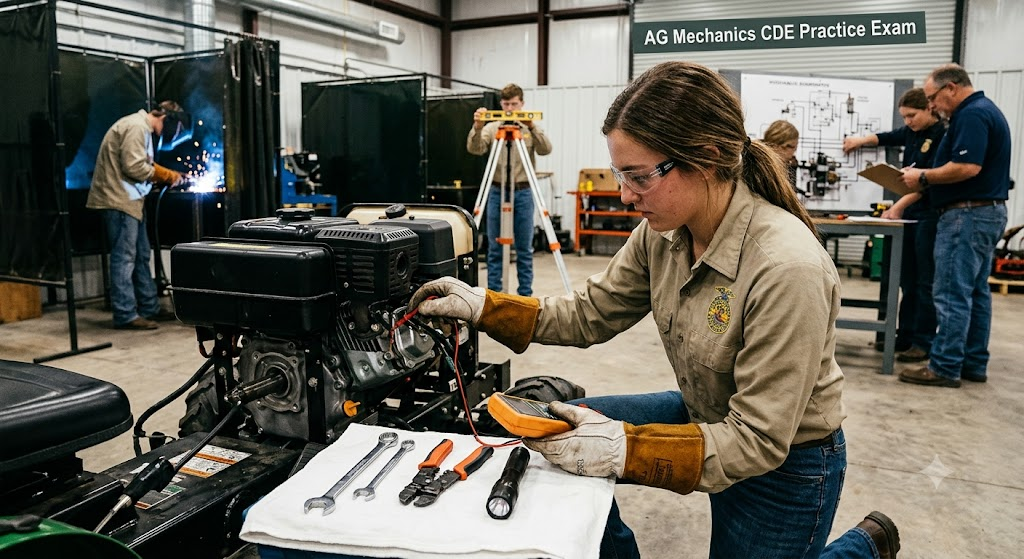
Additional Information
What the Course Entails and Exam Details
The Ag Mechanics CDE doesn't just measure memory; it measures capability. The competition is built around a "systems approach," requiring students to understand how individual components interact to solve complex, real-world problems. The core areas covered include:
Compact Equipment: Focus on small engines, their operation, maintenance, troubleshooting, and repair.
Electricity: Covers AC/DC power, electrical safety, standards, wiring, controls, and motor operation.
Environment and Natural Resources: Tests knowledge of soil and water conservation, surveying, water quality, and sustainable practices.
Machinery and Equipment: Includes repair, maintenance, adjustment, and metal fabrication for agricultural machinery.
Structures: Evaluates understanding of building materials, construction, ventilation, plumbing, and concrete/masonry.
The competition typically consists of three primary components, worth a total of 1,000 points for a four-member team:
Written Examination (200 team points / 50 individual points): A 60-minute test with multiple-choice and/or problem-solving questions. It covers all five system areas, drawing from the last three years of national exams.
Individual Performance Skills (600 team points / 150 individual points): Each member completes hands-on tasks in selected areas. Students have 25 minutes for each operation.
Team Activity (200 team points): A collaborative problem-solving scenario that requires the team to work together to develop a solution and present their findings.
What to Expect in the Final Exam
When you step into an Ag Mechanics CDE competition, you are stepping into a dynamic environment designed to simulate workplace challenges. For the written exam, expect a challenging 50-question paper that demands critical thinking and calculation. While multiple choice, these questions test deep comprehension.
The practical skill stations are the core of the event. You will navigate multiple timed rotations, each testing a specific competence. You may be asked to arc weld a butt joint, identify complex hydraulic system parts, troubleshoot a non-starting small engine, or calculate differential leveling field notes. Your performance is evaluated on technical accuracy, safety practices, and efficient problem-solving.
Teamwork is paramount. During the team activity, you must communicate effectively, delegate tasks, and synthesize your diverse skills to produce a comprehensive, logical solution to a multi-system problem scenario. Judges will observe your collaborative process as closely as your final result.
While specific regional and state rules may vary, a team typically has four members, with the top three scores contributing to the final tally. Passing scores aren't set; instead, it's a competitive event where you are ranked against other teams. High standards for safety are non-negotiable; any serious safety violation can result in disqualification from an event area or the entire competition.
How to Study and Exam Centers
A passive approach will not cut it for the Ag Mechanics CDE. You need a proactive, hands-on study strategy:
Dive Into the Past: Get copies of previous written exams from the last three to five years. These are invaluable for understanding the question style, difficulty, and recurring topics. Practice with a non-programmable calculator to mirror competition rules.
Hands-on, Every Day: You cannot learn to weld or repair an engine from a textbook. Work with your Ag teacher to access shop equipment and repeatedly practice the performance skills listed in the CDE handbook. Build familiarity and efficiency.
Master the Math: The written exam and practical tasks involve numerous calculations (area, volume, load, voltage, percentages, etc.). Strengthen your mental math and ability to set up and solve these problems quickly.
Study as a Team: Organize group study sessions. Use them to run mock team activities, discuss complex system interactions, and test each other's knowledge in a collaborative way.
The "exam centers" for the Ag Mechanics CDE are the sequential levels of FFA competition. These start at the sub-district or district level, with top teams advancing to regional, state, and finally, the National FFA Convention. These events are physical, requiring you to be present at an authorized school, fairground, or other designated testing facility. Official registration is completed online by your FFA chapter advisor.
Job Opportunities from the Course
The Ag Mechanics CDE equips you with a formidable set of in-demand skills, opening doors to diverse and rewarding career paths. This competition isn't just about winning a plaque; it is a gateway to high-skill, essential roles across the agricultural and mechanical sectors:
Agricultural Technician: Specialize in maintaining, troubleshooting, and repairing advanced farm machinery.
Fabricator and Welder: Design, build, and repair equipment for agricultural and construction projects.
Small Engine Mechanic: Service and repair everything from chainsaws and lawnmowers to specialized power equipment.
Irrigation Technician: Design, install, and manage water delivery systems for crop and livestock production.
Agricultural Engineer (with further education): Design new machinery, structural systems, and conservation practices.
Heavy Equipment Operator: Work in construction and large-scale agricultural projects.
Farm Manager: Use your multi-disciplinary knowledge to oversee the complete operation of a farm.
Agricultural Educator: Share your knowledge and passion, training the next generation of technicians and leaders.
Successful completion of the Ag Mechanics CDE is a strong indicator of your readiness for an technical post-secondary program or an immediate career, proving you have the knowledge, skill, and grit to thrive in industry.
Frequently Asked Questions
Reviews
5.0
Based on 0 reviews
Leave a Review
No reviews yet. Be the first to review!