
AFOQT Word Knowledge Practice Test 2026
$69.00
- Buy to unlock unlimited access to all Quiz questions.
- After purchase you can print a PDF of the whole quiz at any point. The PDF will contain the questions and the correct answers.
About this Exam
The Air Force Officer Qualifying Test (AFOQT) is a comprehensive standardized exam required for any individual seeking a commission as an officer in the United States Air Force or Space Force.
It is a crucial component of the application package for programs including Officer Training School (OTS), the Air Force Reserve Officer Training Corps (AFROTC), and the United States Air Force Academy (USAFA).
Designed to measure aptitudes essential for success in military officer roles, the AFOQT assesses verbal, quantitative, and specialized skills. Within the verbal section, the Word Knowledge subtest is pivotal. It specifically evaluates a candidate's mastery of the English language through vocabulary definition and the ability to identify synonyms under significant time pressure. Success in this subtest is vital, as it directly impacts your overall Verbal Composite score, which is a mandatory metric for commissioning.
Ready to test your knowledge?
Buy Now to Access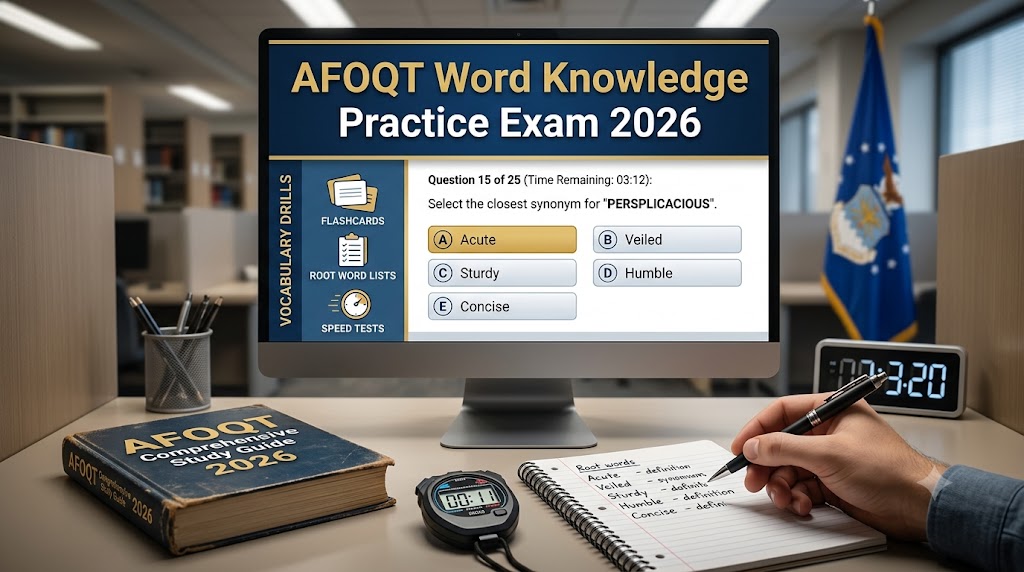
Additional Information
What the Course Entails and Exam Details
While the user focuses on a “practice test,” true preparation means understanding that the AFOQT Word Knowledge section is not a course, but a measurement of long-term linguistic aptitude. The section tests your ability to understand the precise meaning of words used in a professional, military context.
The core skills tested are vocabulary recognition, semantic understanding, and the ability to distinguish subtle differences in meaning between similar words. The subtest consists exclusively of multiple-choice questions. A typical question provides a single target word, and the candidate must select the most accurate synonym from a list of five possible options. In 2026, the section will test a mix of common academic vocabulary, professional terminology, and words often found in official military documentation or historical contexts. To excel, you must understand a word’s form (noun, verb, adjective) and how its prefix, root, or suffix dictates its core meaning.
What to Expect in the Final Exam
The AFOQT is notorious for its strict time constraints, and the Word Knowledge section is among the fastest-paced. Candidates must mental process and answer approximately 25 questions within a strictly enforced 5-minute time limit. This leaves only about 12 seconds per question.
The subtest uses a standard multiple-choice format, typically administered digitally or on a scan-able bubble sheet. There is no penalty for guessing; therefore, it is always advisable to mark an answer for every question, even if you are uncertain. Your score is based on the number of correct responses, which is then converted into a percentile ranking (1 to 99) comparing your performance to a baseline normative group. Tocommission, candidates must meet minimum percentile scores, which are often set at 15 for the Verbal Composite area, though competitive programs usually require much higher rankings. You are generally allowed to take the full AFOQT only twice in your life, with at least a 180-day window between attempts, making disciplined preparation essential.
How to Study and Exam Centers
Effective study requires a two-pronged approach: vocabulary expansion and speed drills. To broaden your vocabulary, do not just memorize lists. Instead, actively study Greek and Latin roots, prefixes, and suffixes, which will enable you to decipher unfamiliar words on exam day.
Read sophisticated materials, including military journals, high-level current events publications, and classical literature, keeping a dictionary handy for unknown terms. The second critical component is speed. You must take timed practice tests that precisely replicate the 5-minute pressure of the actual subtest. This builds the mental stamina and rapid-recall response necessary to answer intuitively rather than analytically.
The AFOQT is typically administered on physical military installations. Active duty airmen take the test at Base Education Centers. For civilian candidates or ROTC cadets, administration is scheduled through your local Air Force Recruiter or the test control officer at your university’s AFROTC Detachment. Some specific locations may utilize Pearson VUE professional testing centers for computer-based administrations, but scheduling is always facilitated through military channels.
Job Opportunities from the Course
A strong performance on the AFOQT Word Knowledge section, as part of a high Verbal Composite score, is mandatory for commissioning into the Air Force or Space Force. While it is not the sole determinant for job classification, your verbal aptitude is considered for every officer specialty, particularly those requiring strong communication, analysis, or instructional skills. A low score can disqualify you, while a high score enhances your competitiveness for specialized fields.
Below is a list of officer career paths and specific job titles where high verbal aptitude, evidenced by the AFOQT Word Knowledge subtest, is vital:
Intelligence Officer
Public Affairs Officer
Regional Affairs Strategist
Judge Advocate General (JAG) Corps (separate entry requirement, but AFOQT is often part of initial screening)
Missile Operations Officer
Combat Systems Officer (CSO)
RPA (Remotely Piloted Aircraft) Pilot
Mobility/Fighter Pilot
Air Battle Manager
Force Support Officer
Acquisitions Manager
Aircraft Maintenance Officer
Security Forces Officer
Frequently Asked Questions
Reviews
5.0
Based on 0 reviews
Leave a Review
No reviews yet. Be the first to review!