
AFOQT Table Reading Practice Test 2026
$69.00
- Buy to unlock unlimited access to all Quiz questions.
- After purchase you can print a PDF of the whole quiz at any point. The PDF will contain the questions and the correct answers.
About this Exam
The Air Force Officer Qualifying Test (AFOQT) is a crucial step for aspiring officers in the United States Air Force and Space Force. This comprehensive examination assesses aptitude in various areas essential for success in military operations. The Table Reading subtest is a highly specific section designed to measure an applicant's speed and accuracy in locating specific data points within a data grid. It is primarily utilized for individuals seeking to commission as an officer, especially those pursuing competitive rated positions such as pilots and combat systems officers. This subtest is known for its intense time pressure and demands extreme mental agility.
Ready to test your knowledge?
Buy Now to Access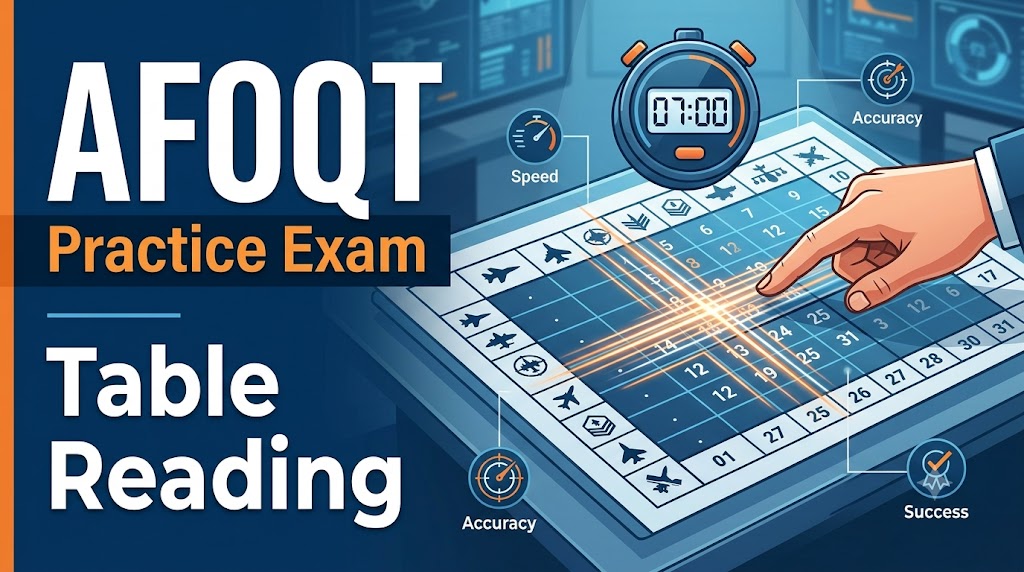
Additional Information
What the Course Entails and Exam Details
Preparation for the AFOQT Table Reading subtest focuses heavily on developing dynamic cognitive visual scanning abilities. It entails training candidates to analyze large data matrices featuring numbered horizontal rows and labeled vertical columns. Students must develop the skill of instantly locating the intersection of specific X and Y coordinates provided in each question. The subtest is designed specifically to measure perceptual speed and accuracy under stress. You are not required to interpret complex data, but rather to perform rapid visual search and extraction of information.
What to Expect in the Final Exam
The Table Reading subtest in the official 2026 AFOQT consists of 40 multiple-choice questions.
The entire section is extremely time-limited, giving you only 7 minutes to answer all 40 questions.
This permits an average of only 10.5 seconds per question, making it the fastest section of the exam.
While the subtest contributes to overall qualifying scores, it is a critical component of the Pilot composite score and other rated career field qualification composites.
During the test, candidates are generally forbidden from touching the data table physically, requiring them to rely entirely on visual coordination and rapid mental processing.
How to Study and Exam Centers
Effective study strategies for the Table Reading section must focus on building immense speed while maintaining absolute accuracy. Utilize timed practice drills using large grids to train your eyes and mind to locate coordinates instantly. Practice minimizing common horizontal or vertical errors that occur under extreme pressure. Mock exams specifically simulating the 7-minute constraint are vital for success. The AFOQT is not available through open commercial portals like Pearson VUE; it is administered through military channels. The primary testing locations include Military Entrance Processing Stations (MEPS) and Air Force ROTC (AFROTC) detachments. Active-duty personnel typically take the exam at their base’s education center.
Job Opportunities from the Course
A strong performance on the AFOQT Table Reading subtest is essential for achieving the required composite scores to qualify for many highly sought-after officer roles.
The specific job titles this exam unlocks include:
Pilot
Combat Systems Officer (CSO)
Remotely Piloted Aircraft (RPA) Pilot
Air Battle Manager (ABM)
Intelligence Officer
Logistics Readiness Officer
Cyberspace Operations Officer
Security Forces Officer
Frequently Asked Questions
Reviews
5.0
Based on 0 reviews
Leave a Review
No reviews yet. Be the first to review!