
AFOQT Math Knowledge Practice Test 2026
$69.00
- Buy to unlock unlimited access to all Quiz questions.
- After purchase you can print a PDF of the whole quiz at any point. The PDF will contain the questions and the correct answers.
About this Exam
The Air Force Officer Qualifying Test (AFOQT) is a standardized examination used by the United States Air Force and United States Space Force.
It is a critical component of the selection process for aspiring officers, evaluating candidates for commissioning programs such as Officer Training School (OTS) and the Air Force Reserve Officer Training Corps (AFROTC).
The Math Knowledge (MK) subtest specifically measures your ability to understand and apply fundamental mathematical principles.
This practice exam is designed for individuals dedicated to earning a commission and who need a focused, realistic way to prepare for the quantitative challenges of the final test.
Ready to test your knowledge?
Buy Now to Access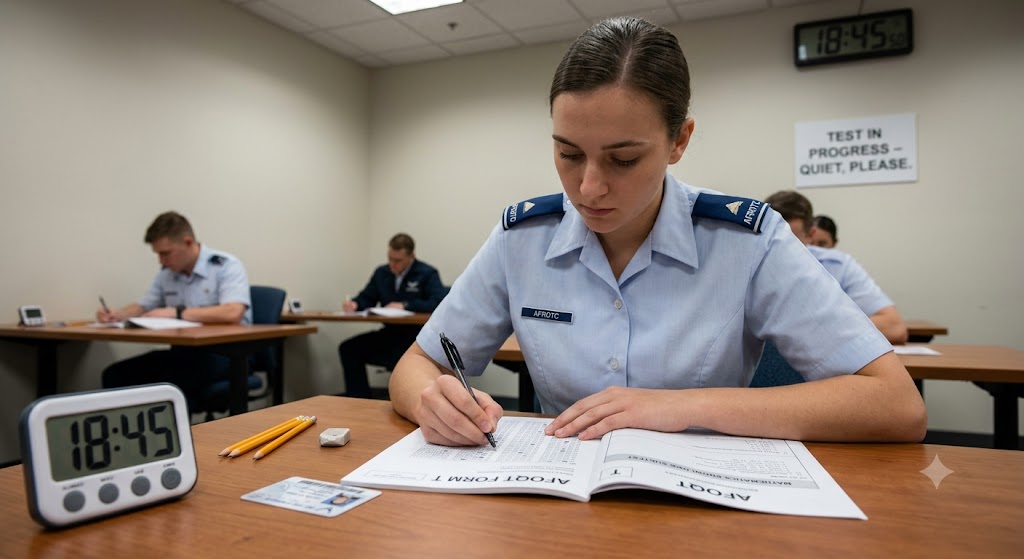
Additional Information
What the Course Entails and Exam Details
The AFOQT is a comprehensive, multi-hour exam, but the Mathematics Knowledge subtest focuses purely on direct mathematical application.
It does not include word problems (which are covered in the Arithmetic Reasoning section); instead, it requires you to solve equations and identify correct principles directly.
The core areas you must master for this subtest include:
Algebra: Solving linear equations, systems of equations, inequalities, absolute values, and quadratic equations.
Geometry: Applying formulas for area, perimeter, volume, and circumference; understanding angles, triangles, polygons, and the Pythagorean theorem.
Number Properties: Working with exponents, roots, ratios, proportions, percentages, fractions, and decimals.
Data Interpretation: Understanding basic statistical concepts and algebraic expressions.
The Math Knowledge subtest consists of 25 multiple-choice questions. Candidates are given exactly 22 minutes to complete this section. This rapid pace means mental math and immediate recall of formulas are essential.
What to Expect in the Final Exam
On test day, you will take the full AFOQT, which includes 12 timed subtests ranging from Verbal Analogies to Aviation Information.
The entire experience lasts approximately five hours, including scheduled breaks.
The Mathematics Knowledge section is entirely multiple-choice. Crucially, you are NOT allowed to use a calculator during this subtest, nor are you permitted to bring outside scratch paper, though some will be provided.
Your results on the MK subtest feed into your "Quantitative" composite score. AFOQT scores are reported as percentiles (1–99), comparing your performance to a baseline group.
While passing scores can vary by commissioning source and current needs, a minimum Quantitative percentile score is required for all officer candidates, with higher scores necessary for technical or "rated" careers like piloting.
How to Study and Exam Centers
Preparation for the AFOQT Math Knowledge subtest requires a mix of content mastery and speed drills.
Because calculators are forbidden, you must sharpen your mental math, long division, and multiplication skills.
Effective study strategies include:
Drill Formulas: Memorize geometry formulas (perimeter, area, volume, Pythagorean theorem) and algebra rules (laws of exponents, FOIL method, quadratic formula) until you can recall them instantly.
Use Quality Practice Tests: Take timed practice exams that simulate the structure, difficulty, and time pressure of the real test. Analyze your mistakes to identify weak areas.
Strengthen Core Algebra: Focus on solving for variables, simplifying complex expressions, and understanding inequalities.
Practice Without a Calculator: Complete all study materials and drills manually to build confidence in your hand-written calculations.
You cannot register for the AFOQT independently. You must arrange to take the exam through specific military channels:
Active Duty: Contact your base Education Center or Test Control Officer.
AFROTC Cadets: The exam is scheduled through your detachment.
Civilian Applicants (OTS): Work directly with an Air Force Recruiter to verify eligibility and schedule a testing date.
Testing typically occurs at specific military bases, military entrance processing stations (MEPS), or AFROTC detachments, often using a computer-based format.
Job Opportunities from the Course
A strong performance on the AFOQT is the primary academic qualification for dozens of specialized careers in the Air Force and Space Force. The Quantitative composite, heavily influenced by your Math Knowledge score, is a prerequisite for many technical and rated fields.
Careers you can unlock include:
Pilot (Requires the highest AFOQT and PCSM scores)
Combat Systems Officer (CSO)
Air Battle Manager (ABM)
Intelligence Officer
Developmental Engineer (e.g., Aerospace, Electrical, Mechanical)
Cyberspace Operations Officer
Space Operations Officer (Space Force)
Weather and Environmental Sciences Officer
Acquisitions Manager
Logistics Readiness Officer
Frequently Asked Questions
Reviews
5.0
Based on 0 reviews
Leave a Review
No reviews yet. Be the first to review!