
AFOQT Arithmetic Reasoning Practice Test 2026
$69.00
- Buy to unlock unlimited access to all Quiz questions.
- After purchase you can print a PDF of the whole quiz at any point. The PDF will contain the questions and the correct answers.
About this Exam
The Air Force Officer Qualifying Test (AFOQT) is a crucial step for aspiring officers looking to serve in the United States Air Force. This standardized examination assesses various aptitudes to determine eligibility and potential success within officer training programs. The AFOQT Arithmetic Reasoning subtest specifically evaluates your ability to solve mathematical word problems, requiring you to apply basic mathematical reasoning principles to real-world scenarios rather than just crunching numbers. A strong performance on this section is vital for achieving a competitive overall score and advancing your goal of earning an Air Force commission.
Ready to test your knowledge?
Buy Now to Access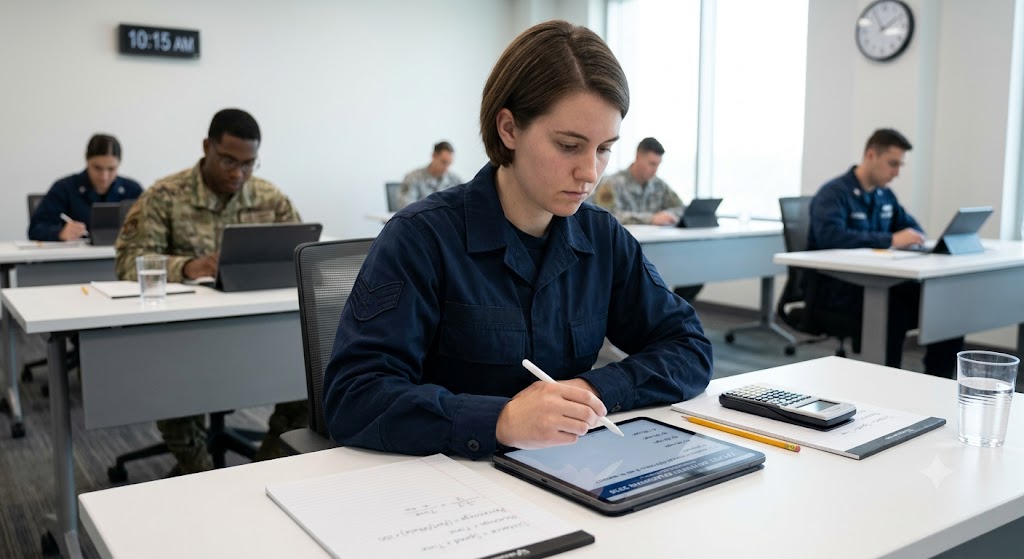
Additional Information
What the Course Entails and Exam Details
Mastering the Arithmetic Reasoning portion of the AFOQT demands a thorough understanding of fundamental mathematical concepts commonly taught up to the high school level. The exam covers a broad spectrum of topics, including arithmetic operations, word problem solving, ratios, proportions, simple algebraic equations, geometry essentials (such as perimeter, area, and volume), measurement conversions, and basic statistical data interpretation. Developing proficiency in these areas allows candidates to quickly analyze situations and apply correct mathematical formulations. Solidifying these core skills is paramount to success on test day.
What to Expect in the Final Exam
When you sit for the final AFOQT, the Arithmetic Reasoning section presents you with 25 multiple-choice questions. A rigorous time limit of only 29 minutes is allocated for this specific part, meaning you have just over one minute per question on average. This time pressure emphasizes the importance of both accuracy and speed. You will be required to work solely with pencil and paper, as the use of calculators is strictly prohibited throughout the entire examination. Maintaining mental math agility and strategic problem-solving approaches is essential to maximize your score in this demanding environment.
How to Study and Exam Centers
Effective study strategies for the AFOQT Arithmetic Reasoning section combine focused content review with regular practice under timed conditions. Utilizing comprehensive study guides and practice tests specifically designed for the AFOQT is highly recommended to become familiar with the question formats and types. Creating a consistent study schedule, practicing mental calculations, and timing your responses will improve both your speed and confidence. Since calculators are disallowed during the actual test, dedicate ample time to solving problems without external aids.
Regarding exam logistics, you do not select a commercial testing center. As a military applicant, you will typically take the AFOQT at your local Military Entrance Processing Station (MEPS) or sometimes on an active-duty Air Force base, particularly if you are already serving or participating in an ROTC program. Your Air Force recruiter will guide you through the process, confirm eligibility, and schedule your test appointment at the appropriate official testing facility.
Job Opportunities from the Course
Success on the AFOQT is not just about passing a test; it is the fundamental credential unlocking numerous officer career opportunities within the United States Air Force. The scores you achieve across all sections, including Arithmetic Reasoning, directly impact your competitiveness for selection into prestigious officer candidate programs and subsequent commissioning as an officer.
Achieving a high AFOQT score significantly enhances your prospects for entering training pipelines for exciting and demanding roles such as:
Air Force Pilot
Combat Systems Officer (CSO)
Air Battle Manager (ABM)
Remotely Piloted Aircraft (RPA) Pilot
Operations Officer (Various specialties)
Logistics Readiness Officer
Intelligence Officer
Cyberspace Operations Officer
Acquisitions Manager
Medical Service Corps Officer
JAG (Judge Advocate General) Corps Officer
Chaplain
And many other officer roles critical to national defense and global operations.
Frequently Asked Questions
Reviews
5.0
Based on 0 reviews
Leave a Review
No reviews yet. Be the first to review!