
Aerospace Engineering Practice Exam
$69.00
- Buy to unlock unlimited access to all Quiz questions.
- After purchase you can print a PDF of the whole quiz at any point. The PDF will contain the questions and the correct answers.
About this Exam
Embarking on a career in Aerospace Engineering is a journey to the forefront of innovation. This comprehensive study guide, and the associated Aerospace Engineering Practice Exam, are meticulously designed for students and aspiring professionals who aim to master the fundamental principles and intricate details of flight vehicles, from commercial aircraft to space systems. Whether you are aiming for a professional license or preparing for a rigorous university-level exam, this guide provides a structured pathway to success.
The practice exam serves as a crucial benchmarking tool, mirroring the complexity, style, and scope of typical certification or licensing assessments in the aerospace field. By utilizing this resource, you will not only gauge your knowledge but also build the necessary confidence to tackle the final challenge with precision and speed.
Ready to test your knowledge?
Buy Now to Access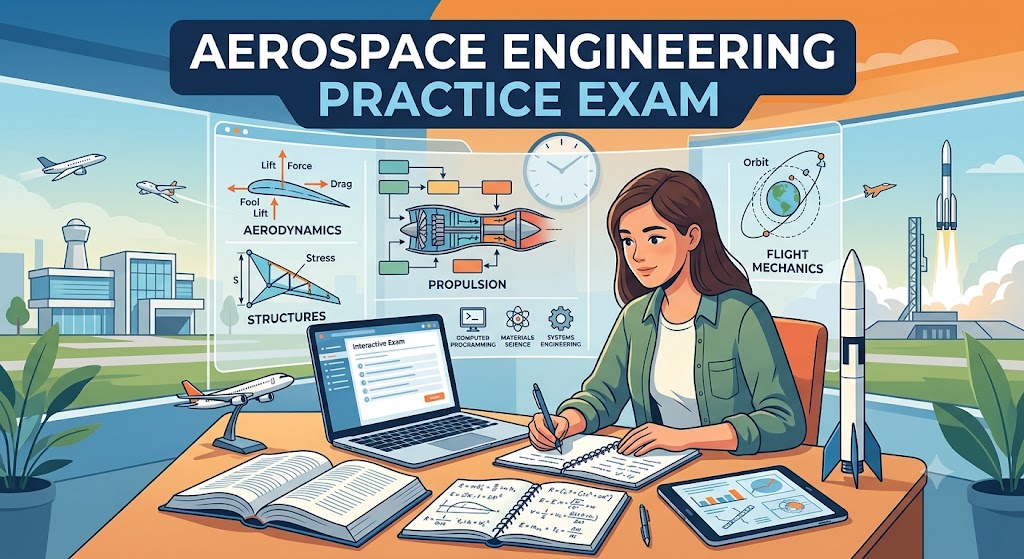
Additional Information
What the Course Entails and Exam Details
This section outlines the diverse knowledge areas covered in
a standard aerospace engineering curriculum and, consequently, tested in this
practice exam. The exam is structured to assess your understanding and
application of concepts across several core domains.
The aerodynamics section challenges your
understanding of airflow over lifting bodies, covering topics such as lift and
drag forces, boundary layer theory, and compressible and incompressible flows.
Flight mechanics and dynamics delve into the
stability, control, and performance of aircraft and spacecraft, requiring a
firm grasp of equations of motion, trim, and maneuver performance.
Propulsion systems test knowledge of different
engines, including jet engines, rockets, and internal combustion systems, and
the thermodynamic cycles that govern their operation.
Structures and materials focus on the mechanical
properties and stress analysis of components, including the study of
composites, fatigue, and aeroelasticity.
Systems engineering and avionics examine the
integrated approach to design and operation, alongside the electronic systems
essential for flight control, navigation, and communication.
Mathematics, particularly differential equations and
linear algebra, and foundational physics and chemistry concepts
underpin all aerospace principles and are tested explicitly and implicitly
throughout the exam.
What to Expect in the Final Exam
While individual certifying bodies and universities may vary
slightly, typical final exams for aerospace engineering licensure or major
certifications adhere to a general standard format that this practice exam is
modeled after. The goal is to simulate the actual testing experience as closely
as possible.
The exam usually follows a multiple-choice format,
designed to test a broad range of knowledge efficiently. There may be hundreds
of questions, divided into distinct sections.
Passing score requirements are usually not a fixed
percentage but are determined based on a scaled score system, taking into
account the relative difficulty of the exam version. The actual cut-off score
is set to reflect a minimum level of competency as determined by industry standards
or academic guidelines.
Time limits are typically strict, often spanning a
full day or multiple sessions. Expect a test duration in the region of 6 hours,
with designated breaks. Effective time management during the practice exam will
be key to your actual performance.
Specific rules and reference materials are often very
strict. Typically, standard reference books or your own manuals are not allowed
in the testing room. A specific, approved reference handbook (provided by the
exam body or accessible as a digital tool within the exam) is often the only
tool permitted, emphasizing the need for familiarity with its structure and
formulas. Calculators must also be from an approved list.
How to Study and Exam Centers
Preparation is paramount in the field of aerospace. This
section provides actionable strategies and clear directions on how to take both
your practice and final exams.
Actionable study strategies: Don't just read; actively
solve problems. Use this Aerospace Engineering Practice Exam
repeatedly to identify weak areas. Make use of official review manuals, join
study groups, and utilize engineering software (such as CAD and MATLAB) to
visualize and solve complex problems. Simulating timed conditions during
practice is essential for building the speed and mental stamina needed on the
actual test day.
Accessing the practice exam: This resource is
typically accessible through a dedicated online portal, allowing you to
take timed or untimed practice sessions, review solutions, and track your
progress. The digital nature also allows for immediate feedback.
Registering for the final exam: Taking the actual
final licensing or certification exam requires registration through the
recognized engineering board or certifying body in your region. These exams are
usually not administered directly on university campuses.
Final exam centers: Most final, high-stakes exams are
proctored and taken at physical testing centers or authorized
facilities. A well-known example for many engineering exams is Pearson VUE,
which has extensive networks globally. Ensure you understand the specific
center, location, and requirements well in advance. Some certification exams
might also be proctored online under strict security conditions, though this is
less common for full licensing exams.
Job Opportunities from the Course
A strong foundation in aerospace engineering, validated by
licensure or certification, unlocks a wide array of career paths in an industry
known for its high impact and future potential.
- Aerospace
Engineer: The core role, involving the design, development, and
testing of aircraft, spacecraft, or satellites.
- Aeronautical
Engineer: Specializing in flight vehicles that operate within the
Earth's atmosphere.
- Astronautical
Engineer: Focused on spacecraft and missions that operate in outer
space.
- Flight
Test Engineer: Designing, conducting, and analyzing the results of
flight tests on aircraft or systems.
- Systems
Engineer: Integrating different engineering disciplines to ensure a
project works as a cohesive whole.
- Propulsion
Engineer: Designing and analyzing engines and motors for atmospheric
or space vehicles.
- Aerodynamicist:
Specializing in the analysis of airflow and the development of vehicle
geometries.
- Structural
Engineer (Aerospace): Designing and testing the load-bearing
components of flight vehicles.
- Avionics
Engineer: Designing and testing the electronic systems within aircraft
and spacecraft.
- UAV
(Drone) Engineer: Focus on the rapidly expanding field of unmanned
aerial vehicles.
- Project
Manager (Engineering): Leading complex engineering projects from
conception to deployment.
- Safety
Engineer (Aerospace): Ensuring regulatory compliance and optimizing
the safety of aircraft and operations.
- Aerospace
Data Analyst: Using flight data and simulation results to optimize
performance and operations.
- Consultant
/ Academic Researcher: Providing expertise or conducting cutting-edge
research in specialized aerospace areas.
Frequently Asked Questions
Reviews
5.0
Based on 0 reviews
Leave a Review
No reviews yet. Be the first to review!