
Aeronautical Information Manual (AIM) Block 3 Practice Test
$69.00
- Buy to unlock unlimited access to all Quiz questions.
- After purchase you can print a PDF of the whole quiz at any point. The PDF will contain the questions and the correct answers.
About this Exam
The Aeronautical Information Manual (AIM) Block 3 Practice Test is a crucial milestone for advanced flight students and certified pilots aiming for higher ratings, such as Instrument, Commercial, or Flight Instructor certificates. This comprehensive practice exam is specifically designed to evaluate a pilot's ability to interpret and apply complex regulatory information and operational procedures found in the FAA's official Aeronautical Information Manual. It serves as a definitive benchmark, ensuring candidates possess the deep understanding requisite for safe, efficient, and compliant operations within the National Airspace System.
Ready to test your knowledge?
Buy Now to Access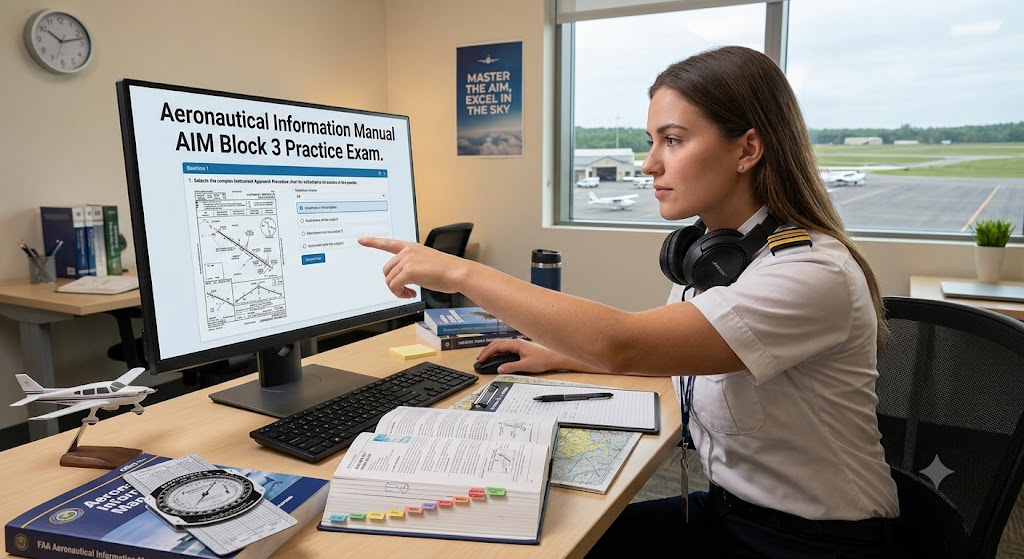
Additional Information
What the Course Entails and Exam Details
This course provides an immersive study of the key chapters
and sections of the AIM that form the core of advanced and complex flight
operations. While exact curriculum details may vary by training provider,
typical subjects covered in a 'Block 3' focus include: a profound knowledge of
all airspace classes, special-use airspace, and temporary flight restrictions;
an advanced understanding of Air Traffic Control (ATC) services and procedures,
including specific phraseology for complex scenarios; a detailed breakdown of
all IFR and VFR departure, en route, and arrival procedures, including complex
instrument approach layouts; a comprehensive analysis of all aeronautical
lighting, airport marking aids, and sign systems; and a critical assessment of
emergency procedures, weather data interpretation, and advanced navigation
systems. This course prepares pilots not just to pass an exam, but to function
as a professional in a dynamic, real-world aviation environment.
What to Expect in the Final Exam
The final practice exam is structured to simulate the
pressure and formatting of an official FAA knowledge test. Candidates can
expect a 100-question, multiple-choice, computer-based test that must be
completed within a strict 120-minute time limit. The passing score is typically
set at 80% to ensure a high level of competency before attempting any official
FAA assessment. The exam utilizes a blend of scenario-based questions that
require the pilot to apply AIM knowledge to real-world problems, interpret
charts, analyze ATC instructions, and make critical safety decisions, rather
than just recalling rote facts. There are no practical elements to this
specific knowledge-based test.
How to Study and Exam Centers
Effective preparation requires a multi-faceted approach.
First, master the core source material: the official, current Aeronautical
Information Manual (AIM), which is freely available on the FAA website.
Supplement this with structured ground school courses and study guides from
reputable aviation training providers, such as Gleim, King Schools, or
Sporty's. These materials provide focused summaries, explanatory text, and
practice questions. Use a structured system like flashcards to memorize complex
symbols, airspace dimensions, and specific procedures. Consistency is key;
commit to regular, daily study sessions rather than cramming. Finally, take
numerous simulated practice exams to identify weak areas and build
time-management skills. Because this is a practice test, it is most commonly
accessed and taken online through the training provider’s personal study
portal, allowing for immediate feedback and performance analysis from the
comfort of your own home or flight school. If you are preparing for the final,
official FAA knowledge test, that will be administered in person at an
authorized testing center, such as those in the Pearson VUE network.
Job Opportunities from the Course
A strong performance on this and related advanced knowledge
tests is essential for any career path beyond recreational flying. Achieving
mastery in these subjects is a requirement for, and unlocks, numerous
professional roles:
- Commercial
Pilot (Airlines, Charter, Cargo)
- Instrument-Rated
Private Pilot (Enhanced capability and safety)
- Certified
Flight Instructor (CFI and CFII)
- Airline
Transport Pilot (ATP)
- Aircraft
Dispatcher
- Air
Traffic Controller (ATC)
- Corporate
or Business Aviation Pilot
- Aviation
Safety Inspector (FAA)
By demonstrating a command of the information in the AIM
Block 3 Practice Exam, you are proving your commitment to professional-level
aviation knowledge and safety.
Frequently Asked Questions
Reviews
5.0
Based on 0 reviews
Leave a Review
No reviews yet. Be the first to review!