
Aerial Ladder Practice Test
$69.00
- Buy to unlock unlimited access to all Quiz questions.
- After purchase you can print a PDF of the whole quiz at any point. The PDF will contain the questions and the correct answers.
About this Exam
The Aerial Ladder Practice Test is a crucial assessment for firefighting professionals seeking certification as an Aerial Apparatus Operator. This specialized exam evaluates a candidate's comprehensive understanding of safe and effective aerial device deployment, operation, and maintenance. It is designed for firefighters who are advancing their careers and aiming to assume responsibilities involving high-rise rescue, elevated master stream operations, and strategic positioning of aerial platforms and ladders during emergency incidents. Achieving this certification validates a firefighter's ability to operate complex, high-reach equipment under pressure.
Ready to test your knowledge?
Buy Now to Access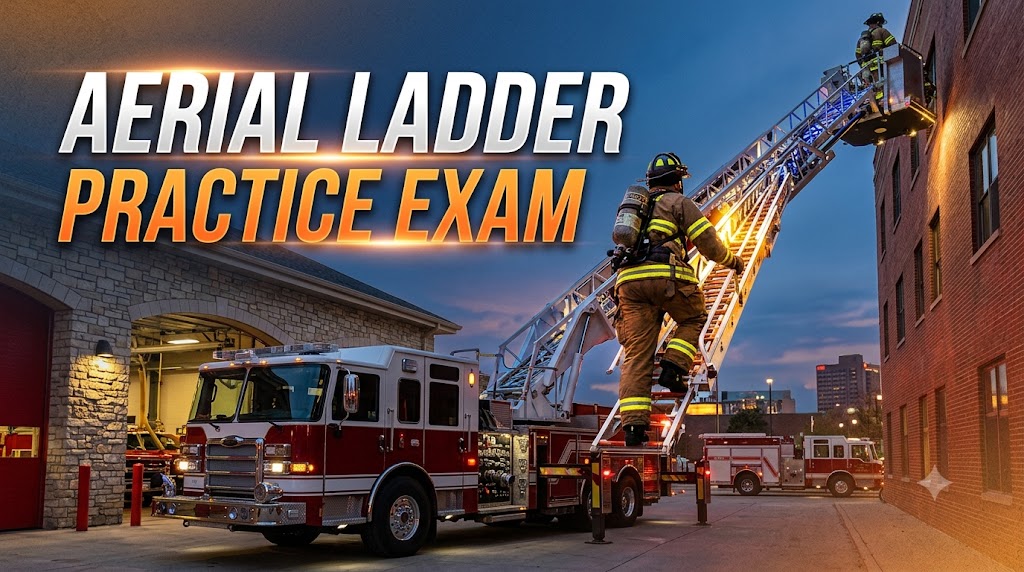
Additional Information
What the Course
Entails and Exam Details
This comprehensive course covers several critical domains
essential for aerial ladder proficiency. Candidates will master the fundamental
principles of aerial apparatus stabilizing systems, including outrigger
placement on various terrains and understanding load capacities. A significant
portion focuses on tactical positioning, analyzing fire ground factors, and
maximizing the reach and effectiveness of the aerial device. Detailed instruction
is provided on hydraulically operated systems, electrical overrides, safety
interlocks, and manufacturer-specific operational procedures. Furthermore, the
curriculum emphasizes pre-trip inspections, routine maintenance, and
troubleshooting common mechanical issues that may arise in the field.
What to Expect in
the Final Exam
The final certification exam typically consists of two
distinct but equally important components: a written knowledge test and a
practical skills evaluation. The written portion is often comprised of
multiple-choice questions designed to assess theoretical understanding. Topics
frequently include NFPA 1002 standards, mathematical calculations related to
elevated streams and scrub areas, hydraulic principles, and emergency
procedures. Following successful completion of the written exam, candidates
must demonstrate hands-on competency during a rigorous practical skills test.
This involves setting up and operating a real aerial apparatus, executing
precise maneuvers, and responding correctly to simulated emergency scenarios
within specified time limits.
How to Study and Exam Centers
Effective preparation for this high-stakes exam requires a
combination of self-study and practical application. Candidates are strongly
encouraged to thoroughly review IFSTA and Jones & Bartlett manuals
specifically focused on Aerial Apparatus Driver/Operator. Utilizing practice
tests, flashcards, and online study guides can help reinforce theoretical
knowledge and identify areas for improvement. Additionally, scheduling
dedicated hands-on practice sessions under the guidance of certified
instructors is paramount. These sessions allow candidates to build muscle
memory and confidence in stabilizing, elevating, and positioning the apparatus
in a controlled environment. The final certification is often administered
through specialized firefighter training academies, recognized state agencies,
or authorized third-party testing organizations utilizing their own training
grounds and equipment.
Job Opportunities from the Course
Successfully passing this test and obtaining certification
as an Aerial Apparatus Operator dramatically enhances a firefighter's career
trajectory. This credential is widely respected within the fire service and
unlocks numerous advanced roles, reflecting the specialized skills and
increased responsibility. Some of the specific career paths and job
opportunities that this qualification supports include:
- Aerial
Apparatus Operator / Driver Engineer
- Company
Officer (Captain, Lieutenant) in an Aerial-Equipped Unit
- Specialized
Rescue Technician (e.g., Urban Search and Rescue)
- Fire
Academy Instructor (Specializing in Aerial Operations)
- Fire
Service Promotional Candidate (often a requirement or strong asset for
advancement)
Frequently Asked Questions
Reviews
5.0
Based on 0 reviews
Leave a Review
No reviews yet. Be the first to review!