
Aerial Fire Apparatus Driver/Operator Practice Exam
$69.00
- Buy to unlock unlimited access to all Quiz questions.
- After purchase you can print a PDF of the whole quiz at any point. The PDF will contain the questions and the correct answers.
About this Exam
The Aerial Fire Apparatus Driver/Operator certification is designed for firefighters seeking specialized skills in operating complex emergency vehicles equipped with aerial ladders, platforms, or water towers. This practice exam provides candidates with a realistic assessment tool to gauge their readiness for the official certification. It covers the crucial knowledge and decision-making abilities required to safely position, stabilize, and operate these apparatus under stressful emergency conditions, supporting both rescue and fire suppression operations. This is a critical next step for ambitious fire service professionals aiming to advance their careers and take on significant operational responsibilities.
Ready to test your knowledge?
Buy Now to Access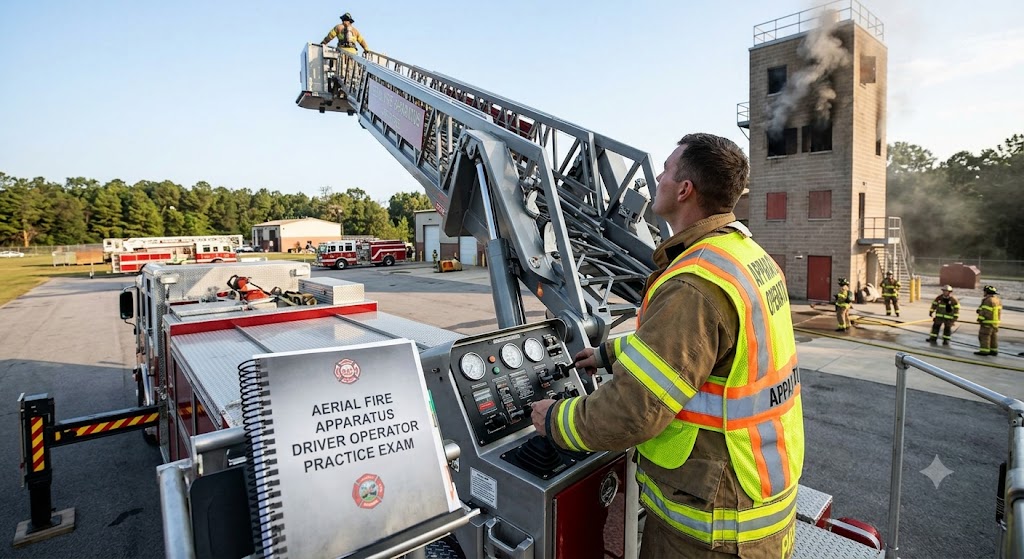
Additional Information
What the Course Entails and Exam Details
This comprehensive practice exam reflects the curriculum
aligned with standard fire service professional qualifications, particularly
NFPA 1002. The associated learning curriculum entails rigorous training in
apparatus maintenance, preventive care, and advanced driving techniques for
large emergency vehicles. It covers the intricate knowledge required for
precise apparatus positioning relative to structures, taking into account
factors like wind, terrain, and building height. Furthermore, it details the
stabilization process, deploying outriggers or stabilizers safely. The practice
material specifically tests a candidate's understanding of hydraulic systems,
load capacities, operational constraints, and emergency override procedures for
various aerial devices, ensuring they understand the mechanical limitations and
safety parameters.
What to Expect in
the Final Exam
The actual final exam for this certification typically
consists of both a cognitive (written) component and a psychomotor (practical
skills) component. The written portion is usually a proctored multiple-choice
examination, requiring a high level of technical knowledge. A typical passing
score is 70% or higher. Time limits are strictly enforced, often allowing
around two to three hours for the written exam. The practical exam is a
hands-on demonstration where candidates must successfully perform tasks such as
driving a prescribed course, positioning and stabilizing the apparatus,
deploying the aerial device to specific targets (e.g., a window, a rooftop),
and demonstrating knowledge of emergency procedures. Proper time management and
meticulous execution are essential for success in both phases.
How to Study and Exam Centers
Effective preparation requires a combination of self-study
and practical application. Reviewing NFPA 1002 standards is foundational. Study
the manufacturer operating manuals for the specific aerial apparatus you will
be tested on. Utilize the Aerial Fire Apparatus Driver Operator Practice Exam
repeatedly to identify weak areas and reinforce key concepts like load charts,
hydraulic formulas, and tactical positioning. Create flashcards for critical
operational parameters and safety limitations. Whenever possible, seek hands-on
time with an aerial apparatus to practice setting stabilizers and maneuvering
the ladder in a non-emergency training environment.
The final certification exam is typically administered
through state fire academies, regional training centers, or individual large
fire department training divisions. These institutions possess the specialized
equipment and facilities necessary for the practical skills assessment. Contact
your local department’s training officer or your state’s fire service
certification agency for specific locations, test dates, and registration
information.
Job Opportunities
from the Course
Earning an Aerial Fire Apparatus Driver/Operator
certification unlocks significant career opportunities within the fire service.
This specialized skill set makes individuals highly valuable to departments and
essential for key operational roles. Specific job titles and career paths this
certification opens include:
- Aerial
Apparatus Operator
- Firefighter
Specialist (Aerial/Truck Company)
- Driver/Operator
(Engine or Ladder)
- Apparatus
Operator – Aerial Platform
- Fire
Lieutenant (often requires advanced operator certifications)
- Technical
Rescue Team Member
- Fire
Department Instructor (specializing in apparatus operations)
By mastering these complex systems, certified operators
become indispensable members of modern fire companies, ensuring safe and
efficient aerial operations during complex emergencies.
Frequently Asked Questions
Reviews
5.0
Based on 0 reviews
Leave a Review
No reviews yet. Be the first to review!